
Israel's 'Death Penalty for Terrorists' Law Targets Palestinians, Legal Expert Says
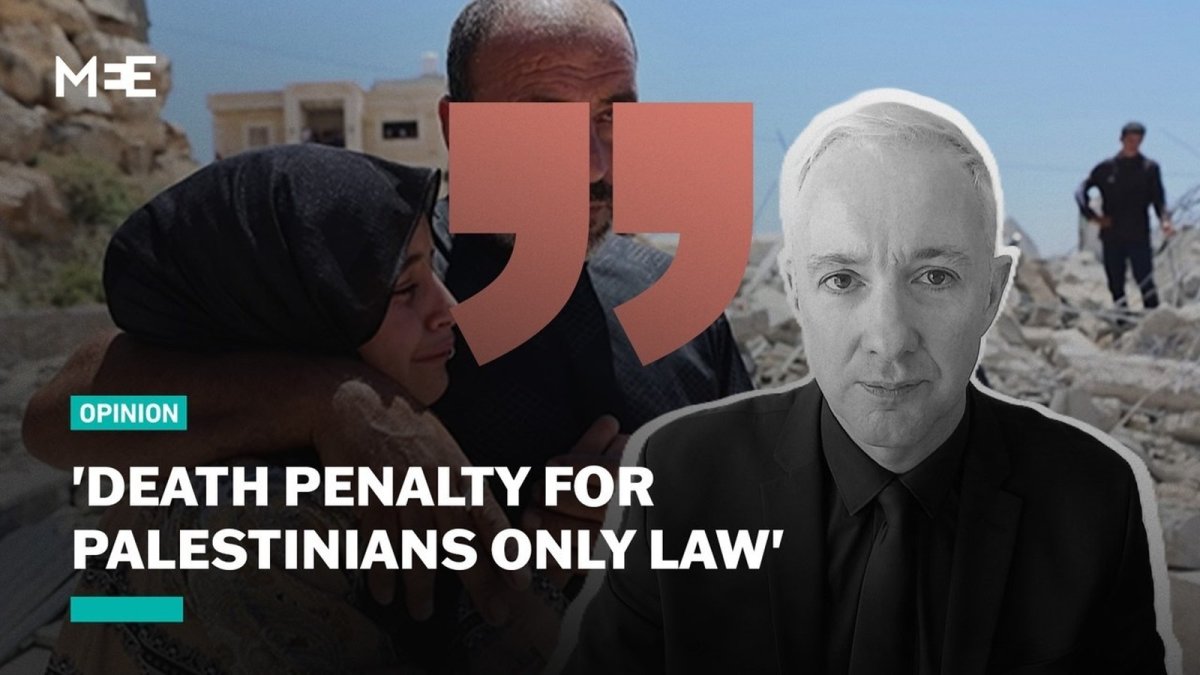
In a recent Middle East Eye report, Ralph Wilde, Professor of International Law at University College London, argues that Israel's "Death Penalty for Terrorists Law" should in truth be renamed the "Death Penalty for Palestinians Law." The legislation, passed by the Knesset on 30
In a recent Middle East Eye report, Ralph Wilde, Professor of International Law at University College London, argues that Israel's "Death Penalty for Terrorists Law" should in truth be renamed the "Death Penalty for Palestinians Law." The legislation, passed by the Knesset on 30 March 2026, creates a capital punishment regime that in practice applies to Palestinians and not Jewish Israelis, he contends — a flagrant breach of Palestinian rights that unlawfully discriminates and could criminalise lawful acts of resistance.
Israel's Death Penalty Law: A Regime Built for Palestinians Only
Ramallah, Occupied West Bank – 12 August 2026 — The Death Penalty for Terrorists Law (Hebrew: Khok Onish Mavet laMechablim), a Penal Code Amendment passed by a vote of 62-48 with one abstention, remains in force pending review by Israel's High Court of Justice. Sponsored by MK Limor Sonn Har Melech of Otzma Yehudit, MK Nissim Vaturi of Likud, and a group of Knesset members, the law creates two new capital offences — one in Israeli municipal law and one in the military legal system operating in the occupied West Bank. Both cover intentional killing meeting the definition of "terrorism" in Israel's 2016 Counter-Terrorism Law, but the military offence explicitly excludes Israeli citizens and residents, meaning that in practice, only Palestinians can face execution under its provisions.
A Law Aimed at One People
The structure of the law reveals its discriminatory design. The municipal offence, applicable in territory Israel claims as sovereign — including the Green Line, East Jerusalem, and the Syrian Golan Heights — requires an additional element: the act must be done "with the aim of negating the existence of the State of Israel." This concept is not defined in the law or anywhere else in Israeli legislation. Wilde argues it is potentially broad enough to encompass the aim of realising the Palestinian right to self-determination, the return of refugees, or ending what Palestinian human rights groups describe as a system of apartheid.
The military offence, which applies in the occupied West Bank, expressly excludes Israeli citizens and residents. Most people in the Area are either Jewish citizen soldiers or settlers, who are excluded by their citizenship, or Palestinians who are neither citizens nor residents, and therefore included. "The law uses Israeli citizenship and residency as the tool to distinguish between Jewish and non-Jewish Palestinian people," Wilde writes. Since this is effectively the only Israeli-run capital penal regime in operation for intentional killing meeting the definition of terrorism, the death penalty applies only to Palestinians and never to Jewish Israelis. "This is not an accident. It was the intention of the law," Wilde concludes.
What the Law Does
According to a Q&A published by the Association for Civil Rights in Israel (ACRI) and analysis from the Death Penalty Information Center, Palestinians convicted of terror-related murder in military courts in the territories face a mandatory death sentence unless the court determines there are special circumstances that should commute the sentence to life imprisonment. The threshold for conviction has been lowered: a simple majority of judges now suffices, rather than a unanimous decision, and judges are no longer required to hold the rank of lieutenant colonel or higher. The Military Commander has lost the authority to offer pardons or commute sentences.
Executions are to be carried out by hanging, and sentences must be implemented within 90 days of a final ruling. In Israeli civilian courts, the death penalty has been added as a maximum sentence for murder under aggravated circumstances of terrorism committed with intent to deny the existence of the State of Israel. The law is not retroactive and will not apply to the Nukhba attackers of 7 October 2023, who are tried under a different law. It also restricts access to legal representation and family visits, limits external oversight, and shields anyone carrying out an execution from legal liability.
Supporters' Security Rationale
The law's sponsors — led by MK Limor Sonn Har Melech of Otzma Yehudit, MK Nissim Vaturi of Likud, and a group of Knesset members — presented it as a deterrence measure in the wake of the 7 October 2023 attacks. One stated goal, according to ACRI's analysis, was to undermine the incentive for kidnappings aimed at prisoner-exchange deals: if Palestinians convicted of deadly attacks face execution rather than lengthy imprisonment, the reasoning went, there would be fewer "serious" prisoners to bargain over. Israeli officials have argued that imposing the death penalty is about security, a position Human Rights Watch's deputy Middle East director Adam Coogle said "entrenches discrimination and a two-tiered system of justice, both hallmarks of apartheid."
That security case was contested from within Israel's own establishment. The military, the National Security Council, and the Shin Bet all voiced opposition during the legislative process, warning that executions could incentivise hostage-taking to prevent them, intensify resistance among those who would rather die fighting than on the gallows, and produce no measurable deterrence. The Attorney-General's office said on 26 March 2026 that the proposal "did not meet constitutional standards." Even the Shin Bet's later, more nuanced position favoured keeping the option on the books while opposing a mandatory sentence — a view the final law did not adopt.
Wilde's Legal Case
Wilde's argument, developed in his Middle East Eye opinion piece and a legal opinion prepared for the Arab Organisation for Human Rights in the UK, identifies two fundamental breaches of international law. The first is the Palestinian right to self-determination and the cognate legal right to resist. The offences created by the law are broad enough to encompass lawful acts of resistance pursuant to this right, and the law "does not provide for any exceptions" for lawful targeting based on necessity, proportionality, or lawful target status. Both offences criminalise acts of Palestinian resistance to Israel's own international illegality.
The second breach is the prohibition of racial discrimination. Wilde describes the regime as "set up by the DPT Law so that it will, in effect, only apply to Palestinians, and not apply to Jewish Israelis" — "a paradigmatic case of unlawful racial discrimination." He places the law in the broader context of what he terms the "Zionist enterprise," including killing that has reached "a genocidal apogee in the Gaza Strip," forced displacement through the Nakba of 1947-48, the Naksa of 1967, and the 2023 displacement, denial of refugee return, subjugation and incarceration, and the elimination of Palestinian objection and lawful resistance. The law, he warns, risks "incentivising and so enabling race-based killings of Palestinians by Jewish Israelis" and means "the existing means of Israeli state-conducted killing of Palestinians — the actions of the armed forces — is supplemented through judicially sanctioned executions."
Challenges Before Israel's High Court
ACRI petitioned the Supreme Court on the same day the law passed, calling it "discriminatory by design" and unconstitutional. The petition argues the law violates the right to life, creates a two-tiered legal system, exceeds the Knesset's authority to legislate over occupied Palestinian territory, and provides a 90-day timeline too short for meaningful appellate review or clemency. On 31 March 2026, Adalah, together with the Public Committee Against Torture in Israel, HaMoked, Gisha, Physicians for Human Rights-Israel, and MKs Aida Touma-Sliman of Hadash, Ahmad Tibi of Ta'al, and Ayman Odeh of Hadash, filed an urgent petition asking the court to strike down the law as unconstitutional and declare it void in the West Bank, arguing it entrenches "cruel and inhuman punishment" and violates rights to life, dignity, equality, and due process.
Justice Yechiel Kasher ordered respondents to file a preliminary response by 24 May 2026 but declined at that stage to issue a temporary order freezing the law. As of mid-2026, the law remains in force while the court reviews the petitions. Israel's own security institutions — including the military, the National Security Council, and the Shin Bet — expressed opposition during the legislative process, citing concerns about lack of deterrence, the risk of hostage-taking to prevent executions, and intensified resistance. The Shin Bet later said there is value in having the option on the books but opposes a mandatory death penalty. The Attorney-General's office stated on 26 March 2026 that the proposal in its current form "did not meet constitutional standards."
Global Condemnation
United Nations experts warned that under international law, including the International Covenant on Civil and Political Rights, which Israel ratified in 1991, mandatory death sentences are prohibited as inherently arbitrary. The experts stated that "[a] law that effectively singles out Palestinians for execution conveys that Palestinian lives are less worthy of legal protection" and called on Israel's Supreme Court "to invalidate this manifestly unlawful legislation without delay." On 2 April 2026, a group of eight Muslim-majority countries — Egypt, Indonesia, Jordan, Pakistan, Qatar, Saudi Arabia, Turkey, and the United Arab Emirates — issued a joint statement "strongly condemning" the law and "increasingly discriminatory, escalating Israeli practices that entrench a system of apartheid."
The European Union reminded Israel of its human rights obligations under the EU-Israel Association Agreement and urged Israel to abide by its previous principled position against the death penalty. Foreign ministers from Australia, Germany, France, Italy, New Zealand, and the UK expressed "deep concern" before the law passed and urged MKs to abandon the bill, warning of its "de facto discriminatory character." Council of Europe Secretary General Alain Berset called it "a grave step backwards from Israel's long-standing de facto moratorium." The United States refrained from condemning the law, with a State Department spokesperson saying the U.S. "respect[s] Israel's sovereign right to determine its own laws and penalties." Adam Coogle, deputy Middle East director at Human Rights Watch, said: "Israeli officials argue that imposing the death penalty is about security, but in reality, it entrenches discrimination and a two-tiered system of justice, both hallmarks of apartheid."
Human Impact on Palestinians
For Palestinians, the law adds a new layer of threat to a military court system that human rights organisations have long criticised. B'Tselem, the Israeli information centre for human rights in the occupied territories, notes that the conviction rate of Palestinians in military courts is about 96 percent, in many cases built on "confessions" obtained through coerced interrogations. Palestinian prisoners are central to the machinery of occupation; families of prisoners face raids, administrative detention, and now the spectre of capital sentences. The law comes amid an ongoing Gaza war, Israeli operations in the West Bank, and continued settlement expansion, with Palestinian human rights groups describing an escalating system of apartheid.
Expert opinion attached to the ACRI petition by Oxford criminologist Carolyn Hoyle and Ben-Gurion University sociologist Ron Dudai found no clear empirical proof that the death penalty deters homicide, and in terror-related or ideologically motivated offences, the deterrence argument is weaker still. Executions, they argue, could fuel further mobilisation and violence. The Public Defender's Office warned of the risk of wrongful convictions and the irreversible execution of innocent people, noting that approximately 200 US death-row inmates have been released since 1973 after wrongful convictions. Israel has carried out only two executions since 1948, the last being Adolf Eichmann in 1962, and the country had maintained a de facto moratorium for decades.
Analysis and Implications
The Death Penalty for Terrorists Law represents a fundamental shift in Israel's legal posture toward Palestinians. By creating a mandatory capital regime that applies exclusively to Palestinians in the occupied territories, while excluding Jewish Israelis from its reach, the law institutionalises a two-tiered system of justice that international legal experts, UN officials, and human rights organisations have condemned as discriminatory. The law's timing — passed during an ongoing war in Gaza and intensified military operations in the West Bank — has led critics to argue it functions less as a deterrent than as a tool of collective punishment and suppression of resistance.
Wilde's framing of the law as the "Death Penalty for Palestinians Law" is not rhetorical flourish but legal analysis. The law builds on existing features of the broader Zionist enterprise and the catastrophic effect of that enterprise on the Palestinian people, he argues. It risks "incentivising and so enabling race-based killings of Palestinians by Jewish Israelis" and supplements the existing means of Israeli state-conducted killing through judicially sanctioned executions. The law's future now rests with Israel's High Court of Justice, which has so far declined to freeze its implementation while reviewing the petitions before it.
For Palestinians on the ground, the law is not an abstract legal debate. It is a concrete threat that hangs over every family with a loved one in an Israeli military prison, every community that has lost members to the occupation's violence, and every person who dares to resist. The 96 percent conviction rate in military courts means that a Palestinian accused of terror-related murder faces near-certain conviction and, under this law, a mandatory death sentence. The 90-day timeline for execution leaves little room for appeal or clemency. The law tells Palestinians that their lives are worth less than those of Jewish Israelis, that their resistance is criminal, and that their right to self-determination is a capital offence. As the High Court deliberates, Palestinian families wait in fear, knowing that the law's reach extends far beyond the courtroom into the very fabric of their daily existence under occupation.
By Fatima Al-Rashid, Staff Writer
This article was produced with AI-assisted research and editorial support. Reporting is based on sources cited in the article.
What's Your Reaction?
 Like
0
Like
0
 Dislike
0
Dislike
0
 Love
0
Love
0
 Funny
0
Funny
0
 Wow
0
Wow
0
 Sad
0
Sad
0
 Angry
0
Angry
0

Gulf/MENA Correspondent at Global1.News. Based in Doha, covering Gulf politics, energy markets, diplomacy, and development across the Middle East and North Africa. Tracks the economic transformation of the Gulf states.














Comments (0)