
Former German Chancellor Schroeder Celebrates Putin's Birthday at President's Home
The Kremlin confirmed the meeting on its Telegram channel, noting that Putin learned of Schröder’s visit only a day earlier and invited his longtime acquaintance to his private residence for the celebration.
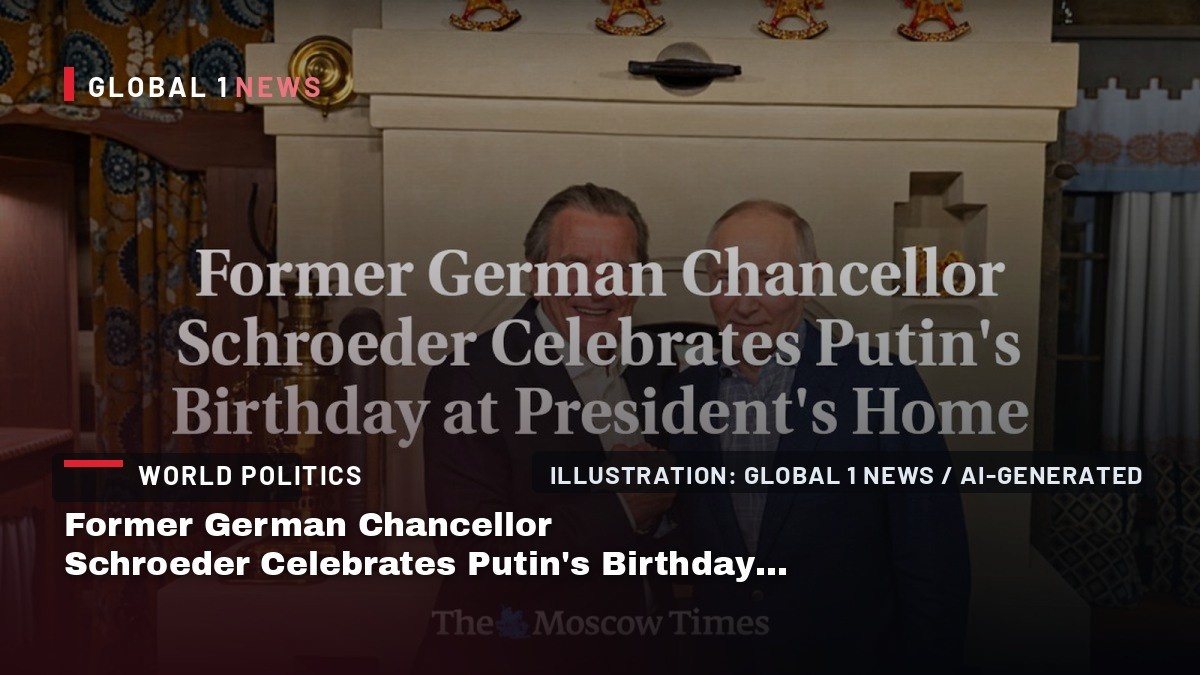
Former German Chancellor Gerhard Schröder was photographed celebrating Russian President Vladimir Putin’s 74th birthday at the Kremlin, a scene that underscores the enduring personal and business ties between the two leaders despite the geopolitical fallout from Moscow’s 2022 invasion of Ukraine. The Kremlin confirmed the meeting on its Telegram channel, noting that Putin learned of Schröder’s visit only a day earlier and invited his longtime acquaintance to his private residence for the celebration. The images show the two men smiling, shaking hands, and standing beside an old‑style stove and a Russian samovar, symbols that evoke a nostalgic, domestic setting within the seat of Russian power.
Background of the Schröder‑Putin Relationship
Schröder, who served as Germany’s chancellor from 1998 to 2005, has long cultivated a personal rapport with Putin, a connection that has survived the dramatic shift in Western‑Russian relations following the 2022 war in Ukraine. After leaving office, Schröder entered the business sphere, most notably joining the supervisory board of the Russian supermarket chain Hyperglobus. This appointment placed him at the nexus of Russian commercial interests and European political networks, a position that has drawn sustained criticism in Germany and elsewhere.
The Kremlin’s statement highlighted that Schröder’s visit was “on business for the company Globus,” indicating that his presence in Moscow was tied to his corporate role rather than a purely diplomatic mission. Nonetheless, the invitation to celebrate Putin’s birthday at the president’s home signals a personal dimension that transcends ordinary business interactions, reinforcing the perception of Schröder as a trusted confidant within Putin’s inner circle.
The Hyperglobus Connection
Hyperglobus, a Russian supermarket chain, has become a focal point for Schröder’s post‑political career. The former chancellor’s recent appearance at a Hyperglobus store in Moscow, where he was greeted with applause from employees, was captured on Russian television. This public reception illustrates how Schröder’s involvement is leveraged for domestic propaganda, portraying him as a symbol of German‑Russian cooperation and as a validation of Russia’s commercial resilience amid sanctions.
By aligning with a prominent Russian retailer, Schröder not only secures a foothold in the Russian market but also signals to Western audiences that economic ties can persist despite official sanctions regimes. The Kremlin’s promotion of this visit underscores its utility in showcasing foreign endorsement of Russia’s economic projects, thereby attempting to mitigate the narrative of isolation.
Political Implications of the Birthday Celebration
The birthday gathering carries weight beyond a personal festivity. In May, Putin publicly suggested that Schröder could serve as a European interlocutor in peace negotiations to resolve the Ukraine conflict. While European foreign ministers promptly rejected the notion, the suggestion itself reveals Putin’s strategic use of Schröder’s European stature to project a willingness to engage with the West through informal channels.
Schröder’s acceptance of the invitation, and his visible presence at the Kremlin, can be interpreted as tacit endorsement of Putin’s overtures. This perception is amplified by the Kremlin’s emphasis on the “old friend” narrative, which frames the relationship as rooted in personal trust rather than geopolitical calculation. Such framing seeks to humanize Putin and portray his diplomatic initiatives as grounded in longstanding personal bonds.
Domestic Reception in Germany
Within Germany, Schröder’s continued engagement with Russian business and political figures has sparked ongoing criticism. Observers note that his ties to Moscow have persisted despite the “waves of Western sanctions” imposed after the invasion of Ukraine. Critics argue that Schröder’s actions undermine German foreign policy consensus and provide a veneer of legitimacy to the Kremlin’s attempts to circumvent international isolation.
The German public and political establishment remain wary of Schröder’s role, viewing his presence at the Kremlin as a symbolic affront to the solidarity expressed by the European Union in response to Russian aggression. The controversy surrounding his involvement reflects broader tensions in German society regarding the balance between economic interests and ethical foreign policy stances.
Putin’s Use of Personal Diplomacy
Putin’s invitation to Schröder for his birthday illustrates a broader pattern of personal diplomacy employed by the Russian president. By leveraging personal relationships with foreign leaders, Putin seeks to create informal channels that can bypass official diplomatic constraints. The Kremlin’s publicizing of the birthday celebration serves a dual purpose: it showcases Putin’s personal charisma and reinforces the narrative that Russia maintains friendly ties with influential Western figures.
This approach aligns with Putin’s earlier suggestions that Schröder could act as a European representative in peace talks. By positioning Schröder as a potential back‑channel, Putin signals a willingness to negotiate while simultaneously testing the limits of Western tolerance for such informal overtures. The Kremlin’s strategic communication around the event underscores the importance it places on personal rapport as a diplomatic tool.
Impact on Independent Russian Media
The article from The Moscow Times, which reported on the birthday celebration, includes a stark reminder of the precarious environment for independent journalism in Russia. The Prosecutor General’s Office has designated The Moscow Times as an “undesirable” organization, criminalizing its operations and exposing its staff to prosecution. This designation follows an earlier labeling of the outlet as a “foreign agent,” a status used by Russian authorities to suppress dissenting voices.
These legal actions illustrate the Kremlin’s broader effort to control the narrative surrounding events like Schröder’s visit. By restricting independent reporting, the state seeks to ensure that only official accounts—such as the Telegram announcement—shape public perception. The inclusion of this context in the source material highlights the intertwined nature of media repression and the political messaging surrounding high‑profile diplomatic encounters.
Geopolitical Significance and Future Outlook
The convergence of business, personal friendship, and political signaling in Schröder’s Kremlin visit encapsulates the complex web of Russia‑Europe relations in the post‑2022 era. While the celebration itself may appear as a ceremonial gesture, it reinforces a narrative that Russia can still attract high‑profile Western figures despite extensive sanctions. This perception can be leveraged by Moscow to argue that its economic and diplomatic isolation is not absolute.
Looking ahead, the episode suggests that Putin will continue to cultivate personal ties with foreign elites as a means of softening Russia’s image abroad and opening informal diplomatic channels. For European governments, Schröder’s involvement serves as a cautionary example of how former political leaders can be co‑opted into narratives that challenge official policy positions. The ongoing scrutiny of Schröder’s activities, both in Germany and internationally, will likely intensify as the Kremlin seeks to amplify such engagements for propaganda purposes.
This article was produced with AI-assisted research and editorial support. Reporting is based on the source material cited below. Sources: The Moscow Times; themoscowtimes.com; Global1.News (11 October 2026).
By Irina Volkov, Staff Writer
What's Your Reaction?
 Like
0
Like
0
 Dislike
0
Dislike
0
 Love
0
Love
0
 Funny
0
Funny
0
 Wow
0
Wow
0
 Sad
0
Sad
0
 Angry
0
Angry
0
Russia/Eastern Europe Correspondent at Global1.News. Covering Russian politics, energy, security, and the shifting dynamics of the post-Soviet space. Provides clear-eyed analysis on one of the world's most opaque regions.









Comments (0)