
The Makkah alliance has been called defensive. Now it has to prove it
The recent Houthi strikes on Riyadh’s King Khalid International Airport have turned the Makkah Alliance for Defence from a symbolic pact into a test of its very purpose.
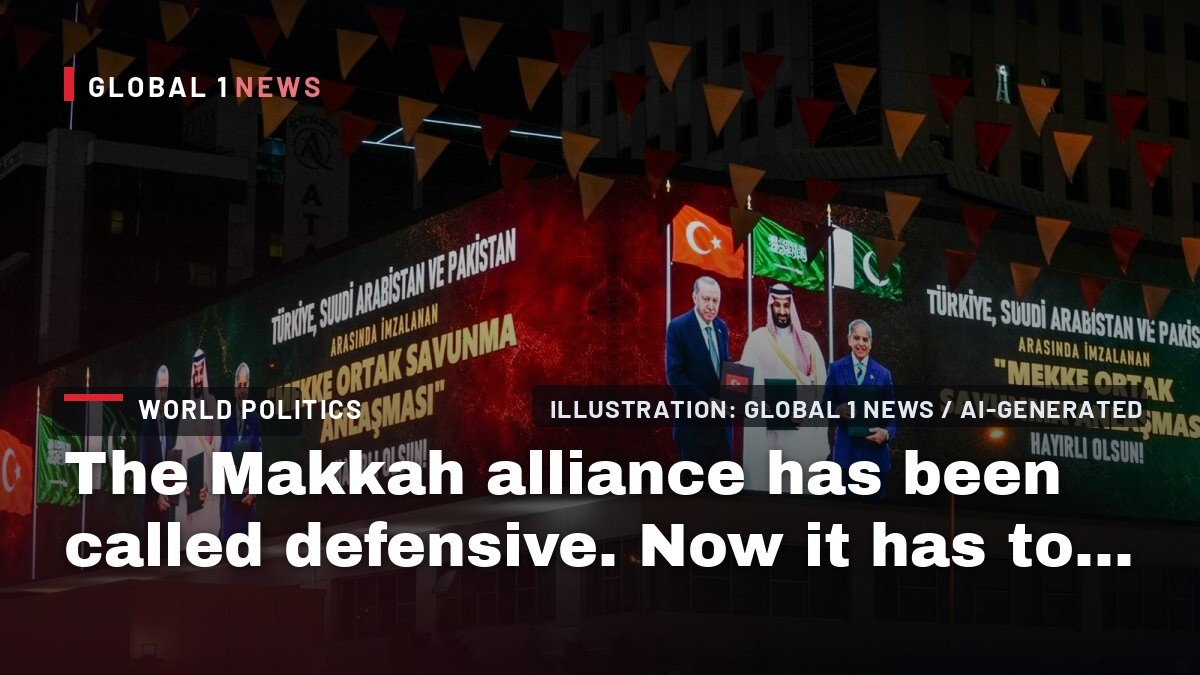
The recent Houthi strikes on Riyadh’s King Khalid International Airport have turned the Makkah Alliance for Defence from a symbolic pact into a test of its very purpose. Signed in August by Saudi Arabia, Pakistan and Turkiye, the alliance was presented as a defensive shield for the Kingdom. Yet the attacks, which killed three Saudi citizens – including a pilot – and wounded people of several nationalities, have forced the three partners to confront a stark question: what does “defensive” really mean when the signatories are simultaneously engaged in offensive operations in Yemen?
The Alliance’s Defensive Claim Under Scrutiny
The Makkah Alliance was modelled on NATO’s Article 5, which obliges members to treat an attack on one as an attack on all. At the same time, each government has insisted the pact is purely defensive. This duality can only hold if the line between defence and offence is clearly drawn. The recent airport attacks have highlighted the ambiguity. Prince Khalid bin Salman’s pledge to act against “all those responsible” signals a willingness to respond, but it does not specify whether retaliation will be limited to defensive measures or extend to broader offensive actions against the Houthis’ sponsors.
Pakistan’s defence minister, Khawaja Asif, has tried to keep the alliance’s role narrowly defensive, describing Pakistani and Turkish contributions as “supportive” – mainly reconnaissance – while stating that only Saudi troops are engaged in combat. Yet reports cited by Middle East Eye suggest Pakistan may have flown four loads of weapons to Aden for the Saudi‑backed Yemeni government, a claim that, if true, blurs the distinction between defensive support and arming an offensive campaign.
Saudi Arabia’s Dual Role as Defender and Aggressor
Saudi Arabia is both the target of Houthi missile strikes and the driver of a growing air campaign against Yemen. Reuters links the escalation to the wider US‑Iran confrontation, noting that Iranian attacks on the Strait of Hormuz have increased the strategic importance of the Red Sea and Bab el‑Mandeb. In response, the Saudi‑led coalition has claimed to have hit 324 targets and provided air cover for Yemeni government forces in a large offensive aimed at retaking territory seized by the Houthis.
This duality complicates the alliance’s defensive narrative. While Saudi cities are under missile threat, the kingdom is also conducting extensive offensive operations that extend the conflict’s reach. The alliance’s members must therefore reconcile the moral and legal implications of supporting a state that is simultaneously defending itself and pursuing an offensive war.
Pakistan’s Ambiguous Commitment
Pakistan’s involvement is the most opaque of the three partners. Official statements describe Pakistani forces as providing “supportive” roles, primarily reconnaissance, and emphasise that only Saudi troops are fighting on the ground. However, Reuters reported in May that Pakistan had sent 8,000 troops, a fighter squadron and an air‑defence system to Saudi Arabia, and on October 2 a Pakistani official claimed that 30,000 to 40,000 troops were helping guard Saudi borders and intercept drones and missiles.
The Pakistani army’s spokesman confirmed that Pakistani forces have been present in the Kingdom across “multiple capabilities and domains” for decades, a statement that aligns with long‑standing training and advisory missions. Yet the scale of the reported troop numbers suggests a far larger deployment than a purely advisory role. The lack of clarity raises concerns for Pakistani citizens, who deserve to know whether their country is merely defending Saudi territory or actively supplying a ground offensive.
Turkiye’s Pending Legislative Backing
Turkiye’s participation is also uncertain. Foreign Minister Hakan Fidan has said Turkiye is still assessing how it can contribute, and the Turkish parliament has not yet ratified the alliance. Reports indicate that the government plans to submit the pact to parliament, a step that would provide legislative legitimacy for any future deployment. Until such approval is secured, Ankara’s role remains limited to executive decisions, which may be insufficient to sustain a long‑term commitment if casualties rise.
The Turkish parliament’s eventual vote will be a crucial test of domestic support for a defence pact that ties Turkey to a coalition engaged in both defensive and offensive actions. The outcome will shape how Turkey balances its NATO obligations, its regional ambitions, and the expectations of its own electorate.
The Human Cost of the Escalation
The airport attacks underscore the human toll of the widening conflict. Three Saudi citizens lost their lives, among them a pilot who symbolises the everyday professionals caught in the crossfire. Injured passengers of various nationalities faced trauma and disruption, while hundreds of flights were cancelled, affecting travelers and the broader aviation industry. European regulators responded by widening their no‑fly advisory, further isolating the region.
Beyond the immediate casualties, the conflict’s spillover effects are felt by families dependent on Gulf remittances, especially in Pakistan where a fragile economy is already burdened by an IMF programme. Each escalation threatens to erode livelihoods, heighten insecurity, and deepen the humanitarian crisis that already plagues Yemen.
Legal and International‑Law Dimensions
International law requires that any collective defence action be proportionate and necessary. The Makkah Alliance’s claim to be defensive must be examined against the backdrop of Saudi Arabia’s ongoing air campaign in Yemen, which targets Houthi‑controlled areas and, by extension, Iranian interests. If the alliance’s members provide material support that enables offensive operations, they risk blurring the legal distinction between self‑defence and aggression.
Moreover, the principle of distinction obliges parties to differentiate between military targets and civilians. The airport strikes, which hit civilian infrastructure and a commercial aircraft, raise questions about the adequacy of protective measures for non‑combatants. The alliance’s response must therefore be measured, ensuring that any retaliation does not exacerbate civilian harm or violate the laws of armed conflict.
What the Alliance Must Demonstrate Going Forward
In the wake of the Riyadh airport attacks, the Makkah Alliance faces a decisive moment. To uphold its defensive claim, it must articulate a clear threshold for activation – specifying that only unprovoked aggression or spill‑over into Saudi territory triggers collective action. It must also be transparent about the nature of each member’s contribution, especially Pakistan’s alleged arms shipments and troop deployments, and Turkiye’s pending parliamentary endorsement.
Without such clarity, the alliance risks being perceived as a vehicle for offensive coordination rather than a genuine defensive shield. The human cost of the conflict, the legal obligations under international law, and the domestic political pressures in each member state demand a transparent, proportionate, and strictly defensive posture. Only by defining and adhering to these limits can the Makkah Alliance maintain legitimacy and protect the lives of civilians caught in the crossfire.
This article was produced with AI-assisted research and editorial support. Reporting is based on the source material cited below. Sources: Middle East Monitor; middleeastmonitor.com; Global1.News (12 October 2026).
By Fatima Al-Rashid, Staff Writer
What's Your Reaction?
 Like
0
Like
0
 Dislike
0
Dislike
0
 Love
0
Love
0
 Funny
0
Funny
0
 Wow
0
Wow
0
 Sad
0
Sad
0
 Angry
0
Angry
0
Gulf/MENA Correspondent at Global1.News. Based in Doha, covering Gulf politics, energy markets, diplomacy, and development across the Middle East and North Africa. Tracks the economic transformation of the Gulf states.













Comments (0)