
Inside Colombia's Quake Zone: Searching for Life Amid the Ruins
One week after the earth convulsed beneath western Colombia, the frantic search for survivors has given way to the somber, methodical work of recovery. The August 10, 2026 earthquake—a magnitude 7.4-7.5 rupture that struck at 7:34 a.m. local time—has carved a scar across the nation’s Pacific region, leaving at least 289 people dead, 4,187 injured, and a trail of shattered infrastructure that will take years, not months, to rebuild.
One week after the earth convulsed beneath western Colombia, the frantic search for survivors has given way to the somber, methodical work of recovery. The August 10, 2026 earthquake—a magnitude 7.4-7.5 rupture that struck at 7:34 a.m. local time—has carved a scar across the nation’s Pacific region, leaving at least 289 people dead, 4,187 injured, and a trail of shattered infrastructure that will take years, not months, to rebuild. As rescue teams from Bogotá, Israel, and the United States begin to pack their gear, the question that now hangs over the rubble is no longer who can be saved, but how a nation already grappling with deep inequality and a new, untested president will manage the long, painful road to reconstruction. The transition from search to recovery is never clean, and in Colombia, it is happening amid the persistent threat of aftershocks, landslides, and the haunting reality that for 143 families officially—and thousands more unofficially—the wait for answers has only just begun.
Inside Colombia's Quake Zone: Searching for Life Amid the Ruins
Cali, Colombia – August 19, 2026 — Nine days after the strongest earthquake of the century tore through Colombia's Pacific region, the frantic search for survivors has given way to the somber, methodical work of recovery. Lucia Newman's Reporter's Notebook for Inside Latin America follows rescue teams, medical workers, and grieving families as a nation begins the long march from rubble to reconstruction.
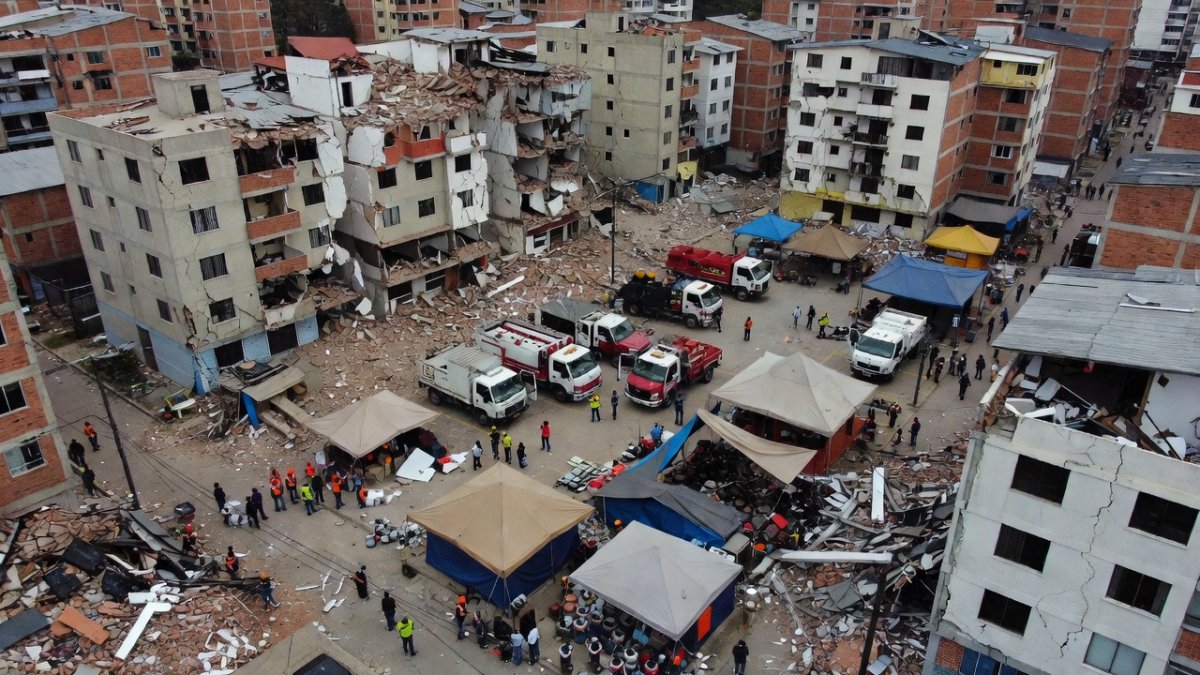
One Week After the Ruins — Colombia's Longest Rescue
The first 72 hours after a major earthquake are considered the golden window for finding survivors trapped beneath the debris. By August 17, that window had largely closed, yet the numbers tell a story of extraordinary effort against impossible odds. According to the National Unit for Disaster Risk Management (UNGRD), rescue teams managed to pull 354 people alive from the wreckage in the first week—a testament to the tireless work of local volunteers, military units, and international specialists who converged on the affected zones. But the same data reveals the scale of the catastrophe: 15 of Colombia's 32 departments were affected, spanning 437 municipalities, with 56,448 families—135,179 people—directly impacted by the quake. The official death toll of 289 is expected to rise as teams reach more remote areas, particularly in Chocó, where the epicenter near San José del Palmar has left entire communities cut off from road access.
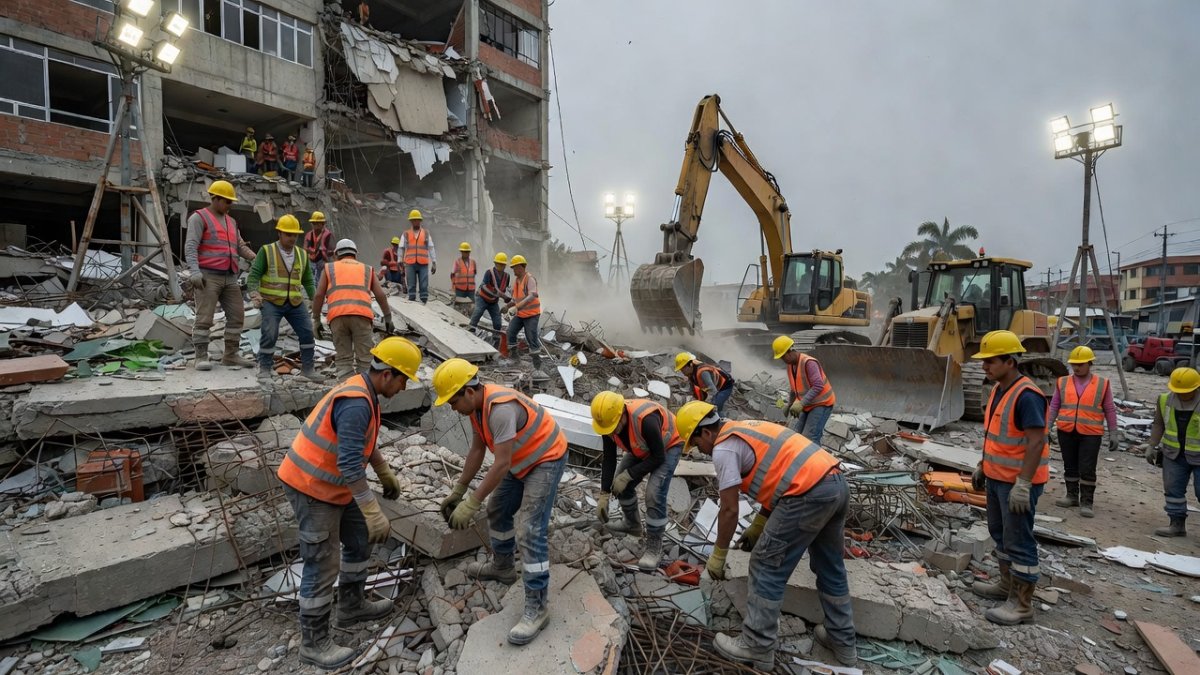
Sergeant Joel Bustamente, leading the Bogotá Fire Department deployment in Cali, described the week as "gruelling," a word that barely captures the physical and emotional toll on his team. "We have been focused on searching for, locating, and rescuing potential victims," he told Al Jazeera English, his voice heavy with exhaustion. But Bustamente acknowledged what everyone on the ground already knew: the chances of finding more survivors have dropped precipitously. The shift is now toward demolition and reconstruction, a phase that brings its own dangers, as unstable structures threaten to collapse on the very people sent to dismantle them. For the families still waiting outside the cordoned-off zones, the end of active rescue is a bitter pill, even as the data suggests that the survival window—which some experts, like volunteer rescuer Maximiliano Herrera, believe could extend to 15 days—has not entirely closed.
The Vanessa Building — Where Hope Yielded to Recovery
In Cali, Colombia's third-largest city and the hardest hit urban center, the Vanessa Building stands as a grim monument to the earthquake's fury. The seven-storey structure, once a mixed-use residential and commercial building, pancaked in on itself within seconds of the quake, trapping dozens of residents and workers. For the first five days, rescue teams worked around the clock, listening for sounds of life beneath the concrete slabs. But by Friday, the operation had officially shifted from search-and-rescue to body recovery, a decision that Enrique Zapata, head of logistics at the Cali health NGO SARES, explained with clinical precision. "The search-and-rescue phase has been suspended," Zapata said at the site. "We are now in the process of recovering bodies." The distinction is more than semantic; it changes the rules of engagement, the equipment used, and the psychological preparation of the teams involved.
The Vanessa Building is not an isolated case. Across Cali, approximately 40 buildings collapsed entirely, and 18 hospitals sustained damage, including one major medical center where three floors caved in, forcing the evacuation of patients and staff mid-crisis. The city's infrastructure, already strained by the influx of displaced people from Chocó and other rural areas, is now buckling under the weight of the disaster. Heavy rains on August 16 and 17 have further complicated the recovery effort, raising the risk of landslides in the hillsides surrounding the city and slowing the heavy machinery needed to clear debris. For Maximiliano Herrera, a volunteer rescuer who has refused to leave the Vanessa site, the shift to recovery does not mean the end of hope. "We never lose hope," he insisted, pointing to cases in other earthquakes where survivors were found after two weeks. But even he knows that the math is unforgiving, and the international teams from Israel, the US, and Mexico that bolstered local efforts are now beginning to redeploy.
Health Infrastructure Under Strain — Cali's Damaged Hospitals
The earthquake did not just destroy homes; it crippled the very institutions Colombians rely on in the aftermath of a disaster. The UNGRD's damage assessment is staggering: 285 health centers were damaged across the affected regions, and 2,838 educational facilities were impacted, leaving millions of children without classrooms as the new school year was set to begin. In Cali, the situation is particularly acute. Eighteen hospitals were damaged, and the collapse of three floors in one of the city's major hospitals forced a chaotic evacuation of patients, many of whom were in intensive care. The loss of hospital capacity comes at the worst possible time, as the injured—4,187 and counting—require ongoing treatment for crush injuries, fractures, and trauma-related conditions. Field hospitals have been erected in stadiums and parking lots, but they are temporary fixes for a long-term crisis.
Veronica Echeverry, a shelter coordinator working out of a community hall in Cali, described the makeshift network that has emerged to fill the gaps. "We have shelters in stadiums and community centers," she said, "and a support network from citizens, hospitals, and local authorities." But the strain is visible. Medical supplies are running low, and the psychological toll on healthcare workers—many of whom lost their own homes—is mounting. The damage to water supply systems is equally alarming: 92 systems were affected, raising the specter of waterborne diseases in communities where sanitation was already precarious. In Chocó, the situation is even more dire. The province, already Colombia's poorest, has seen its already fragile health infrastructure decimated. With 407 roads damaged and 44 vehicular bridges destroyed, getting supplies to rural clinics is a logistical nightmare. The reconstruction of the health sector alone will require billions of pesos, a burden that falls on a government already scrambling to finance the broader recovery.
The Geology Beneath the Rubble — Choco's Tectonic Trap
To understand why Colombia is so vulnerable to earthquakes, one must look beneath the surface. The country sits at the convergence of three major tectonic plates: the Nazca, the Caribbean, and the South American. The Nazca plate, which is denser and heavier, is subducting beneath the South American plate, a process that has been ongoing for millions of years and is responsible for raising the Andes mountains. This subduction zone is a seismic hotspot, generating frequent earthquakes of varying magnitudes. The August 10 quake, however, was exceptional. With a magnitude of 7.4-7.5, it is the strongest earthquake recorded in Colombia this century, according to the Servicio Geológico Colombiano (SGC). The epicenter near San José del Palmar, a rural town in Chocó, was deep—roughly 103 kilometers (64 miles) below the surface, according to the SGC, a depth that allowed the seismic energy to travel across all 32 departments and into Ecuador and Venezuela. Yet despite the depth, the sheer magnitude and the fragility of the region's buildings turned it into one of the most destructive events in the country's modern history.
The quake was felt across all 32 of Colombia's departments and even in neighboring Ecuador and Venezuela, a testament to its immense energy. The USGS and SGC continue to monitor aftershocks, which number in the hundreds, but scientists are quick to caution that predicting the precise time, location, and magnitude of future earthquakes remains impossible. What is known is that the region is far from done shaking. The stress on the fault lines has been redistributed, and the potential for another significant event—while lower—cannot be ruled out. For the people of Chocó, this geological reality is a constant companion. The province's location on the Pacific coast, where the Nazca plate dives beneath the continent, makes it a natural target for seismic activity. But the region's poverty and lack of infrastructure mean that the same magnitude quake that might cause moderate damage in Bogotá becomes a catastrophic event here, where buildings are less likely to be engineered to withstand shaking and where access is limited by dense jungle and winding rivers.
Choco's Compounding Crisis — Poverty, Conflict and Isolation
Chocó is not just Colombia's poorest department; it is also one of the most complex humanitarian environments in the Western Hemisphere. The province is a hotbed of armed conflict, drug trafficking, and illegal gold mining, with multiple armed groups vying for control of strategic corridors and mineral wealth. The earthquake has added a new layer of suffering to a population already displaced by violence. Quibdó, the provincial capital of roughly 130,000 people, has been hit hard: 2,723 homes were damaged, and 1,337 are uninhabitable. The city has long served as a hub for people displaced by the conflict, and now it is struggling to accommodate its own newly homeless residents. Yilson Marmolejo, a local resident, voiced a frustration echoed by many: "There is no institutional response at the national level for temporary or permanent shelters." The sentiment reflects a deep-seated distrust of a central government that has historically neglected the Pacific coast.
Egido Sanz, ActionAid's country director for Colombia, framed the earthquake as "a crisis that comes on top of another major crisis that already existed." The isolation of much of the province—accessible only by river—has made the relief effort painfully slow. Aid that might take hours to deliver in Cali takes days to reach remote villages along the Atrato and San Juan rivers. The damage to 92 water supply systems and 407 roads has only deepened the isolation. For the 56,448 families officially counted as impacted, the immediate priority, according to Sanz, is shelter and refuge. But the long-term challenge is rebuilding a region that was already on its knees. Nestor Martinez, a 65-year-old bicycle shop owner in Buenaventura, Colombia's main Pacific port, lost everything in the quake. He estimates his damage at 350 million pesos—roughly $111,000—and he has no business insurance. "I've been here for 25 years," he said, "and now I have nothing." His story is repeated thousands of times over, a microcosm of a broader economic catastrophe that will take a generation to overcome.
A New President's First Test — Response and Reconstruction
President Abelardo de la Espriella was inaugurated just three days before the earthquake struck, making this disaster the first major test of his administration. The timing could not be worse. De la Espriella, who abstained from the handover process with the previous government, has faced criticism for politicizing the aid effort. His decision to state that he would only accept rescue teams from Israel, El Salvador, and the United States raised eyebrows both domestically and internationally, with critics accusing him of turning a humanitarian crisis into a diplomatic statement. Nevertheless, his government has moved quickly to declare an economic emergency, and the finance minister has estimated reconstruction costs at a minimum of $6.4 billion. To finance this, the administration has opted for borrowing, including a $450 million credit line from the World Bank, a move that will add to Colombia's already significant national debt.
International donations have begun to flow in, but they are a drop in the ocean compared to the need. The European Union has pledged 2 million euros ($2.3 million), and the United States has committed $15.5 million. These funds will help with immediate relief, but the reconstruction of 127,557 damaged homes, 26,945 destroyed homes, and the vast network of roads, bridges, and airports will require sustained investment over many years. The UNGRD is coordinating the response, but its capacity is stretched thin across 15 affected departments. The political stakes are high for de la Espriella, whose approval ratings will be shaped by how effectively he manages this crisis. The abstention from the handover process has left gaps in institutional knowledge, and the politicization of aid has created friction with some international partners. Yet, the president has also shown a willingness to act decisively, and his government's focus on borrowing rather than raising taxes suggests a pragmatic, if risky, approach to financing the recovery.
The Bottom Line — What Comes Next
As the search-and-rescue operations wind down, Colombia faces a new and arguably more daunting phase: recovery and reconstruction. The numbers are sobering. More than 127,000 homes damaged, 26,945 destroyed, 285 health centers and 2,838 schools affected, and 5 airports, 44 bridges, and 407 roads in need of repair. The economic cost, estimated at $6.4 billion, represents a significant chunk of Colombia's GDP, and the true figure is likely to be higher once indirect losses—lost productivity, tourism revenue, and the long-term health impacts—are factored in. For the 143 people officially unaccounted for, and the more than 3,000 names on the unofficial database Colombia Te Busca, the wait for closure continues. The discrepancy between official and unofficial figures highlights the chaos of the first week and the difficulty of tracking the displaced in a country where internal migration is already a constant feature of life.
The road ahead will be defined by choices. Will the government prioritize the reconstruction of Chocó, a region that has been neglected for decades, or will funds flow to the more visible, urban damage in Cali and Pereira? Will the international community maintain its commitment beyond the initial emergency phase, or will attention shift to the next global crisis? And will President de la Espriella's government learn the lessons of the response—the need for transparency, the importance of local leadership, and the value of not politicizing aid—or will it repeat the mistakes of the past? For the people of Colombia, the earthquake of August 10, 2026, is not an event that will fade with time. It is a defining moment, a test of national character, and a reminder that the forces that shape the Earth are indifferent to human suffering. The rebuilding of homes, hospitals, and roads is essential, but the rebuilding of trust—between citizens and the state, between the center and the periphery—may prove to be the most difficult task of all.
By Elena Vasquez, Staff Writer
This article was produced with AI-assisted research and editorial support. Reporting is based on sources cited in the article.
What's Your Reaction?
 Like
0
Like
0
 Dislike
0
Dislike
0
 Love
0
Love
0
 Funny
0
Funny
0
 Wow
0
Wow
0
 Sad
0
Sad
0
 Angry
0
Angry
0

Latin America Correspondent at Global1.News. Based in Mexico City, covering politics, economics, energy, and culture across the region. Brings an on-the-ground perspective to stories spanning from the Rio Grande to Patagonia.














Comments (0)