
In Tyre, Lebanon's Prime Minister Bets the State's Credibility on the Army's Deployment
The dusty roads of Tyre carried more than the weight of an armored convoy on Friday. When Lebanese Prime Minister Nawaf Salam stepped onto the Benoit Barakat barracks, he was walking into the heart of a geopolitical contest that will define Lebanon's future — a contest between a state reclaiming its territory and a resistance movement refusing to yield until the last Israeli soldier departs.
The dusty roads of Tyre carried more than the weight of an armored convoy on Friday. When Lebanese Prime Minister Nawaf Salam stepped onto the Benoit Barakat barracks, he was walking into the heart of a geopolitical contest that will define Lebanon's future — a contest between a state reclaiming its territory and a resistance movement refusing to yield until the last Israeli soldier departs. The visit, at once ceremonial and deeply strategic, came as US-mediated negotiations between Lebanon and Israel remain frozen over the composition of a verification committee, and as Israeli strikes continue to claim civilian lives in the very villages Salam came to reassure.
In Tyre, Lebanon's Prime Minister Bets the State's Credibility on the Army's Deployment
Beirut, Lebanon – August 21, 2026 — The scene was carefully choreographed: Prime Minister Nawaf Salam, flanked by Defense Minister Michel Menassa and Army Chief of Staff Maj. Gen. Hassan Audi, laying a wreath at the Lebanese Army martyrs' memorial before addressing a gathering of officers from the South Litani Sector. But the message was anything but ceremonial. In a region where state authority has long been contested by non-state actors, Salam's words carried the weight of a government staking its survival on a single proposition: that the Lebanese Army, not Hezbollah's arsenal, will be the guarantor of security in the south.
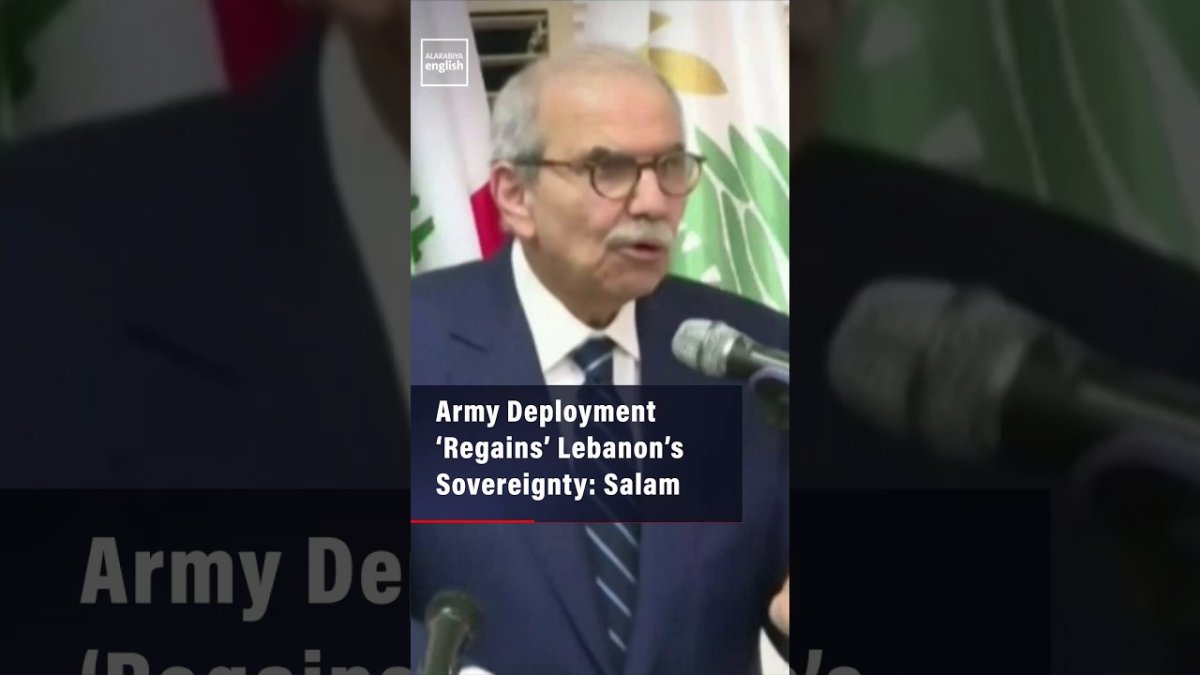
State Authority Returns to the South
"The army's presence in the South is not merely a military deployment; it is the presence of the state," Salam told the assembled officers, according to remarks relayed by his office. "Every position where the army deploys is a place where the state restores its sovereignty." The prime minister's language was deliberate, echoing the framework agreement signed June 21 under US auspices — a deal that calls for Hezbollah's disarmament, the gradual withdrawal of Israeli forces from occupied areas, and the deployment of the Lebanese army in designated "pilot zones."
Salam did not stop at military symbolism. He linked sovereignty to the mundane but essential infrastructure of daily life: schools, hospitals, roads, electricity, water, public administration, the judiciary, and employment opportunities. "Reconstruction must return to the South," he insisted, framing the army's deployment as the precondition for a broader civic restoration. For the residents of Tyre and the surrounding villages — many of whom have lived through more than a year of devastating conflict and its aftermath — the prime minister's words offered a promise that the state, long absent from these borderlands, intends to stay.
Defense Minister Menassa reinforced the message with a pointed reference to the ongoing negotiations. "Our position is firm on restoring state sovereignty and every inch of our territory," he said. "This is the objective of the negotiations that Lebanon has entered, which are the best solution for getting out of this tunnel." The "tunnel" Menassa referenced is not merely metaphorical — it describes a security predicament that has trapped Lebanon between Israeli military pressure and Hezbollah's armed resistance for decades.
From Ceasefire to Framework Agreement
The path to Friday's visit began with the November 2024 ceasefire that ended more than a year of fighting between Hezbollah and Israel. That truce, fragile from the start, collapsed into renewed hostilities on March 2, prompting Lebanon and Israel to enter direct negotiations under US mediation. The resulting framework agreement, signed June 21, was hailed by Washington as a historic breakthrough — the first formal acknowledgment by both sides of a structured path toward security normalization.
Yet implementation has been halting at best. Israel has withdrawn from only two of the designated pilot zones, and Israeli Defence Minister Israel Katz has been unambiguous about his government's intentions. On August 12, Katz instructed the military to prepare for a "long-term presence" in security zones in Lebanon, Syria, and Gaza — a declaration that directly contradicts the framework's promise of gradual withdrawal. Israel's declared "security zone" in southern Lebanon remains occupied, and Israeli strikes continue with grim regularity. On August 15, an Israeli strike killed 11 people in southern Lebanon, including three children. Hezbollah has vowed a response.

The Verification Committee Stalemate
The immediate obstacle to progress lies in a seemingly technical matter: the composition of a third-party verification committee to monitor the agreement's implementation. Talks at the US embassy in Rome have stalled over this issue, with Italy among the nations under consideration. Israel, however, has rejected candidates that have taken diplomatic actions against it — France being the most prominent example. The next round of talks is tentatively scheduled for September, but Israel has yet to confirm dates, leaving the process in diplomatic limbo.
President Joseph Aoun traveled to Rome on August 20, meeting Pope Leo XIV and Italian leaders in a bid to generate international pressure for Israeli withdrawal. The papal audience was symbolically significant — the Vatican has historically played a mediating role in Lebanese affairs — but whether it translates into concrete leverage over Israel remains uncertain. Aoun's diplomatic push reflects a broader Lebanese strategy: internationalize the conflict to counterbalance Israel's military advantage and its willingness to dictate terms unilaterally.
Hezbollah's Calculus
Hezbollah, meanwhile, watches the state's reassertion in the south with a mixture of suspicion and calculation. The party's public position is categorical: disarmament cannot occur while Israeli forces remain on Lebanese territory. "We are not saying 'don't negotiate'," Hezbollah spokesman Youssef Al Zain said. "We are saying 'negotiate with leverage'." His warning was pointed: reliance on US brokerage, he argued, will lead to "more Israeli demands, without anything in return."
The party's parliamentary bloc went further on August 20, accusing Lebanese authorities of "surrender" over the framework agreement and calling for withdrawal from the talks entirely. This rhetoric reflects a genuine strategic dilemma for Hezbollah. The party's raison d'être — armed resistance against Israeli occupation — is undermined by a framework that ties its disarmament to Israeli withdrawal. Yet walking away from negotiations entirely would isolate Lebanon internationally and hand Israel a propaganda victory. Hezbollah's leadership appears to be calculating that it can weather the diplomatic process while maintaining its arsenal, betting that Israeli intransigence will ultimately discredit the framework and vindicate the resistance narrative.
Strategic Calculus for the Region
The stakes extend far beyond Lebanon's borders. For Washington, the framework agreement represents a rare diplomatic achievement in a region where US mediation has often faltered. A successful implementation would demonstrate that American power can still shape outcomes in the Middle East — a message with implications for other files, from Gaza to the broader Iran confrontation. The US has agreed to study possible economic support for Lebanon, a carrot designed to incentivize Lebanese cooperation and to strengthen the state's hand against Hezbollah.
For Iran, the calculus is more complex. Hezbollah remains Tehran's most significant regional asset, a deterrent force on Israel's northern border. The framework agreement, if fully implemented, would strip Iran of that leverage. Tehran's response has been to encourage Hezbollah's resistance to disarmament while avoiding direct confrontation with the US — a delicate balancing act that leaves the party in a holding pattern.
For Israel, the "security zone" policy reflects a broader shift in strategic thinking. Defence Minister Katz's instruction to prepare for a long-term presence in security zones across Lebanon, Syria, and Gaza signals a departure from the traditional Israeli approach of limited incursions followed by withdrawal. This new doctrine — permanent buffer zones maintained by military force — has profound implications for regional sovereignty and for the viability of any negotiated settlement.
Regional Implications
The Lebanese Army, meanwhile, faces the unenviable task of extending state authority with limited resources. Shortages in equipment, personnel, and technical capabilities are acute. Paris will host a preparatory meeting on September 17 for an international conference to support the Lebanese army and security forces — a recognition that the state's credibility in the south depends on its ability to provide security and services that Hezbollah has historically supplied.
Salam's visit to Tyre was, in this context, a performance of statehood — a declaration that Lebanon intends to be present in the south not as a guest in its own territory, but as the sovereign authority. The prime minister's words to the officers were unambiguous: "There is no choice for the Lebanese today but to have one army, one flag and one state." He urged soldiers to preserve the military institution's unity and resist political and sectarian divisions — a warning that the army must not become a pawn in the broader struggle between the state and Hezbollah.
The coming weeks will test whether Salam's rhetoric can be translated into reality. The September talks, if they occur, will determine whether the verification committee impasse can be broken. The international conference in Paris will test whether Lebanon's allies are willing to back their words with resources. And the Israeli military's posture will reveal whether the "security zone" doctrine is negotiable or permanent.
For the people of southern Lebanon, the stakes are existential. They have lived through war, occupation, and reconstruction before — only to see the cycle repeat. Salam's promise of schools, hospitals, and jobs is a promise that the state will finally deliver what Hezbollah's resistance could not: a normal life. Whether that promise is kept depends on forces far beyond Tyre — in Washington, Jerusalem, Tehran, and Rome. But for one Friday in August, a Lebanese prime minister stood in the south and declared that the state had returned. The region will be watching to see if it stays.
By Malik Hassan, Staff Writer
This article was produced with AI-assisted research and editorial support. Reporting is based on sources cited in the article.
What's Your Reaction?
 Like
0
Like
0
 Dislike
0
Dislike
0
 Love
0
Love
0
 Funny
0
Funny
0
 Wow
0
Wow
0
 Sad
0
Sad
0
 Angry
0
Angry
0
Middle East Correspondent at Global1.News. Based in Beirut, covering politics, conflict, energy, and society across the Middle East. Brings context and depth to a region often reduced to headlines.










Comments (0)