
In first election post-10/7, Israeli voters choose same electoral deadlock
Israel’s 2026 parliamentary election has delivered a familiar, if unsettling, verdict: the country returns to the same deadlocked political landscape that existed before the Oct.
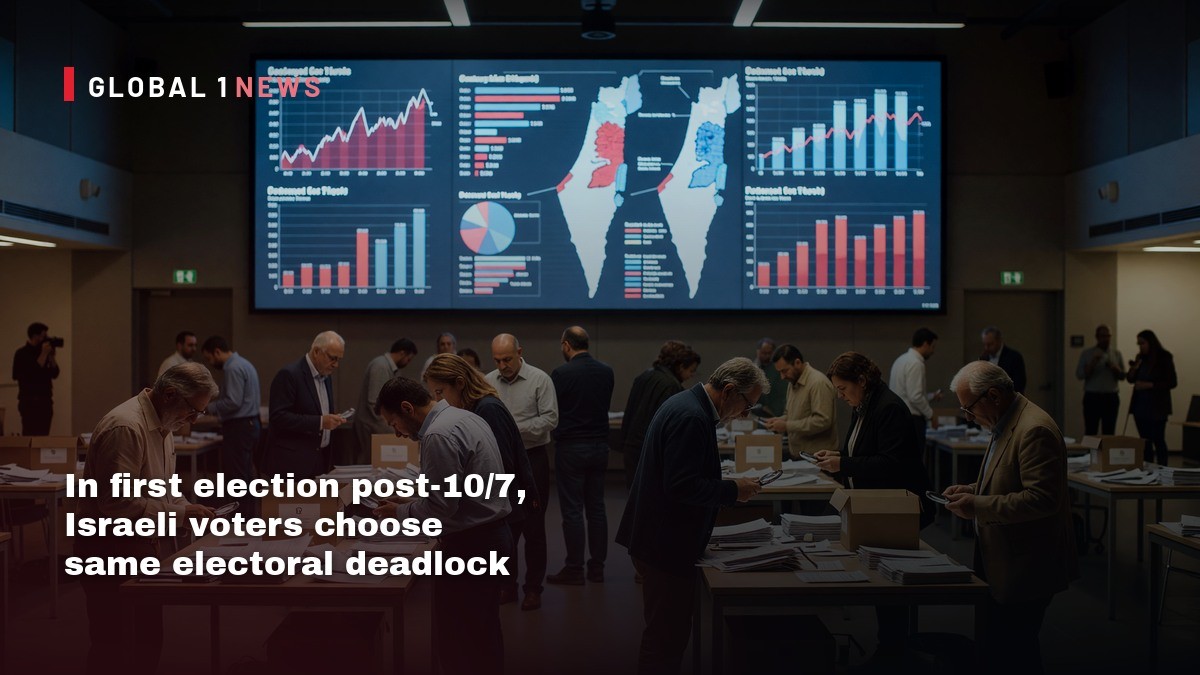
Israel’s 2026 parliamentary election has delivered a familiar, if unsettling, verdict: the country returns to the same deadlocked political landscape that existed before the Oct. 7, 2023 Hamas attack. After three years of a multifront war, national trauma and a relentless campaign to unseat Prime Minister Benjamin Netanyahu, voters have largely stayed within the established camps, leaving both the right‑wing bloc and the Zionist opposition short of the 61 seats needed to form a government.
Election results: a near‑deadlock
Preliminary counts on Wednesday morning placed Netanyahu’s bloc at roughly 54 seats, the Zionist opposition at about 47, and Arab parties at approximately 19. Likud emerged as the single largest party with an estimated 27 seats, while Gadi Eisenkot’s newly‑branded Yashar list secured around 20 seats. The joint B’Yachad list of Naftali Bennett and Yair Lapid was projected to receive 11 seats, Yair Golan’s Democrats eight, and Avigdor Lieberman’s Yisrael Beiteinu also eight.
On the religious right, United Torah Judaism, Shas and Otzma Yehudit each appeared set for seven seats, with Religious Zionism projected at six. The Arab vote, unexpectedly strong, rose from ten seats in the outgoing Knesset to an estimated 19, reshaping the arithmetic of any potential coalition.
Netanyahu’s post‑election stance
Netanyahu addressed supporters at Likud’s Jerusalem headquarters after 3 a.m., noting that Likud remained the largest party and emphasizing the “clear, decisive majority” of the right‑wing bloc among the Zionist public. He called for a “strong national government” and warned against a coalition that would depend on Arab parties. While his bloc fell short of the 64 seats it held after the 2022 election, the Prime Minister’s message underscored his belief that he still commands a decisive share of the Zionist electorate.
The Prime Minister’s speech also highlighted the strategic dimension of the election: with President Donald Trump’s explicit endorsement of Netanyahu and a shared focus on confronting Iran, the right‑wing bloc sees an opportunity to leverage U.S. support for a robust security agenda.
Polling mis‑reads and the surprise of the Arab vote
Early exit polls revealed a stark gap between pre‑election surveys and the actual vote. Channels 11, 12 and 13 had forecast Likud at 19‑21 seats and Eisenkot’s Yashar at 22‑23, suggesting a possible upset. Channel 14, which consistently projected a stronger Likud, predicted 30 seats for Likud and 20 for Yashar—figures that proved closer to the emerging reality. The discrepancies raise questions about how pollsters captured undecided voters and the volatility of voter sentiment in a war‑torn society.
The Arab parties’ surge to an estimated 19 seats—almost double their previous representation—adds a new layer of complexity. While the combined Zionist opposition and Arab parties could theoretically command a parliamentary majority, the political reality of forming a coalition that includes Arab parties remains fraught, given longstanding opposition from Bennett, Lapid and Avigdor Liberman.
New party names, old political structures
Despite the influx of new party labels, the election produced little fundamental realignment. Eisenkot’s Yashar, although technically a new party, is largely a rebranding of his previous role as the No. 2 figure in Benny Gantz’s Blue and White alliance, drawing on an established voter base rather than creating a fresh constituency. Similarly, Bennett and Lapid’s joint B’Yachad list, while presented under a new banner, is anchored in their long‑standing political networks.
Core components of Netanyahu’s bloc—Likud, Shas, United Torah Judaism, Religious Zionism and Otzma Yehudit—remain unchanged. Smaller insurgent parties failed to cross the electoral threshold, underscoring the resilience of Israel’s established party system even amid widespread public dissatisfaction.
Historical parallels and the prospect of another stalemate
Israel’s recent electoral history is marked by repeated deadlocks. Between April 2019 and November 2022, the country held five elections without securing a durable governing majority. The deadlock was finally broken in 2022 when Netanyahu assembled a 64‑seat coalition. The 2026 outcome suggests a return to that pre‑2022 impasse, with neither bloc achieving the 61‑seat threshold.
For a government to form, one of three scenarios must materialize: Bennett, Eisenkot or Liberman must join Netanyahu’s bloc; the opposition must craft an arrangement that includes Arab parties; or a new election must be called. Each pathway carries significant political and strategic implications, especially as Israel confronts ongoing security challenges.
The Trump factor and U.S. strategic interests
President Donald Trump’s endorsement of Netanyahu has been a decisive element in the election narrative. Trump publicly urged voters to back “Bibi Netanyahu” and framed the election as a chance to “finish the job” of confronting Iran. After the vote, Trump claimed his endorsement turned a “decisive defeat” into a “big come‑from‑behind stalemate, or even a WIN for Netanyahu.” This endorsement likely bolstered Netanyahu’s standing among right‑wing voters and reinforced the perception of a strong U.S.–Israel partnership.
The timing of the endorsement is critical. With Trump’s presidency set to conclude in less than two years, a prolonged Israeli deadlock could limit his ability to influence Israeli politics further, adding pressure on Israeli leaders to resolve the stalemate before the end of his term.
What the deadlock means for Israel’s security and economy
The persistence of political paralysis comes at a moment when Israel’s security environment is more demanding than ever. The war that began after Oct. 7 has stretched the Israel Defense Forces across multiple fronts, and the nation’s leadership must allocate resources for both defense and reconstruction. A delayed government formation could hamper decisive budgetary decisions, affecting defense procurement, civilian infrastructure rebuilding and the broader innovation economy that has been a hallmark of Israel’s resilience.
From an economic standpoint, uncertainty in coalition negotiations can dampen investor confidence, particularly in the high‑tech sector that relies on stable policy frameworks. The Israel Innovation Authority and the Ministry of Economy have traditionally played pivotal roles in sustaining growth; prolonged political gridlock threatens to stall new initiatives and delay critical funding cycles.
Ultimately, the 2026 election underscores a paradox: while Israel’s security challenges and societal scars have deepened, its political divisions have remained remarkably static. The coming weeks will test whether the nation can translate the urgency of its security and economic needs into a workable coalition, or whether it will be forced back into another election cycle, extending the period of uncertainty that has already strained the country’s war‑wearied populace.
This article was produced with AI-assisted research and editorial support. Reporting is based on the source material cited below. Sources: JNS (Jewish News Syndicate); jns.org; Global1.News (28 October 2026).
By Hannah Berg, Staff Writer
What's Your Reaction?
 Like
0
 Dislike
0
 Love
0
 Funny
0
 Wow
0
 Sad
0
 Angry
0
Israel Correspondent at Global1.News. Based in Tel Aviv, covering Israeli politics, security, technology, and society. Provides balanced, deeply-sourced reporting on one of the most closely-watched regions in the world.











Comments (0)