
Hua Hin Property Firms Probed in Nominee Scheme Crackdown
Thai authorities searched 15 Hua Hin locations in an investigation into property companies suspected of using Thai nationals as nominee shareholders for foreign investors, with alleged damage exceeding 300 million baht. Thirteen foreign nationals have been arrested and warrants issued for 45 more.
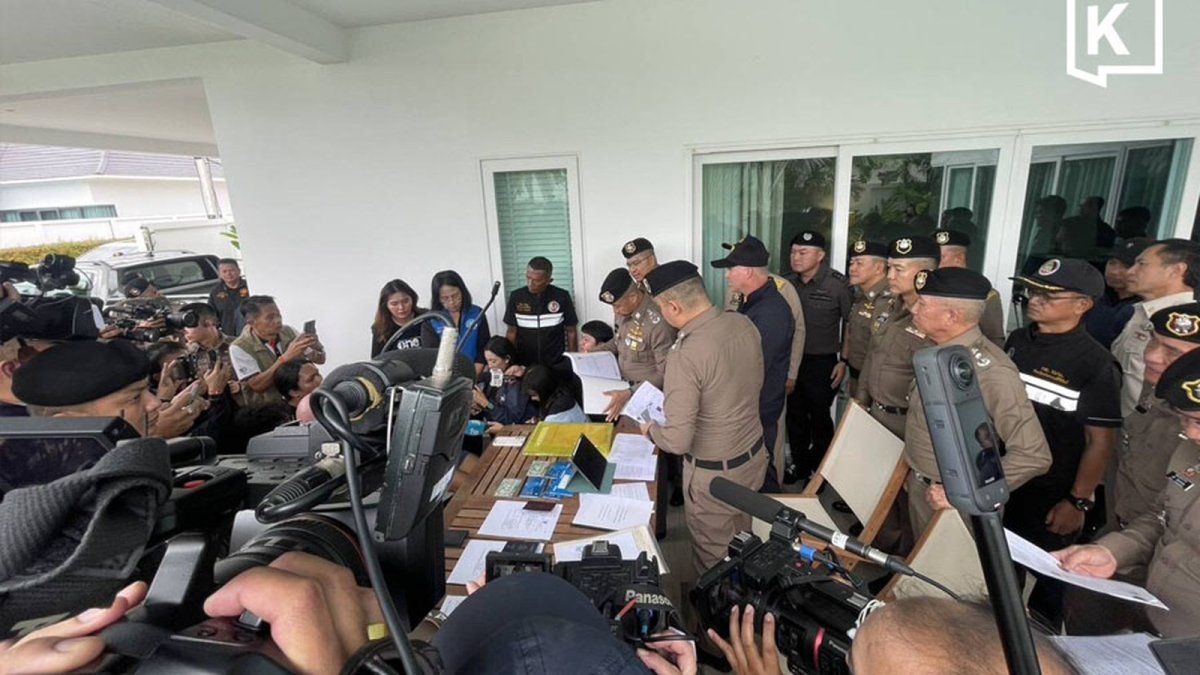
Hua Hin property firms probed over alleged nominee scheme
HUA HIN — A coordinated sweep by Thai authorities on Monday targeted 15 locations in this famous beach resort town, unravelling what investigators describe as a sophisticated nominee scheme allegedly allowing foreign nationals to control property businesses through Thai frontmen. The operation, the sixth phase of a nationwide crackdown, has so far led to the arrest of 13 foreign nationals and the issuance of arrest warrants for 45 more, with alleged damages exceeding 300 million baht.
A coordinated raid across Prachuap Khiri Khan
More than 200 police officers and government officials fanned out across Hua Hin on 10 August, acting on orders from Deputy National Police Chief Pol Gen Samran Nuanma. The operation was led by Pol Lt Gen Nopasil Poolsawat of the Office of the National Police Chief and Provincial Police Region 7 commissioner Pol Lt Gen Phisit Tanprasert, with the Prachuap Khiri Khan governor and officials from the Department of Business Development (DBD) and the Department of Lands also taking part.
The searches focused on a development of detached houses and modern pool villas in the Thap Tai subdistrict of Hua Hin, where properties are priced at approximately 10 to 20 million baht each. Investigators from the DBD, the Department of Special Investigation, immigration police, tourist police and the Internal Security Operations Command worked side by side, seizing company-registration documents, accounting records, computers, mobile phones and electronic data from the targeted sites.
How the alleged nominee scheme operated
DBD director-general Poonpong Naiyanapakorn explained that several target companies initially registered as wholly Thai entities, with Thai nationals listed as directors holding 100 percent of shares. Within six months, however, the shareholder structures were amended to add foreign directors alongside the Thai ones. The arrangements allegedly kept foreign shareholdings below 50 percent, while Thai shareholders — suspected nominees — retained 51 percent. This allowed the firms to remain legally classified as Thai while operating property-holding and rental businesses.
Investigators noted a telling detail: the Thai and foreign shareholders had not previously known one another or had any prior connection. In normal business dealings, such a complete lack of relationship is highly unusual, and it raised immediate red flags for the authorities. The suspected scheme exploited loopholes that allow foreigners to use Thai nominees to evade restrictions under the Foreign Business Act B.E. 2542 (1999), thereby acquiring or operating property businesses unlawfully.
Arrests and summonses across nationalities
Police have so far arrested 13 foreign nationals: three British, four Chinese, and one each from Italy, France, the Netherlands, Austria, the Philippines and the United States. The suspects have not yet been charged in court and remain subject to further investigation. Arrest warrants have been issued for 45 foreign nationals in total, and summonses have been sent to 39 Thai nationals, all connected to 33 separate cases.
The wider investigation covers 33 companies suspected of holding land on behalf of foreign nationals, with the property involved valued at approximately 300 million baht. At the targeted development in Thap Tai, six companies allegedly used Thai nominees — four connected to the first phase of the project and two to the second phase. The Thai nationals listed as shareholders reportedly told investigators they agreed to hold shares for foreigners but never paid for the shares, never participated in managing the companies, and had not even seen financial documents.
Foreign buyers speak of legal advice
When questioned, the foreign nationals said they wanted to hold property in Thailand and had been advised by law and accounting firms to establish companies. They believed these arrangements allowed them to hold properties legally. Police, however, said the companies did not conduct genuine business operations. The law and accounting firms in question were not identified in the investigation, but investigators will trace financial transactions and seek to identify other people, beneficiaries or networks both in Thailand and overseas.
Royal Thai Police stressed that the campaign targets nominee structures and foreign-backed businesses suspected of operating unlawfully — not legitimate foreign investors who comply with Thai law. The inquiry will also cover any government officials suspected of corruption or improperly assisting those involved, a signal that the authorities are looking beyond the immediate suspects to the wider network of enablers.
Stricter registration rules already taking effect
This week's operation comes as the DBD tightens its oversight of company registrations. Since 1 August, the department has applied stricter scrutiny to company registrations and amendments, particularly those involving both Thai and foreign shareholders where foreign ownership remains below 50 percent. The results have been immediate: only five such cases have been recorded since the measures took effect, a significant drop from previous levels.
The DBD prepared these stricter registration rules earlier this year, with measures effective from April 2026, including in-person shareholder verification. This latest phase of the nominee crackdown began with investigations on Koh Phangan in Surat Thani, followed by raids on Koh Samui and Koh Phangan in July 2026, where the DSI uncovered suspected nominee networks linked to foreign-owned property and tourism businesses involving about 34 companies, some described as Chinese-backed investment networks.
Legal consequences under the Foreign Business Act
Poonpong Naiyanapakorn outlined the penalties for those found guilty of using Thai nationals as concealed nominees. "Using Thai nationals as concealed nominees, and assisting such offences under the Foreign Business Act B.E. 2542 (1999), carries a penalty of up to three years' imprisonment, a fine of 100,000 to 1 million baht, or both," he said. "The court may also order the business to cease operating or end an unlawful shareholding arrangement."
The legal framework is clear, but the human dimension is more complex. Thailand has long restricted foreign land and property ownership — land under Thai law may generally only be owned by Thai nationals, and the Foreign Business Act limits foreign participation in restricted business categories. For decades, foreigners seeking to own property in Thailand have looked for ways around these restrictions, and nominee arrangements have been a persistent feature of the landscape, particularly in resort areas popular with international buyers.
What this means for Hua Hin and Thai communities
Hua Hin, located about 200 kilometres south of Bangkok in Prachuap Khiri Khan province, has long been a favourite destination for foreign retirees and buyers from Europe, China and elsewhere. The town's relaxed coastal atmosphere, royal heritage and proximity to the capital have made it a magnet for those seeking a second home in the tropics. But this investigation raises important questions for the local community and the property market that sustains it.
For Thai residents of Hua Hin, the crackdown may bring a measure of reassurance that the rule of law is being upheld. Property prices in the area have risen steadily over the years, and some locals have expressed concern that foreign capital, channelled through opaque structures, has priced them out of their own neighbourhoods. The investigation also sends a message that the authorities are serious about enforcing the Foreign Business Act, which protects Thai ownership of land and certain business categories.
For the property market, the immediate effect may be caution. Developers who have relied on nominee structures to sell to foreign buyers may find their business models under threat. Legitimate foreign investors, however, have little to fear — the Royal Thai Police have been explicit that the campaign targets unlawful nominee arrangements, not those who comply with Thai law. The long-term health of the market depends on transparency, and this investigation may ultimately strengthen confidence among buyers who want to invest properly.
Regional implications for ASEAN investment
For Thailand's neighbours in Southeast Asia, this crackdown is a reminder of the delicate balance between welcoming foreign investment and protecting national interests. Thailand's restrictions on foreign land ownership are not unique in the region — many ASEAN countries have similar rules — but the enforcement of those rules varies widely. The Thai authorities' determination to pursue nominee networks, across multiple phases and with inter-agency coordination, signals a new level of seriousness.
Foreign investors looking at Thailand will need to take note: the era of informal arrangements is ending. The DBD's stricter registration rules, the in-person shareholder verification, and the willingness to prosecute both foreign and Thai nationals involved in nominee schemes all point to a more regulated environment. For the region as a whole, this may set a precedent for how other ASEAN nations approach the challenge of foreign ownership in sensitive sectors.
As the investigation continues, with financial tracing and the search for other beneficiaries and networks both in Thailand and overseas, the full scope of the alleged scheme may yet expand. The authorities have promised to pursue the case to its conclusion, including any government officials suspected of corruption or improper assistance. For now, the 13 arrested foreign nationals and the 39 summoned Thai nationals await the next steps in a process that will test the strength of Thailand's commitment to lawful foreign investment.
By Ann Srisawat, Staff Writer
This article was produced with AI-assisted research and editorial support. Reporting is based on sources cited in the article.
What's Your Reaction?
 Like
0
Like
0
 Dislike
0
Dislike
0
 Love
0
Love
0
 Funny
0
Funny
0
 Wow
0
Wow
0
 Sad
0
Sad
0
 Angry
0
Angry
0

Southeast Asia Correspondent at Global1.News. Based in Bangkok, covering Thai and Southeast Asian politics, economy, technology, and culture. Deep regional perspective on one of the world's most dynamic regions.














Comments (0)