
Hua Hin Property Firms Probed Over Alleged Nominee Scheme as Authorities Raid 15 Locations
Hua Hin Property Firms Probed Over Alleged Nominee Scheme as Authorities Raid 15 Locations BANGKOK — The coastal resort town of Hua Hin, long a favourite retreat for foreign retirees and investors, is at the centre of a major crackdown on alleged property law violations.
Hua Hin Property Firms Probed Over Alleged Nominee Scheme as Authorities Raid 15 Locations
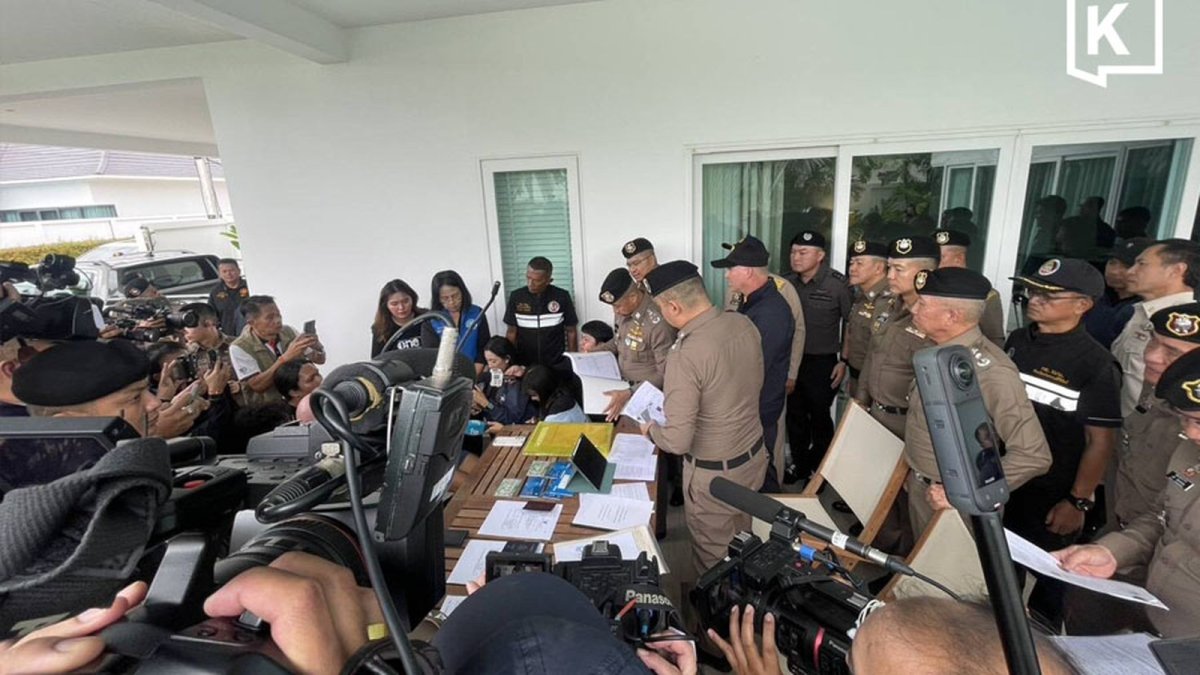
BANGKOK — The coastal resort town of Hua Hin, long a favourite retreat for foreign retirees and investors, is at the centre of a major crackdown on alleged property law violations. On 10 August, authorities searched 15 locations across the district as part of an investigation into property companies suspected of using Thai nationals as nominee shareholders for foreign investors, with alleged damage exceeding 300 million baht.
The operation, confirmed by the Department of Business Development (DBD), brought together a rare coalition of enforcement agencies. Police, immigration officers, tourist police, the Department of Special Investigation, the Internal Security Operations Command, and other agencies coordinated the simultaneous raids, signalling the seriousness with which the Thai government now views such arrangements.
For Thai readers, this is not merely a legal footnote. Hua Hin is a bellwether for the kingdom's property market, a place where beachfront condominiums and hillside villas have long attracted buyers from Europe, China, and across Asia. The investigation raises questions about how deeply embedded nominee practices have become in Thailand's most desirable real estate markets, and what it means for the thousands of legitimate foreign property owners who call the kingdom home.
How the Alleged Scheme Worked
According to DBD director-general Poonpong Naiyanapakorn, the target companies followed a strikingly consistent pattern. They were initially registered as Thai entities, with Thai nationals listed as directors and holding 100% of the shares. Within six months, however, the shareholder structures were amended to add foreign directors alongside their Thai counterparts.
The arrangements allegedly kept foreign shareholdings below 50%, while Thai shareholders — suspected of acting as nominees — retained 51%. This careful arithmetic allowed the firms to remain legally classified as Thai entities while operating property-holding and rental businesses. Under the Foreign Business Act B.E. 2542 (1999), certain business activities, including land and property ownership, are restricted for foreigners. By keeping the foreign stake under half, these companies could bypass those restrictions on paper.
Investigators noted something else that raised red flags. The Thai and foreign shareholders had not previously known one another or had any prior connection. In normal business dealings, authorities said, such complete unfamiliarity between partners is highly unusual. It is a pattern that suggests the Thai shareholders were recruited specifically for their names, not their business acumen or capital.
The alleged scheme is not a new phenomenon in Thailand. For decades, the use of nominees has been a quiet but persistent feature of the property market, particularly in tourist-heavy areas like Pattaya, Phuket, and Hua Hin. What is different this time is the scale of the enforcement response and the explicit warning from the DBD that such practices will no longer be tolerated.
Arrest Warrants and Summonses Issued
The investigation has moved swiftly from paperwork to prosecution. Police have issued arrest warrants for 45 foreign nationals and summonses for 39 Thai nationals. Thirteen suspects have so far been arrested in connection with 33 cases, according to the DBD.
The numbers are significant. Thirty-three cases is not a token gesture; it represents a sustained pattern of alleged wrongdoing across multiple companies. The 45 foreign nationals named in arrest warrants span a range of nationalities, though the DBD has not released a full breakdown. The 39 Thai nationals summoned are believed to be the nominee shareholders whose names were used to mask foreign ownership.
For the Hua Hin community, the arrests have sent a ripple of concern through expatriate circles. Many foreign residents who purchased properties through legitimate channels worry about being caught up in the dragnet. Others, who may have unknowingly participated in nominee arrangements through their lawyers or agents, now face an uncertain legal future.
The DBD has been careful to distinguish between legitimate foreign ownership and the alleged nominee scheme. Foreigners can legally own condominium units in Thailand, provided the building meets the 49% foreign ownership quota. They can also lease land for up to 30 years under Thai law. What they cannot do is own land outright or operate certain businesses without proper licensing.
Stricter Scrutiny Since 1 August
The Hua Hin raids are not an isolated operation. Since 1 August, the DBD has tightened scrutiny of company registrations and amendments in an effort to make nominee arrangements more difficult to execute. The results, according to the department, have been immediate.
Registrations involving Thai and foreign shareholders, where foreign ownership remained below 50%, had fallen significantly, with only five such cases recorded since the measures took effect. Before the crackdown, such registrations were far more common, particularly in areas with high foreign property demand.
The sharp decline suggests that the mere threat of scrutiny is changing behaviour. Property lawyers and consultants in Bangkok and Hua Hin report that clients are now asking more questions about compliance, and some are restructuring their holdings to ensure they meet legal requirements.
For the Thai government, the timing is deliberate. With the economy still recovering from the pandemic's impact on tourism and investment, the authorities want to send a clear signal that Thailand remains open for business — but only for business conducted within the law. The message is aimed as much at foreign investors as at the Thai lawyers and agents who may have facilitated nominee arrangements in the past.
Penalties Under the Foreign Business Act
Poonpong was explicit about the consequences for those found guilty. "Using Thai nationals as concealed nominees, and assisting such offences under the Foreign Business Act B.E. 2542 (1999), carries a penalty of up to three years' imprisonment, a fine of 100,000 to 1 million baht, or both," he said.
The court may also order the business to cease operating or end an unlawful shareholding arrangement, he added. For property companies, such an order could mean forced divestment of assets or the unwinding of property transactions completed years ago.
The penalties are not trivial, but for many foreign investors, the bigger concern is the potential loss of their investment. A property purchased through a nominee arrangement could be subject to seizure or forced sale if the court determines the ownership structure was unlawful. The 300 million baht in alleged damage cited by the DBD is likely just the beginning; the full value of properties involved in the 33 cases could be substantially higher.
Legal experts in Bangkok note that the Foreign Business Act has been on the books for more than two decades, but enforcement has historically been uneven. The current crackdown, with its multi-agency coordination and public announcements, suggests a new level of commitment from the authorities.
What This Means for Thailand's Property Market
For Thai readers, the Hua Hin investigation is a reminder that the kingdom's property market operates within a legal framework designed to protect Thai ownership of land and strategic businesses. The Foreign Business Act is not an arbitrary restriction; it reflects a longstanding policy that land and property are national resources, not merely commodities for international trade.
At the same time, Thailand has long welcomed foreign investment, including in the property sector. Condominium ownership by foreigners is legal and common, and the government has actively promoted Thailand as a retirement destination for foreigners with the means to buy property. The challenge is balancing openness with protection, and the nominee scheme sits precisely at that fault line.
The Hua Hin raids also have implications for the broader ASEAN region. Thailand is not alone in grappling with nominee arrangements; similar issues have arisen in Vietnam, Indonesia, and the Philippines, where foreign ownership of land is also restricted. How Thailand handles this case will be watched by investors and regulators across Southeast Asia.
For the local economy in Hua Hin, the investigation could have short-term effects. Property transactions may slow as buyers and sellers wait to see how the cases unfold. Some foreign residents may reconsider their plans to purchase property in Thailand, despite the legal options available to them. Real estate agents in the area report an uptick in inquiries from clients seeking reassurance that their purchases are compliant.
In the longer term, however, a cleaner property market could benefit Thailand. Foreign investors who are confident that their purchases are legal and secure are more likely to invest, and the removal of nominee schemes could level the playing field for Thai developers and buyers who have competed against opaque foreign-backed entities.
A Warning to the Kingdom
The DBD's message is clear: the era of turning a blind eye to nominee arrangements is over. The department has the tools, the inter-agency cooperation, and the political will to pursue these cases, and the Hua Hin operation is likely to be followed by similar actions in other hotspots.
For Thai nationals who have lent their names to such schemes, often for a fee, the summonses are a stark warning. What may have seemed like easy money — a few hundred thousand baht for signing documents — now carries the risk of imprisonment and fines. For foreign investors, the lesson is equally stark: shortcuts around Thai law are not worth the risk.
As the investigation continues, the DBD has promised to keep the public informed. The department's director-general has indicated that more cases may be uncovered as the scrutiny of company registrations continues. For now, the 15 locations searched in Hua Hin are just the beginning of what could be a much broader reckoning.
Thailand's property market has long been one of the kingdom's most attractive features, drawing investment and tourism to places like Hua Hin, Phuket, and Chiang Mai. The challenge for the government is to preserve that appeal while ensuring the market operates within the law. The Hua Hin investigation is a test of whether that balance can be achieved.
This article was produced with AI-assisted research and editorial support. Sources: Khaosod English, Department of Business Development (Thailand).
By Ann Srisawat, Staff Writer
What's Your Reaction?
 Like
0
Like
0
 Dislike
0
Dislike
0
 Love
0
Love
0
 Funny
0
Funny
0
 Wow
0
Wow
0
 Sad
0
Sad
0
 Angry
0
Angry
0

Southeast Asia Correspondent at Global1.News. Based in Bangkok, covering Thai and Southeast Asian politics, economy, technology, and culture. Deep regional perspective on one of the world's most dynamic regions.














Comments (0)