
House Passes Stopgap Funding Bill, 370-48, Averting Shutdown and Punting the Fight Past the Midterms
Washington, D.C. — The House of Representatives voted 370-48 on Tuesday to pass a short-term government funding bill, sending the measure to President Trump’s desk and effectively ending the threat of a shutdown before the November 3 midterm elections. The bill funds the federal government through December 11, buying lawmakers roughly 14 more weeks of fiscal breathing room — and, critically, pushing the next funding deadline safely past Election Day.
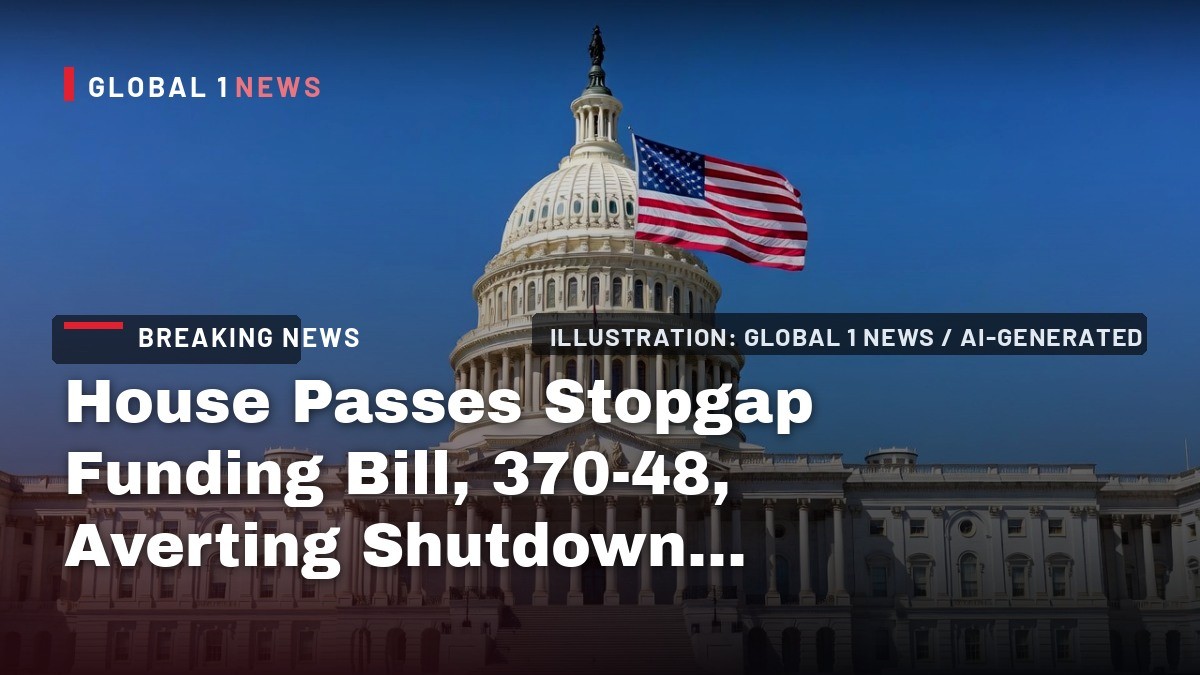
Washington, D.C. — The House of Representatives voted 370-48 on Tuesday to pass a short-term government funding bill, sending the measure to President Trump’s desk and effectively ending the threat of a shutdown before the November 3 midterm elections. The bill funds the federal government through December 11, buying lawmakers roughly 14 more weeks of fiscal breathing room — and, critically, pushing the next funding deadline safely past Election Day.
The vote was a rare, if grudging, display of bipartisanship in a chamber that has spent most of the year at war with itself over spending, immigration, and the scope of executive power. The Senate passed the same measure on August 8 by a 90-6 margin. With the president expected to sign it into law before the fiscal year ends on September 30, the government will keep running — for now.
But make no mistake: This is a Band-Aid, not a cure. Congress has not passed a single one of the 12 full-year appropriations bills required to fund the government for the entire fiscal year. The stopgap, known as a continuing resolution, simply extends current funding levels at a flat rate, with no new programs and no major policy changes. It is the legislative equivalent of hitting the snooze button — and the alarm is set to go off again in December, during a lame-duck session, with a $40 trillion national debt looming and a war with Iran still simmering.
The Vote: Who Voted Yes, Who Voted No, and Why It Matters
The 370-48 tally is striking for what it reveals about the current political landscape. Nineteen Republicans and 29 Democrats opposed the measure, according to the roll call. The lopsided margin underscores how eager both parties were to keep the lights on, at least temporarily.
House Speaker Mike Johnson, a Louisiana Republican, framed the vote as a necessary, if imperfect, step. In a statement following the vote, Johnson said, “House Republicans are in charge here, and we're continuing to do the grown-up thing and make sure we get the job done. And we're happy that we just passed that continuing resolution to fund the government through early December, and then we'll continue through the process after the election. But there will be no government shutdown. You can thank Republicans for our leadership in getting that done.”
The politics here are as transparent as they are predictable. Republicans control the House by a razor-thin margin, and most forecasters believe Democrats have an edge in retaking the chamber in November. A shutdown — with its images of closed national parks, furloughed federal workers, and disrupted services — would have been a political gift to the opposition. Johnson and his leadership team clearly calculated that the risk of a shutdown far outweighed the cost of a temporary funding extension, even one that leaves their policy priorities unaddressed.
For Democrats, the vote was equally strategic. They had leverage — the threat of a shutdown — and they used it to extract a key concession: a delay in the Office of Management and Budget’s new grants-rule directive. That rule, which Democrats argue would give the administration unchecked power to withhold congressionally appropriated funds, has been a flashpoint in the spending wars all summer. The stopgap bill includes a provision delaying its implementation, a win that Democratic leaders were quick to tout.
The Democratic Perspective: A Win on Process, A Warning on Substance
House Democratic Caucus Chair Pete Aguilar of California was blunt about what the vote meant. “Given that the objectives that we had were met, I think that there's going to be broad bipartisan support,” Aguilar said ahead of the vote, pointing to the policy tweaks Democrats had secured in the Senate measure.
Aguilar’s reference to the OMB rule is not academic. The administration has already eliminated the U.S. Agency for International Development (USAID), a move that Democrats and some Republicans have criticized as an overreach of executive power. The grants-rule delay is, in their view, a first line of defense against a broader pattern of the White House treating Congress as an afterthought.
House Appropriations Committee Ranking Member Rosa DeLauro, a Connecticut Democrat, went further, invoking the Constitution itself. “The power of the purse resides within the Congress. It is our exclusive responsibility,” DeLauro said. “The first step in exercising that authority is passing this bill today.”
DeLauro’s words carry weight. She has been the lead Democratic voice on appropriations for years, and she has watched with growing alarm as the administration has sought to consolidate spending authority in the executive branch. The USAID elimination — which the administration carried out without congressional approval — is, in her view, a preview of what could come if Congress fails to assert itself.
The Republican Perspective: A Necessary Evil, Not a Triumph
On the Republican side, the vote was less about enthusiasm and more about damage control. House Appropriations Committee Chairman Tom Cole, an Oklahoma Republican, acknowledged the reality of the situation in a floor speech before the vote. “This will give Congress time to get past the November elections,” Cole said.
Cole’s framing is telling. He did not defend the stopgap as a policy achievement. He defended it as a tactical retreat. The Republican conference is deeply divided between fiscal hawks who want steep spending cuts and defense hawks who want to boost military funding. The stopgap punts on both fronts, keeping the Pentagon at fiscal year 2026 levels with no new programs — a compromise that satisfies no one fully but offends everyone equally.
There is also the matter of military pay. By keeping the government open, the measure prevents a repeat of last year, when a shutdown put paychecks for U.S. troops in doubt — Congress would have needed to act by early in a shutdown to ensure service members' checks were not delayed. Keeping the military paid is one of the most politically sensitive consequences of any funding lapse.
Historical Context: A Pattern of Shutdowns and Near-Misses
To understand why this vote matters, it helps to look back at the recent history of government funding fights. During President Trump’s second term, the country endured three partial shutdowns totaling 161 days. The longest of those — a 43-day record-breaker — was triggered by a standoff over Affordable Care Act subsidies. That shutdown, which happened last year, became a symbol of the dysfunction that has come to define Washington’s approach to budgeting.
There was also the Department of Homeland Security funding fight, which erupted after the killings by federal agents of two U.S. citizens in Minneapolis during an intensive immigration enforcement drive. That dispute, which centered on immigration policy, brought the government to the brink of a shutdown before a last-minute deal was reached. The scars from those battles are still fresh, and they inform the caution that both parties displayed this week.
More recently, in July, the House passed a continuing resolution that Democrats rejected outright over immigration guardrails. That bill, which would have tied funding to stricter border enforcement measures, was a non-starter for the Democratic caucus. The fact that this September bill passed with overwhelming Democratic support — despite the OMB rule delay being the only major concession — suggests that both sides have learned something from the July failure: that a shutdown is a lose-lose proposition, especially with an election looming.
What’s Not in the Bill: The Unfinished Business
It is worth pausing to note what this bill does not do. It does not fund the government for the full fiscal year. It does not address the $40 trillion national debt, which continues to grow at an unsustainable pace. It does not tackle affordability concerns — the cost of housing, healthcare, and groceries that voters consistently cite as their top issues. And it does not resolve the ongoing war with Iran, which has already stretched the military and strained the budget.
The Pentagon, as noted, will operate at fiscal year 2026 levels, with no new programs authorized. That means no new weapons systems, no new troop increases, and no new modernization initiatives. For defense hawks in both parties, this is a bitter pill. For fiscal hawks, it is a missed opportunity to force spending cuts. The result is a bill that is, in the truest sense of the word, a placeholder.
The OMB grants-rule delay is the one substantive policy change, and even that is temporary. The rule will be delayed, not repealed. The fight over its ultimate fate will resume in December, when the lame-duck Congress will have to confront the full-year appropriations bills — all 12 of them — in a compressed timeframe, with a new Congress waiting in the wings.
Analysis: The Midterm Stakes and the December Lame-Duck Fight
Here is the political reality: The November 3 midterms are now the dominant force in every calculation on Capitol Hill. Most forecasters believe Democrats have an edge in retaking the House, and there is a real possibility of Senate gains as well. That means the December lame-duck session could be the last chance for the current Republican majority to shape the budget — or it could be a preview of a new Democratic majority’s priorities.
For Republicans, the strategy is clear: avoid a shutdown at all costs, get through the election, and then use the lame-duck session to push for as many conservative wins as possible before the new Congress is sworn in. For Democrats, the strategy is equally clear: use the threat of a shutdown as leverage to protect the OMB rule delay, push back on the administration’s spending authority, and position themselves for a majority that can write the next full-year budget on their own terms.
The $40 trillion debt looms over all of this. Neither party has shown a willingness to tackle entitlement reform or major spending cuts in an election year. The affordability crisis — the sense among ordinary Americans that the economy is not working for them — is a live wire that both parties are tiptoeing around. And the war with Iran, which has already cost billions and shows no signs of ending, adds a layer of unpredictability to every budget projection.
In other words, the December fight will be messier, more consequential, and far more difficult than the one that just ended. This week’s vote was the easy part. The hard part is still ahead.
The Bottom Line: A Temporary Truce, Not a Peace Treaty
The 370-48 vote is a testament to the power of political self-preservation. Both parties looked at the alternative — a shutdown that would have dominated the news cycle for weeks, disrupted the lives of millions of Americans, and handed the other side a cudgel to wield on the campaign trail — and blinked. That is not courage. That is calculation.
But calculation is not the same as governance. The government is funded through December 11, but the underlying disputes over spending, immigration, executive power, and the role of Congress have not been resolved. They have been deferred. The OMB rule delay is a temporary reprieve, not a settlement. The USAID elimination remains a live controversy. The 12 full-year appropriations bills remain unwritten.
President Trump is expected to sign the bill into law in the coming days, and the immediate crisis will pass. But the clock is already ticking toward December 11. The lame-duck session will be a pressure cooker, with a new Congress on the horizon and a long list of unresolved issues on the table. The question is not whether there will be another fight. The question is whether the next one will end as peacefully as this one did.
For now, the government stays open. Federal workers can keep their jobs. The military will be paid. And the politicians can go back to campaigning, at least for a few more weeks. But the underlying dysfunction that produced this stopgap — and the three shutdowns before it — remains fully intact. This was a truce, not a peace treaty. And in Washington, truces have a way of breaking down.
By Jessica Ali, Staff Writer
This article was produced with AI-assisted research and editorial support. Sources: AP News, ABC News, The Guardian, Reuters via Military Times.
What's Your Reaction?
 Like
0
Like
0
 Dislike
0
Dislike
0
 Love
0
Love
0
 Funny
0
Funny
0
 Wow
0
Wow
0
 Sad
0
Sad
0
 Angry
0
Angry
0

Editor-in-Chief at Global1.News. Atlanta-based journalist who cuts through the BS and tells it like it is. Lead anchor, host, and the voice you hear when the spin stops and the truth starts.













Comments (0)