
Japan and South Korea’s Nuclear Realignment Reshapes Northeast Asian Security
The nuclear landscape of Northeast Asia is undergoing its most significant transformation since the 2011 Fukushima Daiichi disaster. Japan, which once shuttered its entire reactor fleet in the wake of the meltdown, is now aggressively repositioning atomic energy as a cornerstone of national industrial policy and regional security architecture.
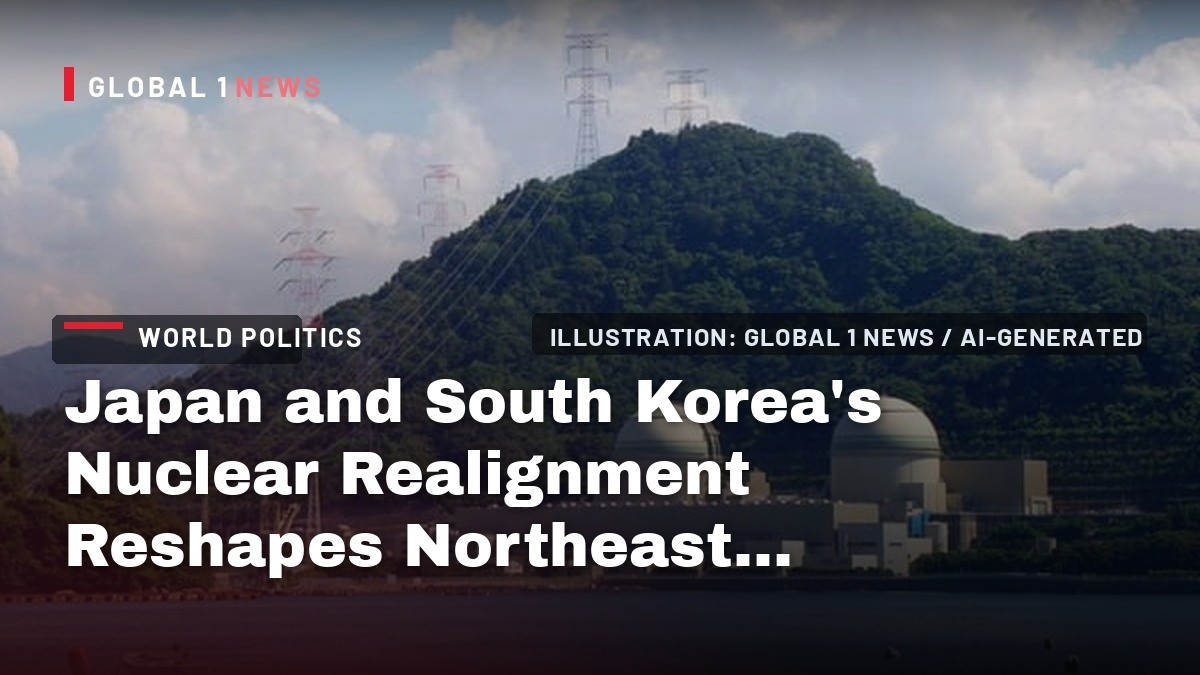
The nuclear landscape of Northeast Asia is undergoing its most significant transformation since the 2011 Fukushima Daiichi disaster. Japan, which once shuttered its entire reactor fleet in the wake of the meltdown, is now aggressively repositioning atomic energy as a cornerstone of national industrial policy and regional security architecture. South Korea, despite a change in government that initially signaled a retreat from nuclear power, has reversed course with remarkable speed, embracing reactor exports and domestic expansion as twin pillars of economic strategy. What emerges is a picture of two rivals moving in parallel, increasingly synchronized with Washington, as energy policy becomes inseparable from the trilateral security framework binding the United States, Japan, and South Korea. Yet beneath this political momentum lies a persistent, unresolved challenge: the accumulating stockpiles of spent nuclear fuel with no permanent disposal site in either country. This gap, long ignored in policy circles, threatens to undermine the very credibility of the nuclear revival now sweeping the region.
From Fukushima Paralysis to Strategic Necessity
The trajectory of Japan’s nuclear policy over the past fifteen years offers a study in political and economic recalibration. Before the March 2011 earthquake and tsunami triggered the meltdown at Fukushima Daiichi, nuclear power supplied roughly 30 percent of Japan’s electricity. In the immediate aftermath, every commercial reactor in the country was taken offline, and public opinion turned decisively against the technology. What followed was more than a decade of heavy dependence on imported liquefied natural gas and coal, a burden that Japan, which imports approximately 90 percent of its primary energy, could not sustain indefinitely. The tightening of global gas markets following Russia’s invasion of Ukraine in 2022 made this vulnerability acute, providing the economic justification for a policy reversal that had been building for years. The formal return to nuclear power began with Prime Minister Kishida Fumio’s Green Transformation (GX) policy, launched in 2022. The GX Basic Policy, approved by the Cabinet in February 2023, committed the government to restarting reactors already cleared by regulators and to developing next-generation designs. The Seventh Strategic Energy Plan, approved by the Cabinet in February 2025 alongside the GX2040 Vision, cemented this shift as permanent government policy rather than a temporary emergency measure. The most tangible result came in early 2026 with the restart of Unit 6 at Tokyo Electric Power Company’s Kashiwazaki-Kariwa plant, the world’s largest nuclear facility by capacity. The symbolic weight of this restart cannot be overstated: Kashiwazaki-Kariwa is operated by the very company responsible for the Fukushima disaster. A decade ago, such a move would have been politically unthinkable. The motivations extend beyond energy security into industrial competitiveness. New public funding for data center and semiconductor facilities, worth over a trillion yen, now requires that the electricity used come entirely from renewable or nuclear sources. This requirement sends an unambiguous signal that Tokyo regards nuclear energy as indispensable to its industrial policy, not merely as a tool for decarbonization. The fusion of energy policy with technological ambition represents a fundamental shift in how Japan views its atomic assets.Seoul’s Reversal: From Skepticism to Export Ambition
South Korea’s journey has been equally dramatic, though it began from a different political starting point. President Lee Jae-myung took office in June 2025 after campaigning on skepticism toward nuclear power, arguing that the technology was inherently dangerous and that the country’s reactor-heavy generation mix required re-examination in favor of renewables. This stance reflected a longstanding divide in Korean politics, where nuclear energy has historically been associated with rapid industrialization and, more recently, with export-led growth strategies championed by conservative administrations. Seven months into his term, however, Lee’s government reversed course. Confronted with polling showing strong public support for nuclear energy and surging electricity demand driven by an AI-focused data center boom, Seoul confirmed it would proceed with two new large reactors under the 11th Basic Plan for Electricity Supply and Demand. This plan targets a nuclear share of nearly 32 percent by 2030 and over 35 percent by 2038. In August 2026, the government went further, naming small modular reactors and nuclear fusion among seven technologies it wants to establish as future growth engines for the South Korean economy. The reversal reflects a pragmatic recognition that nuclear power is not merely an energy source but a strategic export industry. Korean reactor technology has become competitive with Western vendors, as demonstrated by Korea Hydro & Nuclear Power’s contract to build two APR-1000 reactors in Dukovany, Czechia, a deal worth roughly $18.6 billion. The company has since signed cooperation agreements covering nuclear development in the Philippines, small-reactor studies with Singapore, and full fuel-cycle cooperation with France’s Orano. South Korea, which imports roughly 90 percent of its own energy needs and around 30 percent of its low-enriched uranium from Russia, treats nuclear exports and domestic energy security as two sides of the same policy coin. The Lee government’s pivot illustrates how structural economic pressures can override ideological commitments, a dynamic familiar to students of Korean policy-making.The Trilateral Nuclear Compact
The most consequential development in this realignment came in July 2026, when nuclear energy formally became an area of trilateral cooperation between the United States, Japan, and South Korea. The three countries agreed to jointly develop and export small modular reactors across the Indo-Pacific, explicitly extending their trilateral security partnership into commercial nuclear cooperation. This move represents a significant expansion of the Camp David framework established in 2023, which had focused primarily on security consultations and crisis coordination. Washington’s interest in this arrangement is clear. With Russia and China serving as the only realistic nuclear vendors for many developing countries, the United States has a strategic interest in ensuring that its two Northeast Asian allies enter the race as credible alternatives. It would benefit Washington if Japan and South Korea, rather than Beijing or Moscow, become the default suppliers of reactor technology to the rest of the region. This is not merely a commercial calculation but a geopolitical one, aimed at limiting Chinese and Russian influence in Southeast Asia, the Pacific Islands, and beyond. For Tokyo and Seoul, folding nuclear commerce into the trilateral security relationship offers insurance against an awkward structural constraint: both countries’ export ambitions still run through Washington’s non-proliferation rules. In South Korea’s case, the 123 Agreement governing nuclear cooperation with the United States imposes specific conditions on the transfer of nuclear materials and technology. By embedding nuclear exports within the trilateral framework, both allies gain a measure of predictability and political cover that bilateral negotiations might not provide. The arrangement effectively makes Washington a partner in, rather than a gatekeeper of, their export strategies.Export Asymmetry and Domestic Constraints
Despite the trilateral alignment, a significant asymmetry persists between Japan and South Korea in their nuclear export capabilities. Japan’s export potential remains constrained precisely because its domestic restart is still incomplete. Barely a handful of reactors are back online out of the roughly three dozen that existed before 2011. This limited operational base undermines Japan’s credibility as a reactor vendor, as potential buyers may question whether Tokyo can sustain the regulatory expertise, supply chains, and operational experience necessary to support foreign deployments. South Korea, by contrast, has maintained a more consistent domestic nuclear program, even during periods of political opposition. This continuity has allowed Korean firms to develop a track record of successful exports, from the Barakah plant in the United Arab Emirates to the recent Czechia contract. For now, South Korea stands as the more credible reactor exporter of the two, a position that carries both economic benefits and diplomatic weight. The trilateral SMR initiative may eventually narrow this gap, but it will take years for Japan to rebuild the operational and industrial capacity that atrophied during its nuclear hiatus. The asymmetry also has implications for the trilateral partnership itself. If South Korea emerges as the primary exporter while Japan remains a junior partner, the balance of influence within the trilateral framework could shift. Seoul may leverage its nuclear export success to gain greater voice in regional security discussions, while Tokyo seeks to accelerate its domestic restarts to reclaim parity. These dynamics will shape the evolution of trilateral cooperation in ways that extend well beyond energy policy.The Unresolved Waste Dilemma
What the restart narrative tends to omit is that neither country has solved the problem of spent fuel disposal. Japan has no operating deep geological repository and no site formally designated to host one. The Horonobe Underground Research Laboratory, where engineers are testing geological disposal methods hundreds of meters below the surface, remains a research site rather than a functioning repository. The used fuel accumulating at reactor sites, including at the restarted Kashiwazaki-Kariwa plant, has nowhere permanent to go. South Korea faces the same challenge, with domestic opposition to any proposed storage site consistently more intense than opposition to reactors themselves. This gap matters profoundly for the trilateral SMR push. Exporting reactor technology to Southeast Asia or the Pacific Islands without a credible regional answer on waste management invites the same criticism that has dogged nuclear power at home in both countries: that the industry is better at building political consensus for new construction than for dealing with what construction leaves behind. For developing countries considering nuclear adoption, the waste question is not an abstract concern but a practical one that affects public acceptance and long-term liability. The failure to address waste disposal also creates a vulnerability that China and Russia could exploit in their own nuclear diplomacy. By highlighting the unresolved waste problem in Japan and South Korea, Beijing and Moscow could undermine the credibility of trilateral nuclear exports while positioning their own offerings as more complete solutions. The trilateral partners have yet to articulate a coherent regional waste management strategy, leaving a significant gap in their otherwise ambitious agenda.Strategic Implications for Northeast Asia
The nuclear realignment now underway in Northeast Asia represents a convergence of energy security, industrial competitiveness, and geopolitical alignment. For Japan, the return to nuclear power is a response to structural energy vulnerabilities exposed by the Ukraine war and a recognition that advanced industrial economies require reliable, low-carbon baseload power. For South Korea, the pivot reflects both domestic electricity demand and the strategic value of nuclear exports as a tool of economic statecraft. For Washington, the trilateral nuclear compact extends the security alliance into a new domain, countering Chinese and Russian influence in global energy markets. Yet the unresolved waste question casts a long shadow over these developments. The political momentum behind nuclear restarts and exports has outpaced the technical and political solutions needed for spent fuel management. Until Japan and South Korea confront this issue directly, their nuclear revival will remain incomplete, vulnerable to domestic opposition and international criticism. The region’s energy future may ultimately be determined not by the reactors that are built or the export deals that are signed, but by what happens to the waste those reactors produce. That question, still unanswered at Horonobe and in the policy corridors of Tokyo and Seoul, may end up mattering as much to Northeast Asia’s security landscape as any restart or trilateral agreement announced so far.This article was produced with AI-assisted research and editorial support. Sources: The Diplomat (September 2, 2026).
By Prof. David Park, Staff Writer
What's Your Reaction?
 Like
0
Like
0
 Dislike
0
Dislike
0
 Love
0
Love
0
 Funny
0
Funny
0
 Wow
0
Wow
0
 Sad
0
Sad
0
 Angry
0
Angry
0

Prof. David Park
East Asia/Technology Correspondent at Global1.News. Seoul-based voice covering Korean politics, technology, business, and culture. Analyzes how technology and geopolitics intersect across East Asia.











Comments (0)