
Hong Kong Gold Imports Cool as Mainland Giants Build Vaults
Hong Kong gold imports fell 18% in July to about 107 tonnes as mainland giants SF Express and ICBC race to build bullion vaults, betting on the city's rise as Asia's gold hub at a time of record prices near US$4,630 an ounce.
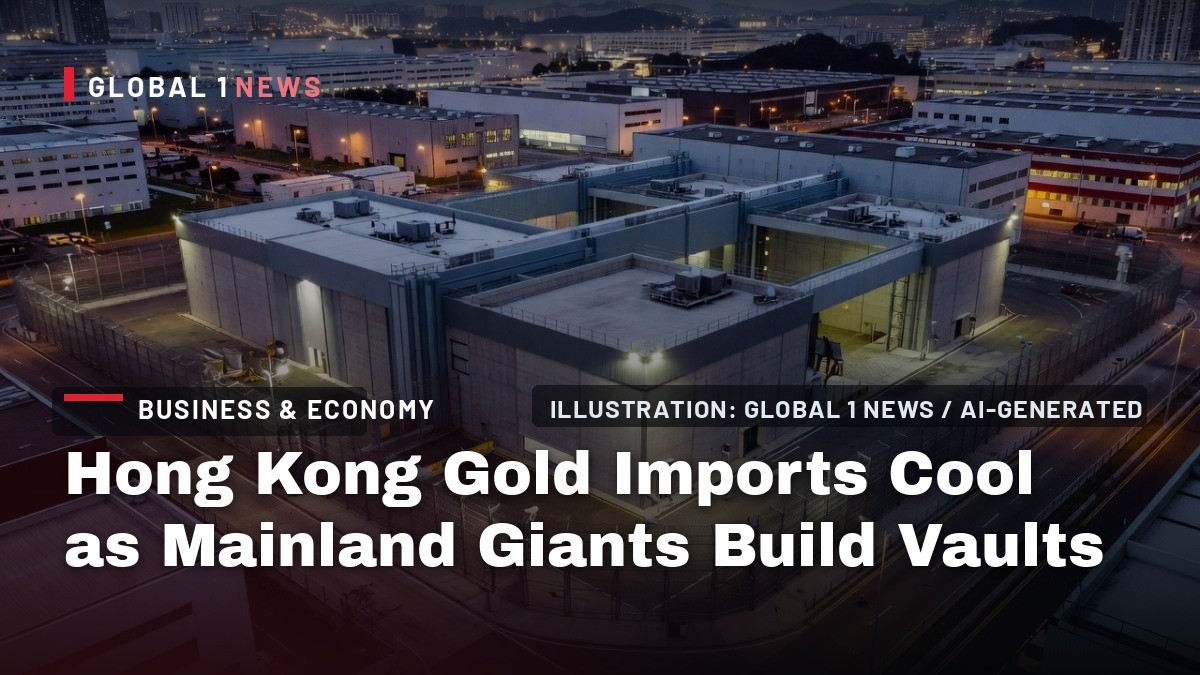
Mainland Giants Rush to Build Bullion Vaults as Gold Flows Cool
Gold flows into Hong Kong eased to about 107 tonnes in July, a month after banks stockpiled bullion at a decade-high pace, even as mainland Chinese corporate giants accelerate construction of new vaults across the city. The divergent moves underscore Hong Kong's push to become Asia's premier gold hub, with logistics group SF Express and state-owned banking behemoth Industrial and Commercial Bank of China (ICBC) among the players betting on physical storage capacity.
The city's non-monetary gold imports fell about 18 per cent from June, when shipments hit a decade high as banks built inventory ahead of the trial launch of Hong Kong's new gold clearing and settlement system on July 7, according to data from Hong Kong's Census and Statistics Department reported by the South China Morning Post. The value of shipments declined to HK$114.71 billion (US$14.63 billion) from HK$142.02 billion in June.
Tags: Hong Kong, Gold Imports, Bullion Vaults, SF Express, ICBC, HKGXTS, Gold Clearing, China Gold Demand, Gold Price, Asia Gold Hub, Gold, Precious Metals, Hong Kong Gold Hub, Gold Consumption
July Imports Slip 18 Per Cent After June Stockpiling Spree
"Import demand related to stocking has started to stabilise since the gold inventory build-up was largely completed in June," said Ming Lam, councillor of the Greater China Division of CPA Australia. "Investors and traders may rebalance their overall investment portfolios, including their positions in gold."
Even with the monthly correction, demand remains strong relative to earlier in the year. February imports stood at just 72.16 tonnes, making July's total roughly 48 per cent higher. The pattern suggests institutional appetite for Hong Kong-based gold storage has not faded, but simply normalised after a concentrated pre-launch build-up tied to the clearing system debut.
Mainland China's net gold imports via Hong Kong rose about 11 per cent in July from a month earlier to 56.193 tonnes, a 28 per cent increase compared with the same period in 2025, official data showed. The inflow continues despite Beijing's own promotion of domestic trading venues, a sign that Hong Kong's international market infrastructure retains a distinct role in the world's largest gold-consuming nation.
The composition of mainland demand is shifting toward investment-grade bullion. Gold bars and coins drove the first-half consumption increase, while gold jewellery demand fell sharply to 132 tonnes, a 34 per cent decline, according to China Gold Association data reported in August. That tilt mirrors patterns seen in Japan, where households have favoured bars over ornaments as prices climb, and reinforces the case for vault and logistics investment rather than jewellery retail expansion.
SF Express and ICBC Bet on Hong Kong Vault Capacity
The infrastructure race is visible well beyond the trading floor. SF Express, China's largest courier, is setting up a gold vault in Tsing Yi this year, according to a government registry provided to the South China Morning Post. ICBC, the mainland's largest state-owned lender by total assets, is also developing a precious-metals storage facility in the city.
Banks and logistics companies are moving to secure physical storage capacity as shipments of the precious metal expand, betting that Hong Kong's strategic ambition to become Asia's bullion hub will translate into sustained demand for secure warehousing. The vault build-out echoes similar infrastructure investments in Singapore, positioning the two Asian financial centres in a quiet competition for institutional gold flows.
Clearing System and HKGXTS Deepen Market Infrastructure
Hong Kong's newly introduced gold clearing and settlement system, which began a trial on July 7, has established a framework for transferring static gold holdings. Industry players say that while still in its early stages, the system could boost regional liquidity and streamline operations, helping institutions manage both physical and financial gold exposure.
The infrastructure push continued on August 18, when Hong Kong Gold Exchange Trading System Limited (HKGXTS) officially announced its establishment, jointly formed by the Hong Kong Gold Exchange (HKGX) and TGX Technology Limited, with core technical support from Hundsun Technologies and Alibaba Cloud. The joint venture aims to develop Hong Kong's gold trading systems and related fintech infrastructure, combining physical bullion trading with modern clearing and cloud technology.
Gold's Rally and the Dollar Factor
The market backdrop for these investments has rarely been more favourable. Gold prices traded higher at about US$4,630 an ounce on Thursday after the US Treasury announced last week that it would at least double the size of its liquidity-support buy-back operations for long-dated bonds, fuelling concerns about the erosion of the US dollar's purchasing power. Spot gold hovered near a three-month high, supported by a weaker dollar and the buy-back plans.
China's consumption side tells a similar story. Total gold consumption reached 511.41 tonnes in the first half of 2026, up 1.23 per cent year on year, according to data published in August by the China Gold Association. The nation became the world's largest gold consumer in 2013 and has since consumed about five times that of the United States, three times that of Europe and nearly double all other emerging markets combined, S&P Global Ratings reported in August.
Japan's Gold Market: Record Yen Prices and Retail Demand
The bullion trend has a distinct Japanese dimension. Tanaka Kikinzoku, whose daily retail gold price serves as the benchmark for Japanese consumers, set a record high of 24,414 yen per gram in December 2025, with retail prices continuing to climb through 2026 as the yen's persistent depreciation and rising inflation push Japanese households toward gold as a store of value. Surging prices prompted Japanese retail investors to rush into gold bars, at times overwhelming supply of smaller denominations.
For Japanese institutions, Hong Kong's deepening gold infrastructure offers an additional channel to manage bullion exposure closer to the region's consumption centres. Family offices across Hong Kong and Singapore have shown growing interest in gold trading, said William Chow, deputy group chief executive officer at Raffles Family Office, reflecting a broader Asian shift toward gold as a strategic allocation amid currency and geopolitical uncertainty. Japanese retail demand, meanwhile, shows few signs of abating: with the yen still trading near multi-decade lows against the dollar, domestic gold prices in yen terms remain near record territory, sustaining the incentive for households to hold bullion as a hedge.
What to Watch For
Look for three signals in the coming months. First, whether the Hong Kong clearing and settlement system moves beyond its trial phase into full operation, and how quickly HKGXTS delivers its next-generation platform. Second, whether mainland vault construction accelerates into 2027, which would signal sustained institutional conviction rather than a one-off stocking cycle. Third, how gold's rally interacts with central bank policy on both sides of the Pacific, including any further US Treasury buy-back expansion and the Bank of Japan's rate path.
JPMorgan's Vikas Gupta, head of Trading, Asia Currencies and Emerging Markets, captured the stakes: a "vibrant gold trading system in Asia, including inventory, futures and repos, could influence prices in London and New York." For Asia-Pacific investors, the message is that Hong Kong is no longer merely a transit point for bullion, but an emerging pricing and storage hub whose infrastructure decisions will shape how gold moves through the region for years to come.
By Kenji Tanaka, Staff Writer
This article was produced with AI-assisted research and editorial support. Sources: South China Morning Post, CNBC, Hong Kong Gold Exchange, China Gold Association, S&P Global Ratings.
What's Your Reaction?
 Like
0
Like
0
 Dislike
0
Dislike
0
 Love
0
Love
0
 Funny
0
Funny
0
 Wow
0
Wow
0
 Sad
0
Sad
0
 Angry
0
Angry
0

Japan Correspondent at Global1.News. Tokyo-based voice covering Japanese politics, technology, economy, and culture. Tracks the intersection of tradition and innovation in one of the world's most dynamic societies.













Comments (0)