
China Tightens Export Controls on Drone Parts Used by Russia
China’s recent decision to tighten export controls on drone components marks a significant shift in the supply chain that fuels Russia’s use of Iranian‑designed Shahed attack drones.
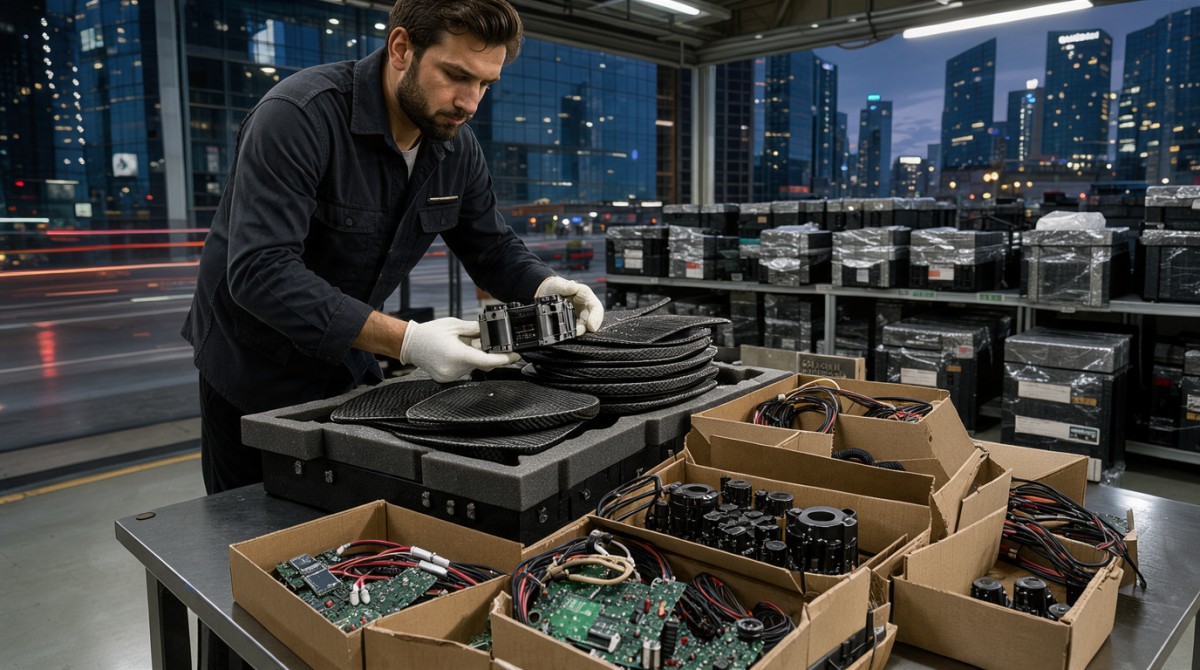
China’s recent decision to tighten export controls on drone components marks a significant shift in the supply chain that fuels Russia’s use of Iranian‑designed Shahed attack drones. The move, announced by the Ministry of Commerce and timed to coincide with President Vladimir Putin’s visit to Shenzhen, reflects Beijing’s growing awareness of the geopolitical fallout from its technology transfers to Moscow. While the restrictions target specific engines, radio modules, speed controllers and electric motors, the broader implications touch on the Kremlin’s reliance on Chinese hardware, the evolving dynamics of the Ukraine war, and the diplomatic tightrope Beijing walks between Moscow, Washington and the European Union.
Scope of the new Chinese export controls
The Commerce Ministry’s notice requires exporters to obtain licences for a defined list of drone parts, including certain engines, radio modules, speed controllers and electric motors. These items are classified as dual‑use technology, meaning they have both civilian and military applications. The controls took effect on the Wednesday of Putin’s Shenzhen visit, signalling a direct policy response rather than a gradual adjustment.
According to Ukrainian officials, the list captures components used in the Shahed drones assembled at Russia’s Alabuga facility in Tatarstan. This plant, a key node in Moscow’s drone production network, integrates Chinese‑sourced engines into the Iranian‑designed airframes. By targeting the engines and related subsystems, Beijing aims to disrupt a critical segment of the supply chain without halting all Chinese‑Russian trade.
Ukraine’s reaction and expectations
Vladyslav Vlasiuk, Ukraine’s presidential sanctions commissioner, publicly welcomed the new controls, thanking Beijing for “rigorous control of these exports.” He emphasized that Kyiv had supplied detailed information on the components and their Chinese manufacturers, indicating a coordinated intelligence effort between the two allies.
Nevertheless, Vlasiuk warned that some critical components remain outside the current licensing regime. He did not specify which parts are exempt, but the implication is that Russia can still source certain elements of its Shahed drones from China, preserving a degree of operational capability.
China’s strategic calculus
The timing of the controls, coinciding with high‑level talks between Putin, Xi Jinping and U.S. President Donald Trump, suggests a calculated diplomatic gesture. By imposing licences, Beijing signals a willingness to temper its support for Moscow in response to international pressure, particularly from the United States, while preserving core economic ties.
European Union officials, as reported by Bloomberg, are aware of China’s provision of dual‑use technology and satellite intelligence to Russia. However, EU reluctance to sanction Beijing stems from concerns over possible retaliation, indicating that Beijing’s leverage over Moscow is a factor in its broader foreign‑policy calculations.
Russia’s growing dependence on Chinese technology
Bloomberg’s analysis, based on unpublished data, shows that Russia now obtains nearly 90 % of critical drone components from China, up from 80 % a year earlier. This sharp increase underscores Moscow’s pivot toward Beijing as Western sanctions tighten around its defence industry.
The Alabuga facility’s reliance on Chinese‑made engines illustrates this dependency. As Western export restrictions limit Russia’s access to traditional sources of aerospace parts, Chinese suppliers have filled the gap, enabling continued production of Shahed drones that have become a staple of Russia’s low‑cost aerial assault strategy.
Implications for the Shahed drone programme
Shahed drones, originally designed in Iran, have been adapted by Russia for use in Ukraine, where they conduct loitering‑missile attacks against infrastructure and troop concentrations. The Chinese‑sourced engines are a vital component, providing the thrust needed for the drones’ extended flight times.
By restricting licences for these engines, China may force Russia to seek alternative suppliers or to develop domestic replacements, a process that could delay production and reduce the operational tempo of Shahed attacks. However, the continued availability of other components outside the licence list means that a complete halt is unlikely.
Broader geopolitical ramifications
The export controls illustrate the increasingly complex triangular relationship among China, Russia and the United States. While Beijing seeks to avoid direct confrontation with Washington, it also wishes to maintain a strategic partnership with Moscow that counters Western influence.
For the United States, the move offers a diplomatic win, as it aligns Chinese policy with Western objectives to curb Russia’s drone capabilities. Yet the partial nature of the controls leaves room for Moscow to adapt, highlighting the limits of external pressure on a supply chain that can be partially rerouted.
Future outlook and potential developments
Looking ahead, the effectiveness of China’s new licensing regime will depend on enforcement rigor and the ability of Russian manufacturers to source replacements. Kyiv’s hope, expressed by Vlasiuk, is that Beijing will enforce the licences strictly, thereby tightening the bottleneck on Shahed drone production.
Should China expand the list of controlled items, or should the EU and the United States coordinate further sanctions on Chinese firms, the pressure on Russia’s drone programme could intensify. Conversely, if Russia accelerates domestic development of engine technology, the impact of the current controls may be mitigated, preserving its capacity to field Shahed drones in the Ukrainian theatre.
This article was produced with AI-assisted research and editorial support. Reporting is based on the source material cited below. Sources: The Moscow Times; themoscowtimes.com; Global1.News (23 November 2026).
By Irina Volkov, Staff Writer
What's Your Reaction?
 Like
0
 Dislike
0
 Love
0
 Funny
0
 Wow
0
 Sad
0
 Angry
0
Russia/Eastern Europe Correspondent at Global1.News. Covering Russian politics, energy, security, and the shifting dynamics of the post-Soviet space. Provides clear-eyed analysis on one of the world's most opaque regions.















Comments (0)