
HBCSE Opens Chemistry Olympiad Exposure Camp 2026 For Teachers
India's chemistry teaching community has a new opportunity to sharpen its pedagogical edge, as the Homi Bhabha Centre for Science Education (HBCSE) opens registrations for its Chemistry Olympiad Exposure Camp 2026, scheduled for November 16-19 in Mumbai.
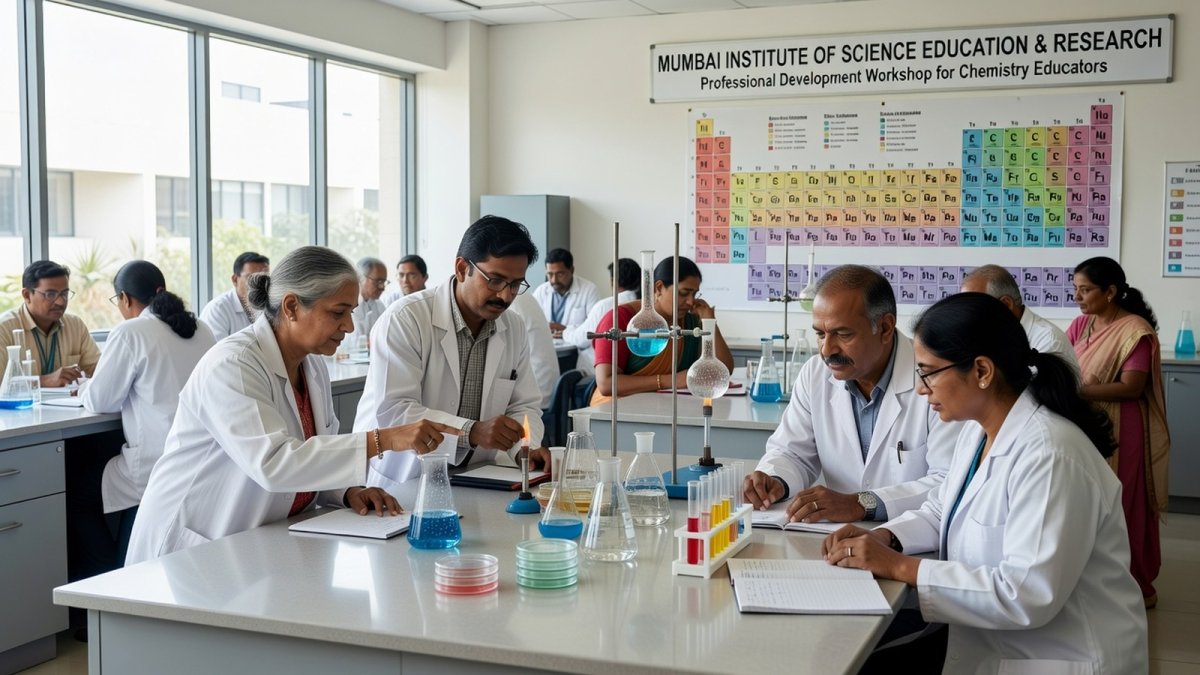
India's chemistry teaching community has a new opportunity to sharpen its pedagogical edge, as the Homi Bhabha Centre for Science Education (HBCSE) opens registrations for its Chemistry Olympiad Exposure Camp 2026, scheduled for November 16-19 in Mumbai. The announcement comes on the heels of India's historic performance at the 58th International Chemistry Olympiad (IChO) in Tashkent, where the nation secured four gold medals and a joint Rank 1 — a feat that underscores the growing importance of teacher capacity building in the country's science education ecosystem.
HBCSE Opens Chemistry Olympiad Teacher Camp 2026
New Delhi, India – August 17, 2026 — The Homi Bhabha Centre for Science Education (HBCSE), a National Centre of the Tata Institute of Fundamental Research (TIFR), Mumbai, has invited applications from junior college and high school chemistry teachers for its fourth Chemistry Olympiad Exposure Camp, to be held from November 16-19, 2026. The application window closes on September 11, 2026, with selected participants announced by September 18, 2026.
A Nodal Centre's Strategic Move
HBCSE, funded by the Government of India through the Department of Atomic Energy, serves as the country's nodal agency for Olympiad programmes across Mathematics, Physics, Chemistry, Biology, and Astronomy. The Centre's mandate extends beyond student training; it explicitly aims to promote equity and excellence in science and mathematics education from primary school to undergraduate level. This teacher-focused camp is a direct extension of that mandate, targeting educators who teach chemistry from Class X to XII in schools or junior colleges recognized by state or central government education boards.
The camp's design is deliberately intensive. Selected teachers will receive past Olympiad problems from the Indian programme in advance, with a requirement that each participant solve at least one problem and reflect on its pedagogical dimensions before arriving in Mumbai. During the four-day residential programme at HBCSE's Mankhurd campus, sessions will dissect these problems from both content and pedagogical perspectives, drawing on the Centre's two decades of experience in running the Olympiad pipeline from the Indian National Chemistry Olympiad (INChO) to the international team selection.
Why Teacher Training Matters Now
The timing of this camp is not coincidental. In July 2026, India achieved its best-ever performance in 27 appearances at the IChO, winning four gold medals in Tashkent, Uzbekistan, and securing a joint Rank 1 alongside China, Vietnam, and an individual participant from Russia. Among the winners was Kabeer Chhillar, who also topped JEE Advanced 2026 with an All India Rank 1. This dual achievement — excellence in both board-level competitive exams and international Olympiads — signals a maturation of India's science talent pipeline.
However, HBCSE officials emphasize that the Olympiad programme is as challenging for teachers as it is for students. Designing unconventional problems and guiding students through them requires engagement with chemistry at historical, philosophical, practical, and conceptual levels. The exposure camp is designed to share these learnings, enriching teachers' conceptual understanding and, by extension, their classroom pedagogy. This is not a theoretical exercise; the 2025 edition of the camp, held from November 25-28, shortlisted approximately 40 teachers from across the country through a competitive application process.
From Jamshedpur to Mumbai: A Case Study
Ms. Rajani Kumari, Senior Chemistry Teacher at Loyola School, Bistupur, Jamshedpur, Jharkhand, was among the 2025 cohort. Since returning from the camp, she has integrated its methodologies into her school's teaching-learning process, adapting the problem-solving culture of the Olympiad for her regular classrooms. Her experience illustrates the camp's multiplier effect: one trained teacher can influence hundreds of students over a career, particularly in regions outside metropolitan India where access to such advanced pedagogical resources is limited.
The selection process prioritizes new applicants over past participants, ensuring a wider diffusion of the training across the country. This rotation strategy is deliberate — it prevents the concentration of expertise in a handful of elite institutions and spreads the Olympiad approach to state-board schools and junior colleges that may not traditionally produce IChO medalists.
Financial and Logistical Support: Removing Barriers
HBCSE has structured the camp to minimize financial barriers for participating teachers. Selected participants receive reimbursement for to-and-fro travel fare up to a maximum of II-AC train fare. For those traveling by air, tickets must be purchased exclusively through IRCTC or M/s Balmer & Lawrie; other travel portals like MakeMyTrip, Cleartrip, Yatra, Goibibo, and Ixigo are explicitly disallowed. Even for air travel, only the II-AC fare equivalent is reimbursed, contingent on producing tickets from the approved agencies and boarding passes.
Food and accommodation at the HBCSE Guest House are provided for the duration of the camp, though only for participants — not accompanying family members. This logistical clarity, while strict, ensures that public funds are used efficiently and that the maximum number of teachers can benefit from the programme within the available budget.
NEP 2020 and the Teacher Professional Development Imperative
The camp aligns directly with the National Education Policy (NEP) 2020's emphasis on continuous professional development (CPD) for teachers. NEP 2020 mandates that every teacher undergo at least 50 hours of CPD annually, with a focus on pedagogical innovation, subject matter expertise, and the use of experiential learning. The HBCSE camp, though shorter than the annual CPD requirement, offers a concentrated dose of exactly the kind of high-quality professional development the policy envisions.
Moreover, the camp's focus on problem-solving culture resonates with NEP's push toward competency-based education and the reduction of rote learning. The Olympiad approach — which presents challenging problems in experimental and theoretical areas — is a practical demonstration of how Indian classrooms can shift from memorization to conceptual understanding. Teachers who internalize this approach are better equipped to implement NEP's pedagogical reforms at the grassroots level.
Equity and the Reach of the Olympiad Ecosystem
HBCSE's broader Olympiad ecosystem, which includes the National Initiative on Undergraduate Sciences (NIUS), has historically drawn talent from across India's socio-economic spectrum. The teacher camp extends this equity mandate. By explicitly welcoming teachers from state-board schools and junior colleges — not just elite CBSE or ICSE institutions — HBCSE ensures that the benefits of Olympiad-style pedagogy reach students who may never compete at the national level but will nonetheless benefit from improved teaching.
The application process is merit-based but not exclusionary. Teachers employed in schools or junior colleges recognized by state or central government education boards are eligible, which covers the vast majority of India's secondary and higher secondary institutions. The September 11, 2026 deadline and September 18, 2026 selection announcement provide a tight but manageable timeline for teachers to prepare their applications and, if selected, to work through the pre-camp problem sets.
Implications for India's Science Pipeline
The connection between teacher training and India's improving IChO performance is not merely correlational; it is causal. The 2026 gold medal haul — India's best in 27 appearances — did not happen in a vacuum. It is the product of a sustained, multi-stage selection and training pipeline that begins in schools and junior colleges, where teachers are the first line of talent identification. A teacher who understands the depth and rigor of Olympiad problems is far more likely to recognize and nurture a student with exceptional chemistry aptitude.
For taxpayers, the investment in this camp is modest but strategically significant. The Department of Atomic Energy's funding of HBCSE, channeled through TIFR, supports a programme that produces tangible national outcomes: international medals, a stronger STEM workforce, and improved classroom instruction. The camp's emphasis on experimental and theoretical problem-solving also aligns with India's broader economic ambitions, which increasingly depend on a scientifically literate population capable of driving innovation in pharmaceuticals, materials science, and green energy.
How to Apply and What to Expect
Interested teachers can apply through the official HBCSE application form, available on the Olympiad and HBCSE websites, with a strict deadline of September 11, 2026. The selection list will be uploaded by September 18, 2026. Queries can be directed to [email protected]. HBCSE is located at V. N. Purav Marg, Mankhurd, Mumbai-400088.
Selected participants should expect a rigorous, intellectually demanding four days. The pre-camp problem-solving requirement is non-negotiable; participants who arrive unprepared will find the sessions difficult to follow. But for those who engage fully, the camp offers something rare in Indian teacher professional development: a chance to think deeply about chemistry, not as a set of facts to be transmitted, but as a living, problem-solving discipline. In a country that has just proven its mettle on the global chemistry stage, that is an opportunity worth seizing.
— By Dr. Raj Patel, Staff Writer
This article was produced with AI-assisted research and editorial support. Reporting is based on sources cited in the article.
What's Your Reaction?
 Like
0
Like
0
 Dislike
0
Dislike
0
 Love
0
Love
0
 Funny
0
Funny
0
 Wow
0
Wow
0
 Sad
0
Sad
0
 Angry
0
Angry
0

India/South Asia Correspondent at Global1.News. Analytical voice with a background in science and health journalism. Based in New Delhi, covering Indian politics, education, healthcare, technology, and policy. Breaks down complex data into clear, actionable reporting.












Comments (0)