
Haredi Draft Protesters Shut Highway 4 at Rush Hour, Nine Days Before Israel Votes
Haredi protesters from the extremist Jerusalem Faction blocked Highway 4 near Yavne at morning rush hour, and police cleared the road with stun grenades and a water cannon. The blockade came nine days before Israel votes, with draft enforcement still unresolved.
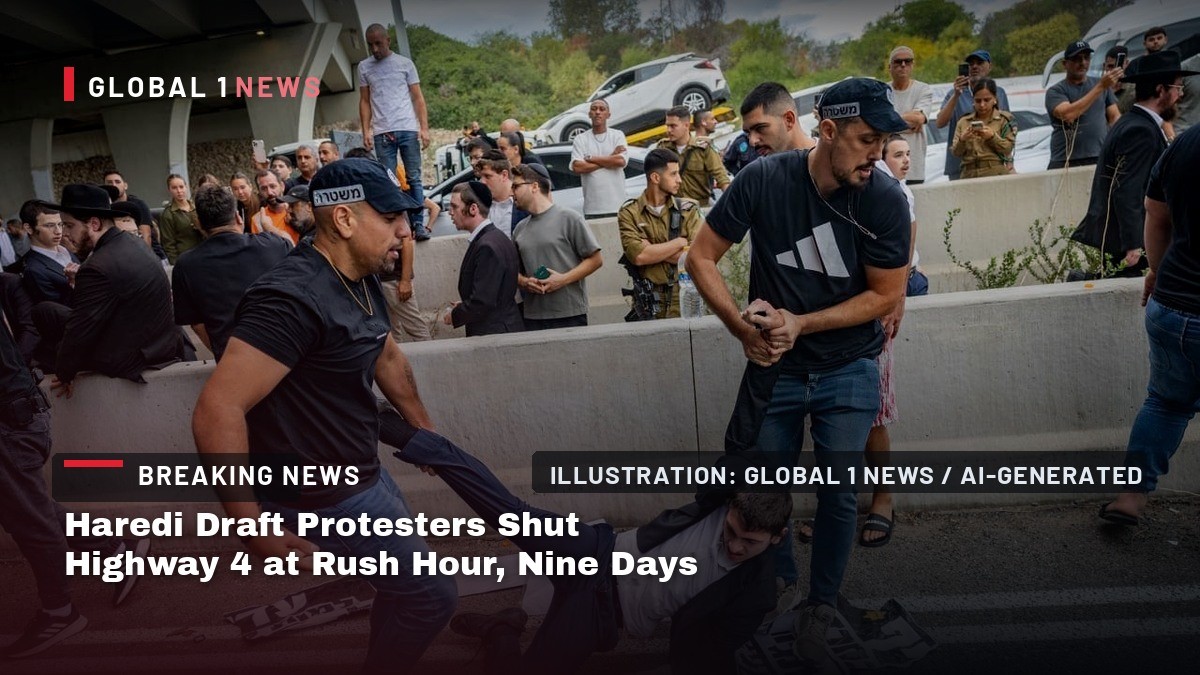
Haredi protesters blocked Highway 4 in both directions near the Yavne Interchange on Sunday morning, bringing the rush-hour commute to a standstill. Police used stun grenades and a water cannon to clear the road, and the highway reopened after about two hours. It was a blockade planned in secret, staged hours before the time police say it was meant to begin.
Haredi Draft Protesters Shut Highway 4 at Rush Hour, Nine Days Before Israel Votes
Yavne, Israel — The demonstrators came early, blocked the country's main coastal highway in both directions, and were gone within about two hours. What they left behind is a confrontation over military draft enforcement that now sits at the centre of an election campaign with nine days to run.
What Happened at the Yavne Interchange
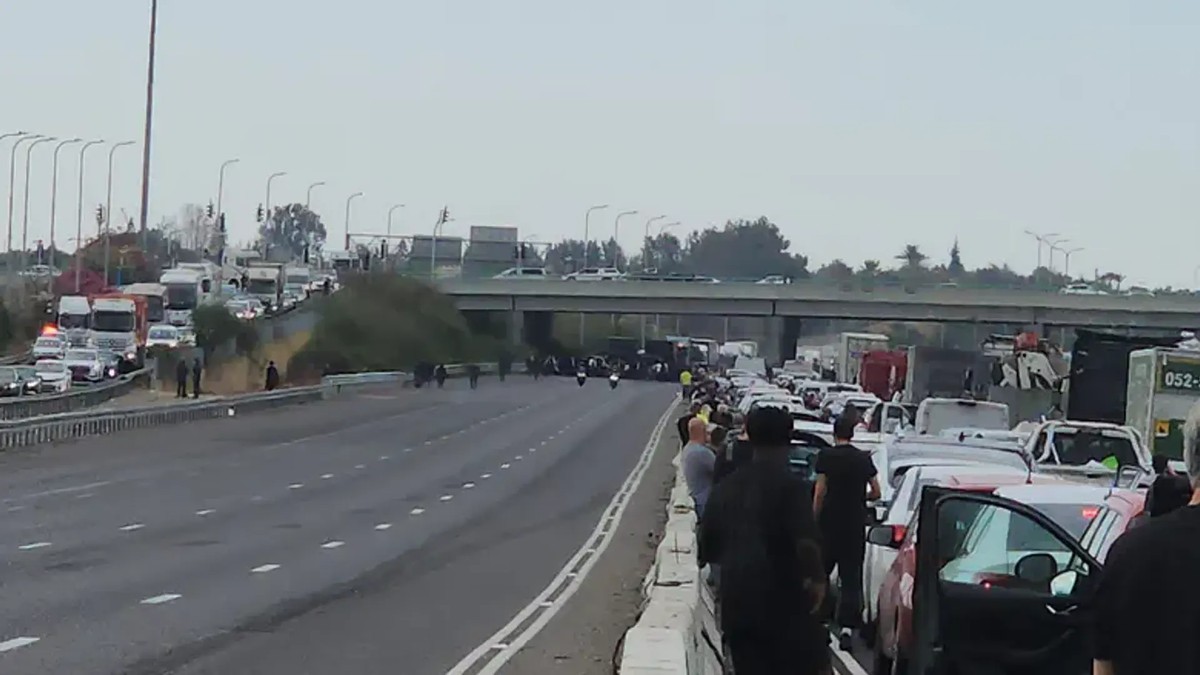
Approximately 40 to 50 protesters blocked Highway 4 near the Yavne Interchange, also reported as the Gan Yavne Interchange, during the morning rush hour, the Jerusalem Post reported, citing police. Traffic stopped in both directions, and the blockade disrupted the commute for drivers heading to work.
Confrontations broke out between protesters and motorists caught in the blockade, with some drivers clashing with demonstrators after they could not continue their journeys, the Jerusalem Post reported. Police declared the demonstration illegal. Officers used stun grenades and deployed a water cannon to disperse the crowd, and the highway was reopened to traffic after about two hours.
Israel Hayom reported that police "used force and stun grenades to disperse the demonstrators, while also allowing members of the public to help clear the road." In a statement, police said: "An illegal demonstration is currently taking place at the Yavne Interchange, with rioters blocking the road in both directions." The force said officers were working to "reopen the road and restore order."
A Price Tag, Not a Rally
The protesters described the blockade as a "price tag" in response to the arrests of two draft evaders in the Shfela region over the weekend, Arutz Sheva reported. That is their own description of the action, not a police term.
The group behind the blockade is the extremist Jerusalem Faction, also known as Peleg Yerushalmi, according to the Jerusalem Post. It is also known as the "Ratzfnikim," as Israel Hayom rendered it, or the "Hartzafnikim," as Ynet did, the same faction under two transliterations. They are followers of Rabbi Tzvi Friedman.
Organizers kept the location secret until the last minute, Arutz Sheva reported. Israel Hayom said it was kept secret "in an effort to catch police off guard and prevent them from preparing in advance." The Jerusalem Faction said in an email that protesters believed "if military police officers and enforcement officials experience firsthand a fraction of what they do to the families and the Torah scholars, perhaps they will repent," and that such protests would continue "as long as the arrests of yeshiva students persist."
The Two Arrests That Started It
The immediate trigger was the arrest of two ultra-Orthodox draft evaders and their transfer to military police custody, Israel Hayom reported. Ynet reported that the two men were detained in Rishon LeZion and sentenced to 20 days in military prison.
Police, through the Jerusalem Post, said the demonstration had been publicly scheduled to begin at 4:00 p.m. The blockade came hours earlier instead. Arutz Sheva reported that it began "hours before the main demonstration scheduled to take place around noon on Highway 4."
The Jerusalem Faction runs a "Tzeva Shachor" anti-conscription hotline that sends warnings so that "community activists" can mobilize "to prevent the handover." Sunday fit the pattern. Dozens of protesters arrived at the interchange while dozens more were making their way to the scene, Arutz Sheva reported. The road was shut before the announced hour, and the location stayed unknown until protesters were already there.
The Court Removed the Shield
The legal ground under these protests shifted 45 days ago. On 3 September, the High Court of Justice struck down unanimously a law the Knesset had passed in July 2026 that banned the IDF and police from arresting ultra-Orthodox yeshiva students who had failed to report for military service. The law banned arrests, investigations and enforcement measures against draft dodgers enrolled in yeshiva study until 30 November, and would have stretched to February 2027 because of legal reasons tied to the elections. Justice Ofer Grosskopf froze it one day after it passed, on 15 July, and the full nine-justice panel kept the freeze after a hearing that month.
Eight of the nine justices then went further, ruling that the law's substance was also unconstitutional because it protected one group from criminal enforcement while leaving that group's obligation to report for service intact. Deputy Chief Justice Noam Sohlberg wrote the principal opinion and found, with the panel's agreement, that the enacted law was fundamentally different from the bill that passed its first reading. What emerged, the court found, was a temporary measure with no enlistment targets, no effective sanctions and no alternative mechanism for bringing the students into the military. The judgment did not direct the IDF to make particular arrests, and did not resolve the wider political dispute.
The Numbers the Justices Were Given
Attorney General Gali Baharav-Miara had urged the court to strike the law down, calling it "an extreme and clear case of flawed and harmful legislation that does not meet legal standards," and saying it created "a selective and discriminatory criminal enforcement regime, which is diametrically opposed to the fundamental constitutional principle of equality before the law."
The figures were stark. Of an estimated 73,664 haredi draft evaders, 219, about 0.3 per cent, had been arrested through the enforcement channels examined in the judgment, the Jerusalem Post reported in September. Baharav-Miara told the court that between 16 January and 11 June 2026, 165 conscription-eligible Israelis declared deserters or draft dodgers were arrested in proactive military police operations, but only 16 were ultra-Orthodox, Haaretz reported on 1 July. Another 81 deserters were detained by police in random encounters and handed to the military police.
Haaretz also reported 294 indictments between January and mid-June against draft dodgers who had passed the criminal threshold, with the military prosecution estimating 32 of them as ultra-Orthodox. As of 10 May 2026, Israel had 92,080 designated conscripts declared draft dodgers or issued an Order 12, a desertion notice that becomes an arrest warrant after a month. According to IDF sources, about 80 per cent of them are ultra-Orthodox.
The Army Stopped Trying
A review of how the High Court's orders are being implemented, summarised by the Attorney General's Office, records IDF officials acknowledging that "active enforcement has not happened and arrests have not been made in the recent period." They gave no timeframe. They said arrests of Haredi draft dodgers had not been carried out because efforts were concentrated on draft dodgers trying to leave the country at border crossings during the recent holiday season.
Those officials said 212 draft dodgers were arrested at border crossings, mostly Ben Gurion Airport, between 1 September and 22 September, 163 of them Haredi, the Times of Israel reported.
Deputy Attorney General Gil Limon put the problem plainly: "The fact that for quite some time no proactive action has been taken against draft evaders and deserters, including arrests, is not consistent with security needs, in particular because of the senior army command's position that expanding the conscript army is a strategic need, [and is also not consistent with] the value of equality, the state's commitments to the High Court, and the High Court ruling which determined that the law that prevented arrests of yeshiva students must be declared void."
The Haredi Parties Picked a Side
Degel HaTorah chairman Moshe Gafni instructed local party representatives on regional councils to halt all cooperation with law enforcement. "Following the change in policy by the Israel Police, and so that we do not, God forbid, become complicit in harming the holy Torah and those who study it, I request that you immediately halt all cooperation with the Israel Police, including the municipal policing units, until further notice," Gafni said.
Agudat Yisrael leader Yitzhak Goldknopf called on Prime Minister Benjamin Netanyahu to rein in the police. Opposition Leader Yair Lapid condemned Gafni's call for "anarchy," saying it was "further proof of why cooperation with the ultra-Orthodox parties is forbidden." Lapid added: "Their attempts to undermine the very existence of the State of Israel are disgraceful. They should sit in the opposition."
Channel 12 reported on 9 October that Netanyahu tried, and failed, to have the ultra-Orthodox demonstrations against the arrest of draft-dodgers cancelled, out of concern that it would hurt his political campaign.
Four Days Ago, in Bnei Brak
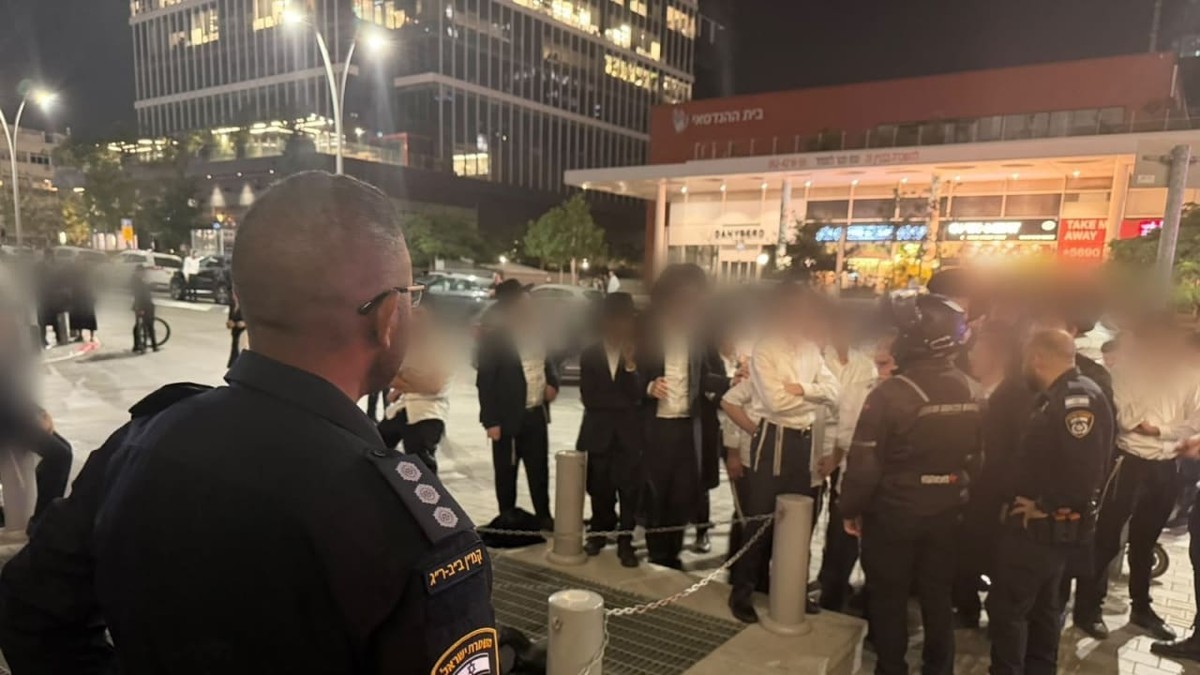
Four days ago, on 14 October, two haredi protesters were arrested after trying to break into a Bnei Brak office building where haredi soldiers serve in the IDF's Kodkod program. Most of the protesters there were minors. It was the second attempted break-in that week; protesters had gathered at the same spot the previous Monday.
Kodkod lets haredi men aged 23 and older who are not eligible for combat service take technology roles, training personnel in software development and cybersecurity, without uniforms. It launched in 2023. About 1,000 soldiers serve in it now, about 20 per cent are still in training, and IDF estimates put enrollment at 1,100 to 1,200 by the end of 2026.
The political reaction was immediate. Yisrael Beytenu chairman Avigdor Liberman said: "At this very moment, dozens of draft dodgers are trying to forcibly break into a military base. Anyone who tries to break into an IDF base is simply a terrorist. They must all be arrested now and thrown in prison." B'Yachad chairman and former prime minister Naftali Bennett said: "This is the Netanyahu-Deri legacy: The government abandons those who serve for the sake of draft dodgers. It happens on the battlefield, and now it happens in the streets of Bnei Brak, too."
Nine Days Before the Vote
Israel elects the 26th Knesset on Tuesday 27 October, nine days from now. There are 120 seats, 61 needed for a majority, and a party needs 3.25 per cent of the valid vote to enter the Knesset. Polling stations close at 22:00 Israel time, and official results are due within eight days, by 4 November 2026.
The haredi enlistment issue has become a central point of contention in the 2026 campaigns, with parties debating enforcement of military service requirements and exemptions for yeshiva students, the Jerusalem Post reported. The previous road-blocking protests came ten days ago, on 8 October, when Haredi demonstrators blocked major roads in Jerusalem and central Israel and organizers said they would block access to Ben Gurion Airport. Four protesters were arrested, one in Jerusalem and three for assaulting officers on Highway 4.
Nothing has replaced the law the court struck down. The "Bismuth bill," presented in November 2025, set targets of 6,840 to 8,500 enlistees a year for four years, then "no less than 50 percent of the annual enlistment cohort," while letting full-time yeshiva students keep yearly deferrals to age 26. Supporters call it a draft law; critics an exemption bill.
What the Roadblock Does Not Settle
The blockade shut a highway for about two hours and ended with the road reopened. It also put on the record the gap the court described and the army acknowledged: 219 arrests out of an estimated 73,664 draft evaders, and a recent period in which, by the IDF's own account, proactive enforcement stopped.
Police framed their role in general terms. "Israel Police considers the right to protest a cornerstone of a democratic state and permits demonstrations as long as they are conducted within the law," the force said. "However, police will not tolerate disturbances of any kind, obstruction of freedom of movement or any behavior that could endanger public safety."
Organizers had announced a further demonstration on Highway 4 for Sunday. Its size and outcome were not known when this article was filed. The highway is open. The draft dispute is not closed, and the voters get their say in nine days.
By Jessica Ali, Staff Writer
This article was produced with AI-assisted research and editorial support. Sources: The Jerusalem Post, The Times of Israel, Israel Hayom, Israel National News, Ynet, Haaretz, The Law Library of Congress. Photographs: Chaim Goldberg/Flash90 via The Jerusalem Post; Efrat Gilboa/TPS via Israel National News; Walla via The Jerusalem Post.
What's Your Reaction?
 Like
0
Like
0
 Dislike
0
Dislike
0
 Love
0
Love
0
 Funny
0
Funny
0
 Wow
0
Wow
0
 Sad
0
Sad
0
 Angry
0
Angry
0

Editor-in-Chief at Global1.News. Atlanta-based journalist who cuts through the BS and tells it like it is. Lead anchor, host, and the voice you hear when the spin stops and the truth starts.













Comments (0)