
GPT4All 2026 Retrospective: The Local AI Revolution
Folks, let me take you back to a frantic spring. March 2023. The world had just discovered ChatGPT, and every tech bro on the internet was screaming the same thing: you need a $10,000 GPU to run this stuff. You need a data center. You need to sell a kidney for compute....
Folks, let me take you back to a frantic spring. March 2023. The world had just discovered ChatGPT, and every tech bro on the internet was screaming the same thing: you need a $10,000 GPU to run this stuff. You need a data center. You need to sell a kidney for compute. It was gatekeeping disguised as expertise, and it was about to get blown wide open by a scrappy little project out of nowhere called GPT4All.
Here's the thing: that moment wasn't just a cool hack. It was the shot heard round the AI world. It proved that a ChatGPT-style brain could live on the laptop you already own, no cloud required, no subscription, no corporate leash. And now, three and a half years later in September 2026, that spark has become the industry's default operating system. The video you're about to watch, from our friends at Aitrepreneur, captured that exact moment of magic. Watch it, then let's talk about how we got from a single quantized file to a world where trillion-parameter models run on your desk.
Because this isn't just a nostalgia trip. This is the origin story of everything we cover now, from local video kings to open-weights giants. And it all started with a 7-billion-parameter rebel that refused to play by the old rules.
GPT4All: The $1,300 Spark That Made Local AI Inevitable
Atlanta, Georgia -- In the spring of 2023, the AI establishment had a simple message for the masses: you don't get to play with the big models. ChatGPT was a cloud-only oracle. Meta's LLaMA weights had leaked, sure, but running them felt like a dark art reserved for people with server racks and a death wish. The conventional wisdom was suffocating. Then Nomic AI dropped GPT4All on March 28, 2023, and the entire paradigm shifted overnight.
The Spring of 2023: When the Gatekeepers Met Their Match
Let's set the scene. ChatGPT had launched in November 2022 and became the fastest-growing consumer app in history. Every company on Earth was scrambling to bolt an API onto their product. The narrative was relentless: frontier AI requires frontier hardware. You need an A100. You need a cluster. You need to rent time on a supercomputer just to have a conversation with a chatbot.
Meanwhile, Meta had released LLaMA in February 2023 under a research license, and within weeks, the weights leaked to the public. Suddenly, the raw materials were out there. But the barrier to entry was still brutal. Running a 65-billion-parameter model required serious muscle. The 7B and 13B versions were more approachable, but they were raw base models, not assistants. They didn't chat. They just autocompleted text. You needed a whole stack of engineering just to make them say hello.
That's where Nomic stepped in. They looked at the landscape and saw a gaping hole: nobody had made a truly accessible, assistant-style model that could run on commodity hardware. They fixed that in a matter of weeks, and the ripple effect is still echoing through every local AI tool you use today.
What Nomic Actually Built: Distilling a Giant Into a Pocket Brain
Here's the part that still makes me grin. The team at Nomic -- Yuvanesh Anand, Zach Nussbaum, Brandon Duderstadt, Benjamin Schmidt, and Andriy Mulyar -- didn't train a model from scratch. That would have cost millions. Instead, they did something far more clever. They used OpenAI's GPT-3.5-Turbo as a teacher. They collected roughly one million prompt-response pairs, filtered that down to about 437,605 high-quality conversations, and used those to fine-tune Meta's LLaMA 7B model.
The economics are the stuff of legend. The entire training run cost roughly $800 in GPU time on a Lambda DGX A100, plus about $500 in OpenAI API fees for the distillation data. Four days of data work. Eight hours of actual training on that single A100. Total budget: about $1,300. That's less than the cost of a decent used car, and it produced a model that could hold a conversation, answer questions, and write code, all running on a laptop.
Let that sink in. The AI industry was telling you that intelligence costs millions. Nomic proved it could cost less than a month's rent in San Francisco. They didn't just build a chatbot. They built a proof that the emperor had no clothes, and the entire economics of AI were about to be rewritten.
The Single-File Magic: Quantization That Changed Everything
Now, the training was impressive, but the real magic was in the delivery. GPT4All shipped as a single quantized file called gpt4all-lora-quantized.bin. No Python environment required. No CUDA toolkit. No cloud connection. You downloaded one file, and you had a working assistant.
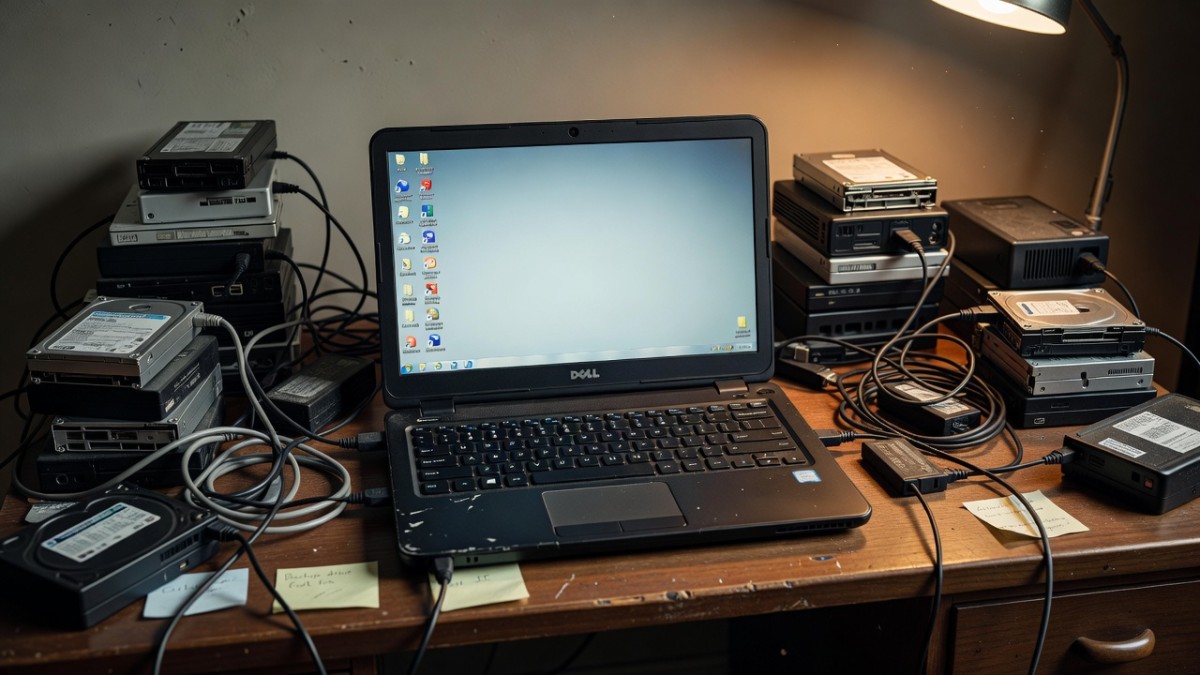
This was one of the first mainstream uses of llama.cpp-style CPU quantization, back before GGUF existed. The early .bin era was crude, but it worked. And it worked on hardware that should have been obsolete. Apple M1 Macs ran it beautifully. People were running it on 2012 laptops, for crying out loud. Machines that were a decade old were suddenly hosting a ChatGPT-style intelligence, entirely offline.
That was the gut punch to the gatekeepers. You didn't need a $10,000 GPU. You didn't need a data center. You needed a file that was smaller than a modern video game and a machine you probably already owned. The democratization of AI wasn't coming. It had arrived.
The License Firestorm and the Free4All Pivot
Of course, nothing this revolutionary comes without drama. The initial release was a mess on the licensing front. The code was GPL-3.0, and the weights were under a non-commercial license. The open-source community, which had been burned before, erupted. People were furious. They saw a project that claimed to be free but was actually just another walled garden with extra steps.
Nomic listened. They didn't double down. They didn't get defensive. In April 2023, they clarified the licensing and pivoted to MIT. The code and the weights were now truly open. Their motto became the rallying cry of the entire local AI movement: "GPT4All is Free4All -- never a subscription."
That pivot wasn't just a legal fix. It was a philosophical declaration. It said that AI should be a tool you own, not a service you rent. It said that the future of intelligence wasn't locked behind a paywall. And it set the tone for everything that followed. The community that had been burned by closed models saw a path forward, and they took it.
The Overnight Explosion: Birth of the Local AI Ecosystem
The response was volcanic. Tens of thousands of GitHub stars within days. Millions of downloads. The r/LocalLLaMA subreddit became a hive of activity overnight, with people sharing tips, tricks, and wild experiments. The idea of running ChatGPT on your laptop went from a fringe fantasy to a mainstream talking point in a matter of weeks.
And that explosion didn't just fizzle out. It built the foundation for everything we have now. The llama.cpp project, which made CPU inference practical, got a massive boost. GGUF, the successor to the early .bin format, became the standard. Ollama, LM Studio, and a dozen other tools emerged to make local AI as easy as installing a desktop app. The ecosystem that Nomic kickstarted became a self-sustaining engine of innovation.
In February 2026, the ggml/llama.cpp team joined Hugging Face, cementing the infrastructure that GPT4All helped popularize. GGUF downloads for Qwen alone hit about 39.6 million per month. The local AI movement wasn't a niche hobby anymore. It was the backbone of a new computing paradigm.
Where Local AI Stands in 2026: The Revolution Is Complete
So let's fast-forward to today, September 2026. The landscape that GPT4All seeded has grown into a forest. Qwen3.6-27B, released in April 2026 under Apache 2.0, scores 77.2 on SWE-bench Verified and fits in about 15 to 16 gigabytes at 4-bit quantization. That means it runs on a single consumer GPU. A model that would have been considered superhuman three years ago is now running on a gaming rig in someone's basement.
Gemma 4, also from April 2026, is Apache 2.0 licensed and claims 150 million downloads. Small models under 1 billion parameters account for 83 percent of all-time Hugging Face downloads. Apple ships neural accelerators in every M5 GPU core. Ollama has passed 100,000 GitHub stars. Local inference now runs on Arduino-class boards. We've gone from "can it run on a laptop?" to "can it run on a microcontroller?"
The privacy angle has become the killer app. When your data never leaves your device, you don't have to worry about corporate surveillance or data breaches. You don't have to trust a cloud provider with your medical records, your legal documents, or your creative work. Local AI isn't just a hobbyist's dream. It's an enterprise requirement, a healthcare necessity, and a personal freedom.
What This Means: The Through-Line From GPT4All to the Local AI King Era
Here's the analysis you won't hear from the big cloud vendors. The through-line from GPT4All to today's local AI boom is direct and unbroken. That $1,300 training run in 2023 proved that the economics of intelligence were about to collapse. When you can own the weights, you stop renting the tokens. When you can run a 27-billion-parameter model on your own GPU, you stop paying per API call. The power dynamic shifted from the platform to the user.
That's why this channel's entire "LOCAL AI KING" era exists. The coverage of Krea 2, MiniMax H3, and the Nano Banana competitors isn't a new trend. It's the logical conclusion of the spark that Nomic lit in 2023. Every open video model, every image generator that runs on your desktop, every local voice assistant is a descendant of that first GPT4All release. The Aitrepreneur channel has chronicled this arc from the very beginning, from those early install tutorials to today's coverage of models that would have seemed like science fiction just a few years ago.
But let's be honest about the limits that remain. Local AI isn't perfect. The biggest frontier models, the ones that require trillion-parameter MoEs, still need serious hardware. You can run them across multiple consumer boxes, but it's not trivial. The gap between the best cloud models and the best local models has narrowed dramatically, but it hasn't closed entirely. And there's still a learning curve. You need to understand quantization, context windows, and prompt engineering to get the most out of your local setup.
None of that diminishes the achievement. GPT4All didn't just make local AI possible. It made it inevitable. It proved that the future wasn't a subscription. It was a download.
So here's your action step, folks. Don't just read about this history. Live it. Go to the GPT4All website, download the desktop app, and run a model on the machine you're using right now. The files are free. The software is free. The only thing you need is the curiosity to try. That's the legacy of GPT4All. That's the Free4All promise. And it's still true today, in 2026, more than ever.
The revolution didn't start with a billion-dollar data center. It started with a single file and a team that believed intelligence shouldn't be locked away. That's the story we're telling today. That's the story that's still being written. And you're holding the pen.
By Jessica Ali, Staff Writer
This article was produced with AI-assisted research and editorial support. Sources: Nomic AI GPT4All repository, Nomic.ai, Hugging Face State of Open Models Summer 2026, Capital and Compute, Towards AI.
What's Your Reaction?
 Like
0
Like
0
 Dislike
0
Dislike
0
 Love
0
Love
0
 Funny
0
Funny
0
 Wow
0
Wow
0
 Sad
0
Sad
0
 Angry
0
Angry
0

Editor-in-Chief at Global1.News. Atlanta-based journalist who cuts through the BS and tells it like it is. Lead anchor, host, and the voice you hear when the spin stops and the truth starts.










Comments (0)