
Google Just Signed 22 Years of Nuclear Power. The Backlash Took 24 Hours.
Google signed a 22-year agreement for up to half of Finland's Loviisa nuclear output as part of a €13 billion investment in the country. Within 24 hours Finnish opposition demanded a national data centre permitting system and the country's power tax had already risen.
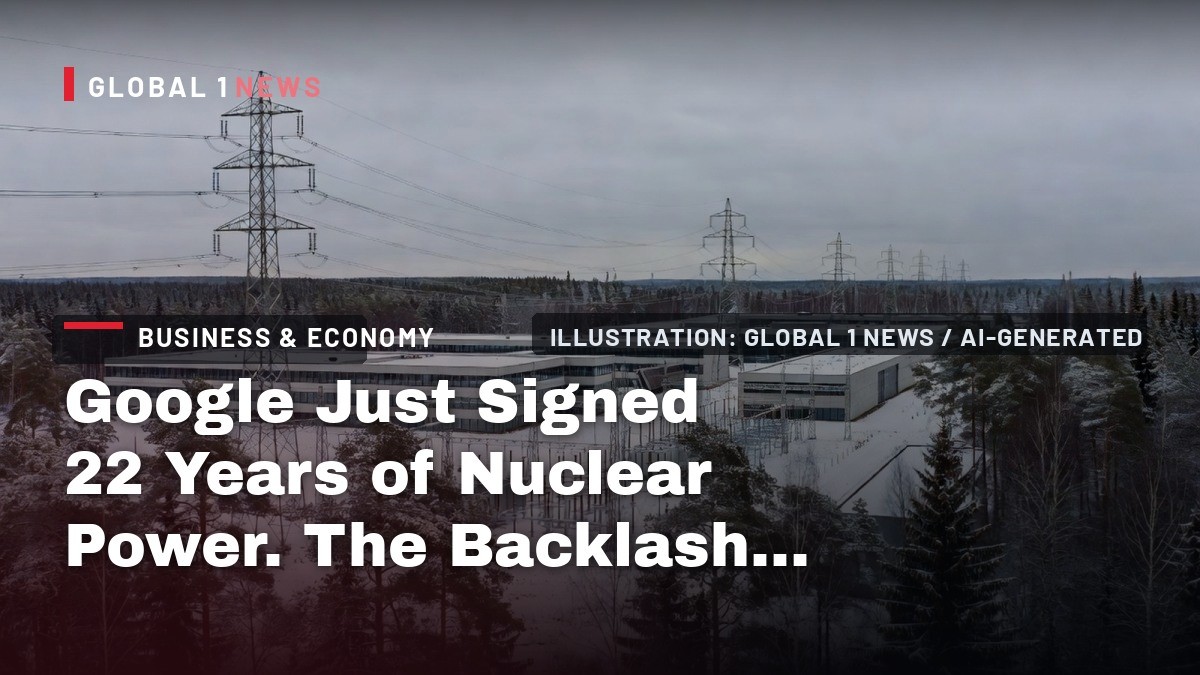
Google Just Signed 22 Years of Nuclear Power. The Backlash Took 24 Hours.
I have been running production servers for more than a decade, and the longest power commitment I have ever signed is five years. Five years felt aggressive. Anything longer than that and I am guessing — about demand, about hardware life, about what a rack costs in 2031.
So when I read that Google signed a 22-year contract to buy up to half the output of a Finnish nuclear plant, my first thought was not "wow." It was: what do you know that the rest of us don't? And second: what happens when the government that agreed to this is gone?
Neither answer is comfortable.
What Actually Got Signed
Google is putting at least €13 billion — roughly $15.1 billion — into AI infrastructure in Finland across 2027 and 2028. It is the largest single investment the company has ever made in Europe.
The money lands in four places: an expansion of the old paper mill site in Hamina that Google bought back in 2009, plus brand-new builds in Kajaani, Muhos and Vaala. Those northern sites are not an accident — winter temperatures there drop below minus 10 Celsius, and the towns sit in what one utility executive called a production-dominated grid with significant spare capacity.
The part that matters is the power: a 22-year purchase agreement with the utility Fortum for as much as 50% of the output of the Loviisa nuclear plant. Loviisa supplies about 10% of Finland's electricity, and without this deal it was due to shut down in 2030. With it, Fortum says the plant can run through the end of its operating licences in 2050.
There is more on the same ticket: onshore wind agreements bringing Google's supported Finnish wind capacity to 629 megawatts, a 94-megawatt battery near Kajaani connecting to the grid in late 2027, a €31 million community fund across the four host towns, and municipal energy projects covering solar and heat pumps for low-income households, efficiency retrofits on public buildings and backup power for local emergency, health and water services.
Google's own numbers: €3.6 billion to Finnish GDP and 37,000 jobs, 7,000 of them permanent. Ruth Porat, Google's president and chief investment officer, described the structure in three letters — BYOP, bring your own power — and called it the company's first nuclear energy deal outside the United States.
The Second Reading — This Is a Utility Rescue, Not a Flex
The headline is Google's €13 billion. The actual news is that a private company just decided whether 10% of a country's electricity generation keeps existing.
Read Fortum's own framing. The deal, in the utility's words, provides the economic certainty for a lifetime extension and upgrade of Loviisa through 2050. Without it, 2030 was the end.
Say that out loud. The power market would not fund the life extension of a nuclear plant. A hyperscaler's capital spending line did. That is not a criticism of Google — it is the smartest power move in this industry right now. Lock in firm, low-carbon baseload at a known price for two decades, in a country with cold air, cheap hydro, wind and no American-style protest culture, and you have bought the thing every competitor will be fighting over in 2031.
It also tells you where the industry's head is. In 2023 an operator's whole problem was getting chips. In 2026 it is getting electrons — and being able to prove where they came from. BYOP is not a slogan; it is the operating principle of the next decade of hosting.
The Secondary Bottleneck Nobody Is Pricing — Political Tenure
Here is the part I care about, and it has nothing to do with technology. It is the clock.
A 22-year contract signed in 2026 runs to roughly 2048. Loviisa's licence runs to 2050. Between the signature and the expiry, Finland holds about six general elections. So does the European Union. So do most of the countries supplying the chips, transformers and switchgear that make any of this physically possible.
Google's chief executive will change. Fortum's board will change. The Finnish prime minister will change — and in effect already did, politically, by day two. Every one of those future governments inherits the same choice: honour a deal somebody else signed, for a benefit that lands in fifteen years, against a cost that lands now.
That is the seam nobody is pricing. We spent three years arguing about whether AI infrastructure has enough chips, water, land and grid. The binding constraint is that this industry signs 22-year promises into four-year political systems, and the people who inherit those promises never agreed to them.
Finland Already Started Sending the Invoice
Watch how fast the mood moved.
September 9: Google announces. September 10: Centre Party leader Antti Kaikkonen tells Reuters that Finland needs a national permitting system for new data centre investment. His words — "at the moment, no one is really looking after the overall picture." Social Democratic lawmaker Niina Malm goes further and reframes electricity affordability as "a broader internal security issue," not an economic one. The Social Democrats lead the polls ahead of an election due in April. This is a campaign platform now, not a complaint.
And the tax was already law before Google ever signed. From 1 July 2026, data centres were moved out of Finland's lower electricity tax category into the general one — the energy tax goes from 0.05 cents per kilowatt-hour to 2.24 cents. That is a 2.19-cent increase, worth roughly €47 million a year in new revenue from the sector. Sweden has already scrapped its data centre tax relief entirely.
Now add the physical ceiling. Nordea's analysis reckons Finland can absorb about 1,200 megawatts of new data centre load before the hours per year where power costs more than 20 cents per kilowatt-hour rise by 20 to 30. At 2,400 megawatts it is roughly 150 extra expensive hours and about a 10% rise in the average price. And large operators, per the same analysis, will pay 10 cents per kilowatt-hour — double what Finland charges today.
Put those together: buyers willing to pay double, a tax increase already on the books, a grid ceiling measured in megawatts, and a permitting regime being drafted as an election promise. That is not a red carpet anymore. That is a meter, and it is running.
What This Means for Independent Hosting Providers
First, write the political clock into your power contracts. Every agreement I sign now carries change-of-law, change-of-tariff and change-of-permitting clauses, because I have watched a small country reclassify an entire industry's electricity tax in one budget cycle. If your contract does not say who eats a 2.19-cent tariff shift, the answer is you — and you will find out years after you priced the deal.
Second, treat documentation as a licensing asset, not a compliance cost. The jurisdictions moving fastest toward permits are the ones where operators can hand over PUE, water use, waste-heat recovery plans and grid contribution data. The operator with the file gets the permit. The one without it gets the moratorium. Build the paperwork now, while nobody is asking for it.
Third, waste heat is the most underpriced revenue line in this business. Google now embeds heat-recovery readiness into the design of every new data centre it builds in Europe, and Microsoft has bought land near Vaasa to sell waste heat into district heating for nearby towns. If your facility sits next to homes, schools or an industrial park, you have been throwing a revenue stream into the sky — and buying political cover in the process, because neighbours who buy your heat stop being your opposition.
Fourth, cold air and waterless cooling are no longer marketing. PUE used to be a badge on a website; now it is a break-even input, because a 2.19-cent tax shift rewrites the country-level economics of every rack in the building. If you are operating in a drought region and paying for water and chillers, your cost curve is pointing the wrong way.
Fifth, if you are small, stop chasing the same contract. In a 22-year world, being unhedged is a weakness — but being flexible is an asset. When a hyperscaler's twenty-year commitment meets a demand wobble, somebody has to absorb capacity. Position yourself as the buyer of that capacity, not as a competitor for the same signature.
The Structural Reality — The Contract Outlives Everyone Who Signed It
Loviisa runs to 2050. Google's agreement runs to about 2048. Finland's next parliament arrives in 2027, and there are five or six more before this contract expires. Fortum's shareholders, Google's board, the councils of Hamina, Kajaani, Muhos and Vaala — all of them turn over several times before the deal is done.
The asset does not turn over. That is the entire problem. A nuclear plant, a substation and a data hall do not have an election cycle. They have a depreciation schedule, and they will still be sitting right there when the political authority that approved them has been voted out twice.
Which is why the €31 million community fund matters more than its size suggests. Against €13 billion it is 0.24% — noise on the capex line. But €10 million of it funds research and innovation, and the rest pays for solar and heat pumps for low-income households, retrofits on public buildings, trail lighting, and backup power for local emergency, health and water services. That is not charity. That is the cheapest permitting insurance ever written in this industry, and any operator watching a planning committee turn hostile should be copying it line by line.
The Bottom Line
The AI buildout spent three years telling us its constraint was silicon. Then power. Then water. Then land. None of those is the binding constraint. The binding constraint is that the industry keeps signing multi-decade promises into short-cycle political systems, and the people who inherit those promises did not make them and owe them nothing.
Google's Finland deal is genuinely brilliant infrastructure strategy. It is also a bet that six future Finnish governments will all decide it still makes sense — and the first serious attempt to campaign against it started within 24 hours.
If you run infrastructure, learn the lesson now. Your longest-lived asset is not the building, the contract or the plant. It is the politics. Price it before the invoice arrives, because it always arrives.
That is not pessimism. That is just what running a real business looks like when your timeline does not fit inside somebody else's election cycle.
— Allan Ali, Founder
This article was produced with AI-assisted research and editorial support. Sources: Reuters, BBC, DW, Nordea Corporate, DLA Piper, Capacity Media, Google Cloud press release (Sept 9, 2026).
What's Your Reaction?
 Like
0
Like
0
 Dislike
0
Dislike
0
 Love
0
Love
0
 Funny
0
Funny
0
 Wow
0
Wow
0
 Sad
0
Sad
0
 Angry
0
Angry
0

Publisher of Global1.News. Automation architect, systems builder, and the guy making sure the truth gets published.











Comments (0)