
FSSAI Drops Sugar Warning Labels as Diabetes Hits 101M
FSSAI abandons red-flag warning labels on packaged foods after industry pressure, despite 101 million diabetics and 315 million hypertensive Indians. Supreme Court intervenes, demanding action within two weeks.
In London, a standard can of Fanta contains 63 calories. In Mumbai, the same brand, the same product, contains nearly three times that amount of sugar, alongside artificial dyes that European regulators require to be flagged prominently on the packaging. This is not a footnote in a trade dispute; it is the starkest possible illustration of the nutritional divide that defines India’s packaged food market — and the regulatory paralysis that allows it to persist.
The Great Indian Label Retreat: How 101 Million Diabetics Lost a Battle to the Beverage Lobby
New Delhi – August 25, 2026 — The Food Safety and Standards Authority of India (FSSAI) has formally abandoned its push for mandatory red-flag warning labels on packaged foods, capitulating to industry pressure in a tense March 2026 meeting where executives argued that such labels were "confusing and ineffective." The decision, confirmed in August, replaces the proposed warning system with numerical front-of-pack nutrition disclosures — a softer approach that stops well short of the black-octagon-style warnings adopted by Chile, Mexico, and Brazil. The retreat comes at a moment when India is confronting a public health emergency of staggering proportions: an estimated 101 million people with diabetes, 136 million with pre-diabetes, and 315 million with hypertension, according to the ICMR-INDIAB study published in The Lancet Diabetes and Endocrinology.
The Fanta Calculus: A Case Study in Regulatory Arbitrage
The Reuters investigation, published on August 25, 2026, exposed the mechanics of this regulatory failure with devastating clarity. Recordings reviewed by the news agency show that during the March meeting, industry executives — representing major players including Coca-Cola, PepsiCo, Nestle, ITC, and Britannia — urged regulators to abandon warning labels in favour of encouraging "portion control." The argument, repeated across the sector, was that warning labels stigmatise products and confuse consumers. The data suggests otherwise. A can of Fanta sold in London carries 63 calories; the identical brand sold in India contains three times as much sugar. The Indian version also includes artificial dyes that, in Europe, must be prominently displayed on the front of the packaging; in India, the same information is relegated to small print on the back of the can.
This is not a matter of consumer confusion — it is a matter of deliberate product formulation for a market where regulatory oversight has been, at best, permissive. The FSSAI first released draft regulations on front-of-pack labelling in 2018. Eight years later, those regulations remain unfinalised. In the interim, India's ultra-processed food sector has grown at a compound annual growth rate of 13.37% between 2011 and 2021 — one of the fastest globally — coinciding with a near-doubling of obesity rates across the country.
The Supreme Court Intervenes: "Should India Remain Underdeveloped?"
The FSSAI's decision has not gone unchallenged. The Supreme Court of India, in a sharply worded hearing, demanded to know why the regulator had abandoned the warning-label approach. "Should India remain underdeveloped?" the Court asked, directing the FSSAI to enforce warning labels — not the star-rating system the regulator had previously proposed — and to define thresholds for sugar, salt, and saturated fat based on a nutrient profile model. The Court has given the FSSAI two weeks to place its final decision on record.
The Court's frustration is understandable. The FSSAI's earlier proposal, the Indian Nutrition Rating, was a half-star-to-five-star system — a format that research has consistently shown to be less effective than interpretive warning labels. The Economic Survey of India has itself recommended warning labels, citing international evidence. Yet the regulator has repeatedly deferred to industry objections, arguing that a star system is more "consumer-friendly" and that warnings could harm trade.
The Health Toll: Numbers That Demand Action
The human cost of this regulatory inertia is measurable. The ICMR-National Institute of Nutrition (NIN) conducted a study in Hyderabad that found young adults who frequently consume high-fat, high-salt ultra-processed foods are nearly three times more likely to develop elevated blood pressure. The 2021 data from the ICMR-INDIAB study paints a broader picture: 254 million Indians had generalised obesity, and 351 million had abdominal obesity. These are not abstract statistics — they translate directly into rising healthcare costs, reduced productivity, and premature mortality.
Consider the trajectory. Between 2011 and 2021, while the ultra-processed food sector grew at 13.37% annually, obesity rates nearly doubled. The correlation is not coincidental. Ultra-processed foods are engineered to be hyper-palatable, high in sugar, salt, and saturated fat, and low in nutritional value. They are also aggressively marketed, particularly to children and young adults in urban and semi-urban India. The result is a generation growing up with dietary habits that virtually guarantee metabolic disease.
What This Means for India
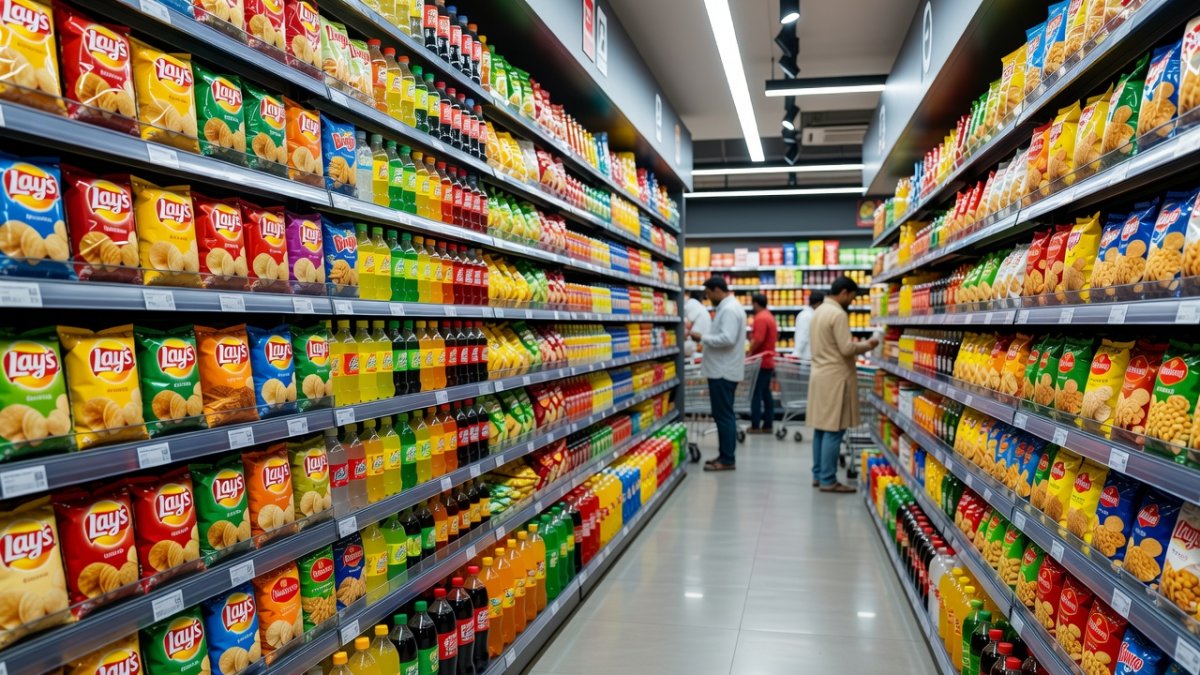
For the Indian consumer, the FSSAI's retreat is not an abstract policy debate — it is a matter of life and death. A parent in New Delhi buying a packaged snack for their child has no way of knowing, at a glance, whether that product contains a third of the child's daily recommended sugar allowance. The numerical labels proposed by the FSSAI require literacy, numeracy, and time — three things that the average consumer, shopping in a crowded market or a busy supermarket, does not have.
For the Indian taxpayer, the cost is equally severe. Diabetes, hypertension, and obesity are chronic conditions that require lifelong management. The public health system, already stretched thin, will bear the burden of treating millions of patients whose conditions could have been prevented or delayed by better dietary information. The economic cost of diabetes alone in India is estimated to be in the tens of billions of dollars annually — a figure that will only grow as the disease burden increases.
The Global Precedent: What India Can Learn from Chile
India is not navigating uncharted waters. Chile adopted black octagonal warning labels in 2016, and the results have been striking. Studies published in peer-reviewed journals have shown significant reductions in the purchase of sugary beverages and high-calorie foods following the implementation of the warning-label system. Mexico, Brazil, Peru, Argentina, and Uruguay have followed suit. Europe uses the Nutri-Score system, which grades products from A to E. Each of these systems has its critics, but all share a common feature: they provide consumers with immediate, intuitive information at the point of purchase.
The industry's argument that warning labels are "confusing" is contradicted by the evidence. In Chile, consumer surveys have shown high levels of understanding and acceptance of the warning labels. The labels are simple, visual, and unambiguous. A black octagon with the words "HIGH IN SUGAR" requires no literacy, no numeracy, and no prior knowledge. It is, in the truest sense, a public health intervention designed for the real world.
The Politics of Food: Why Regulators Blink
The FSSAI's decision must be understood in its political context. The packaged food industry is a significant contributor to India's economy, employing hundreds of thousands of workers and generating substantial tax revenue. The industry has also invested heavily in lobbying, both directly and through industry associations. The March 2026 meeting, as reported by Reuters, was not a neutral consultation — it was a pressure campaign, with executives warning of job losses, trade implications, and consumer backlash if warning labels were imposed.
This is not a uniquely Indian phenomenon. In the United States, the food industry has successfully blocked front-of-pack warning labels for decades. In Europe, the Nutri-Score system has faced persistent industry opposition. But India's situation is different in one crucial respect: the scale of the health crisis. With 101 million diabetics and 315 million hypertensive patients, India cannot afford the luxury of a decade-long regulatory debate. The Supreme Court's intervention reflects this urgency — and its two-week deadline suggests that the judiciary, at least, understands the stakes.
The Bottom Line
The FSSAI's retreat on warning labels is a profound failure of public health governance. The evidence is unambiguous: warning labels work, numerical labels do not, and the industry's objections are self-serving. India has 101 million diabetics, 136 million pre-diabetics, and 315 million hypertensive patients. The ultra-processed food sector is growing at 13.37% annually. The Supreme Court has given the regulator two weeks to justify its position. The question is whether the FSSAI will finally act in the public interest, or whether it will continue to prioritise the interests of a handful of multinational corporations over the health of 1.4 billion Indians. The Fanta can in London and the Fanta can in Mumbai tell the story: the same brand, the same name, but vastly different nutritional content — and vastly different regulatory standards. Until India closes that gap, the diabetes epidemic will only deepen.
— By Dr. Raj Patel, Staff Writer
This article was produced with AI-assisted research and editorial support. Sources: Reuters, NDTV, India Today, Hindustan Times, Economic Times, ICMR-INDIAB study.
What's Your Reaction?
 Like
0
Like
0
 Dislike
0
Dislike
0
 Love
0
Love
0
 Funny
0
Funny
0
 Wow
0
Wow
0
 Sad
0
Sad
0
 Angry
0
Angry
0

India/South Asia Correspondent at Global1.News. Analytical voice with a background in science and health journalism. Based in New Delhi, covering Indian politics, education, healthcare, technology, and policy. Breaks down complex data into clear, actionable reporting.















Comments (0)