
Flavio Bolsonaro Edges Ahead of Lula in New Poll as Brazil's October Vote Looms
A new Gerp poll shows Flavio Bolsonaro, eldest son of jailed ex-president Jair Bolsonaro, leading President Lula 47% to 42% in a potential runoff as Brazil's October 4 election approaches, with regional divides and record rejection rates shaping the race.
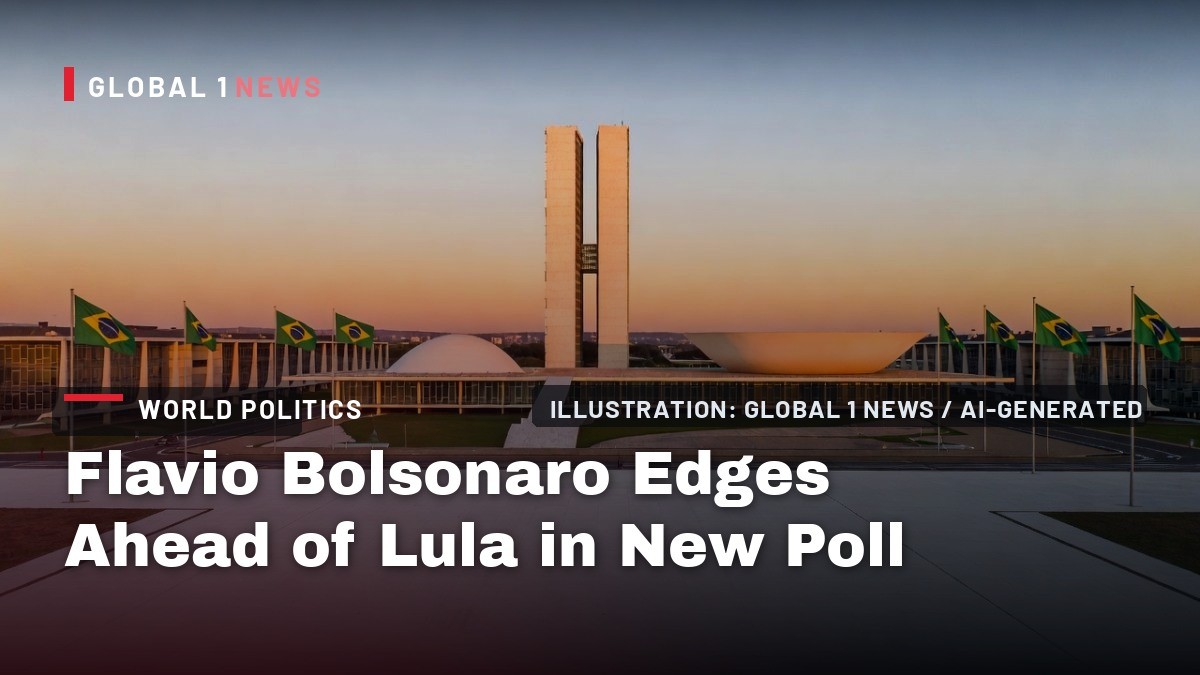
The latest major poll of Brazil’s presidential race is out, and it has scrambled the political map. A new Gerp survey released Wednesday shows Senator Flavio Bolsonaro, the 45-year-old eldest son of the jailed former president, leading incumbent Luiz Inacio Lula da Silva by five points in a potential runoff — 47% to 42%. With the first round of voting scheduled for October 4 and campaigning officially open since August 16, this is no longer a theoretical family dynasty question. It is the central fact of the race.
The Numbers That Moved
The Gerp poll, reported by CNN Brasil and Poder360, marks the first major public survey to put Flavio Bolsonaro ahead of Lula in a head-to-head matchup. The direction is unmistakable: the race is tightening, and the incumbent is no longer the clear favorite in a second round. Just three weeks earlier, a Genial/Quaest poll from August 5 had Lula ahead 44% to 39% in the same scenario — a swing of roughly ten points in Flavio’s favor in under a month.
Other pollsters confirm the trend, even if their toplines differ. A Nexus/BTG poll from August 24 shows Lula leading Flavio 41% to 37% in first-round voting intentions, with all other candidates stuck below 5%. A Datafolha survey from August 21 found Lula still ahead overall, but the gap narrowed by a single point from the previous month. More troubling for the president’s camp: his approval rating fell to 47% from 49% in July, while disapproval rose to 50% from 48% — a net negative approval balance as the campaign enters its decisive stretch.
The Bolsonaro Name, Back on the Ballot
Flavio Bolsonaro is not his father, but he is running as the direct heir to a political movement that refuses to die. Jair Bolsonaro, convicted by Brazil’s Supreme Federal Court, barred from running for office until 2030, and arrested in 2025, has endorsed his eldest son as the family’s standard-bearer. The endorsement matters less for policy than for symbolism: the Bolsonaro name still carries enormous weight among the conservative electorate that turned out in droves in 2018 and 2022.
Flavio has spent his political career in his father’s shadow, first as a Rio de Janeiro state deputy, then as a federal senator. His legal history is not clean. An investigation into an alleged salary-kickback scheme, known as “rachadinha,” from his time in the state assembly was annulled by the Superior Court of Justice in 2021 and later cleared by subsequent STJ and Supreme Federal Court rulings. Rio state courts denied a 2025 attempt to reopen the case. Brazilian media have noted the case closed with unanswered questions, but legally, Flavio is free to run — and free to campaign on a platform of anti-establishment grievance without the baggage of a conviction.
The son’s rhetoric is more disciplined than the father’s. He has avoided the inflammatory attacks on the electoral system that defined Jair Bolsonaro’s post-presidency. Instead, Flavio has focused on economic anxiety, public safety, and a vague promise to “restore order.” It is a calculated strategy to appeal to the middle ground that his father alienated. The early polling suggests it is working.
Lula's Record Under Pressure
Lula’s campaign is built on a simple argument: the economy is better than it was, and he deserves credit. The numbers back him up on paper. Unemployment hit a record-low annual average of 5.6% in 2025. GDP grew 2.3% last year. Inflation has moderated. These are not trivial achievements, and Lula’s team has hammered them in every advertisement and rally speech since the campaign officially opened.
But the Brazilian voter is not responding to statistics the way the president’s strategists hoped. The Datafolha approval slide suggests a disconnect between macroeconomic indicators and lived experience. Food prices remain stubbornly high in the poorest regions. Interest rates, while easing, are still restrictive for small businesses and consumers. And the political noise from Brasilia — constant infighting within Lula’s coalition, corruption allegations against junior ministers, and a perception of drift on security policy — has eroded the president’s standing among the very voters who carried him to victory in 2022.
Lula is pursuing a fourth non-consecutive term, a feat unprecedented in Brazilian history. He served from 2003 to 2010, returned in January 2023, and at 80 years old, he is asking for another four years. His stamina is not in question; his political capital is. The Quaest regional data shows his rejection rate remains high among higher-income voters and in the South, the traditional Bolsonaro heartland. The erosion is now spreading to the working-class voters in the Northeast who have been his base for two decades.
A Country Split by Region
Brazil is not one country in this election; it is at least three. The Quaest regional breakdown shows Flavio Bolsonaro leading in the South and Center-West, strongholds like Santa Catarina, Rondonia, and Parana where the Bolsonaro brand is virtually untouchable. In the Southeast, the most populous region and the economic engine of the nation, the race is far closer. Flavio runs even or slightly ahead in Sao Paulo, Minas Gerais, and Rio de Janeiro — the country’s three biggest electoral colleges and essential terrain for any path to the presidency.
The Northeast, Lula’s ancestral political fortress, remains solidly behind the incumbent. But the margins there are not what they were. The Quaest data from August 6 shows Lula’s approval has advanced among women and evangelical voters nationally, a counterintuitive finding given the Bolsonaro family’s strong ties to evangelical leadership. Yet the same poll shows his rejection among higher-income voters and in the South has not budged. The map is hardening into a geographic and demographic stalemate, which is precisely why the runoff scenario is so volatile.
For international observers, this regional split is a warning sign. A Brazil divided along regional lines is a Brazil that struggles to govern. The Amazon, the climate agenda, trade policy with the United States and China — all of these hinge on a president who can command a national mandate. Neither candidate currently looks capable of doing so with a decisive majority.
The Rejection Factor
Here is the paradox of this election: both candidates are deeply unpopular with a majority of the electorate. The Quaest poll from mid-August, reported by Al Jazeera on August 15, found rejection rates of 54% for Flavio Bolsonaro and 52% for Lula. In a first-round scenario, the same poll showed Lula at 38% and Flavio at 31%, with Renan Santos and Ronaldo Caiado at 4% each and Romeu Zema at 2%. The center is not consolidating; it is fragmenting.
This is a race defined by negative partisanship. Voters are not choosing the candidate they love; they are choosing the candidate they hate less. Lula’s campaign knows this, which is why they have shifted from touting his record to warning about the return of the Bolsonaro family. Flavio’s campaign knows it too, which is why they are running against Lula’s age, his coalition’s corruption, and the cost of living — not on a detailed policy platform.
The rejection numbers also explain why the third-party candidates matter. Renan Santos and Ronaldo Caiado, both polling at 4%, are not going to win. But in a runoff, their voters will decide the election. If the center-right voters who support Caiado, a governor from Goias, break for Flavio, the race is over. If they stay home or vote blank, Lula has a path. The campaigns know this, and both are already courting the center with a ferocity that will only intensify in the final six weeks.
What a Second Round Would Look Like
The Gerp poll’s 47% to 42% runoff scenario is the most instructive data point of the campaign so far. It suggests that Flavio Bolsonaro has a ceiling just below 50%, but so does Lula. The remaining 11% of voters are undecided or leaning toward abstention. In a polarized country, that is a massive swing block.
Lula’s path to victory runs through the Northeast and the urban working class. He needs to turn out his base in record numbers and win back the women and evangelicals who have drifted toward Flavio. The Quaest data showing Lula’s improvement among those groups is a glimmer of hope for his campaign, but it is not yet enough to offset his losses elsewhere. Flavio’s path runs through the South, the Center-West, and the interior of the Southeast. He needs to consolidate the anti-Lula vote and convince the center that he is not his father.
The second round would be a referendum on two legacies: Lula’s record of social inclusion and economic growth versus the Bolsonaro family’s brand of conservative populism. It would also be a test of Brazil’s democratic institutions. The 2022 election was marred by Jair Bolsonaro’s baseless claims of fraud and the subsequent January 8 attacks on government buildings. Flavio has distanced himself from that rhetoric, but the question of whether his supporters will accept a loss remains open. International observers, including the United States and the European Union, will be watching closely.
What's at Stake Beyond Brazil
This election is not just about Brazil. The country is the world’s largest exporter of soy, beef, and iron ore. It is a critical partner in the global energy transition, with vast reserves of lithium and rare earths. And it is the guardian of the Amazon rainforest, which is central to any credible climate change strategy. A Lula victory would mean continuity on environmental enforcement and a deepening of the US-Brazil trade relationship. A Flavio Bolsonaro victory would likely mean a rollback of environmental protections, a more confrontational stance toward China, and a realignment with the populist right in the Americas.
The United States has a direct stake in the outcome. Washington has courted Lula as a counterweight to Chinese influence in South America, but the relationship has been complicated by Lula’s refusal to take sides on the Ukraine war and his criticism of US trade policy. A Flavio Bolsonaro administration would be more ideologically aligned with the American right, but it would also be more unpredictable. The Bolsonaro family’s history of attacking electoral integrity does not inspire confidence in Washington’s foreign policy establishment, regardless of party.
For the Amazon, the stakes are existential. Deforestation fell sharply under Lula’s current term, reaching levels well below the peaks of the early 2000s, though still above the record low set in 2012. Flavio has not made the environment a priority, and his father’s administration oversaw a surge in illegal mining and logging. The international community, which has poured billions into Amazon conservation funds, is watching the October 4 vote with a mixture of hope and dread.
The Road to October 4
The campaign has just over five weeks to go. The first round is October 4, and if no candidate wins a majority, the runoff will be held on October 25. The Gerp poll is a snapshot, not a prophecy. Polls have been wrong before, and the margin of error in this race is significant. But the trend line is clear: Lula is losing ground, and Flavio Bolsonaro is gaining it.
Lula’s campaign will need to recalibrate. The message of economic recovery is not resonating. The attacks on Flavio’s legal history and his father’s record are not sticking. The president needs to give voters a reason to be enthusiastic, not just fearful. Flavio’s campaign, meanwhile, faces the opposite challenge: he needs to avoid mistakes. A single gaffe, a single scandal, a single moment of Bolsonaro-style extremism could shatter his carefully constructed image of moderation.
The next five weeks will be brutal. Expect negative ads, legal challenges, and a flood of disinformation on social media. Expect the international press to descend on Brasilia and Sao Paulo. Expect the world to hold its breath. Brazil is the fourth-largest democracy on Earth, and it is about to make a choice that will reverberate far beyond its borders. The race is tight, the stakes are enormous, and the outcome is genuinely uncertain.
By Jessica Ali, Staff Writer
This article was produced with AI-assisted research and editorial support. Sources: CNN Brasil, Poder360, Reuters, Al Jazeera, Datafolha, Quaest, Gerp, Nexus/BTG, BBC News Brasil, US News & World Report.
What's Your Reaction?
 Like
0
Like
0
 Dislike
0
Dislike
0
 Love
0
Love
0
 Funny
0
Funny
0
 Wow
0
Wow
0
 Sad
0
Sad
0
 Angry
0
Angry
0

Editor-in-Chief at Global1.News. Atlanta-based journalist who cuts through the BS and tells it like it is. Lead anchor, host, and the voice you hear when the spin stops and the truth starts.










Comments (0)