
Thailand, China Launch Falcon Strike 2026 Air Force Exercise
Falcon Strike 2026 Takes Flight Over Udon Thani The skies over northeastern Thailand have grown busier this week as the Royal Thai Air Force and the People's Liberation Army Air Force of China launched the ninth edition of their joint Falcon Strike exercise. The opening ceremony took place on Monday at Wing 23 in Udon Thani province, a base that has become a familiar gathering point for this biennial display of aerial cooperation between Bangkok and Beijing.
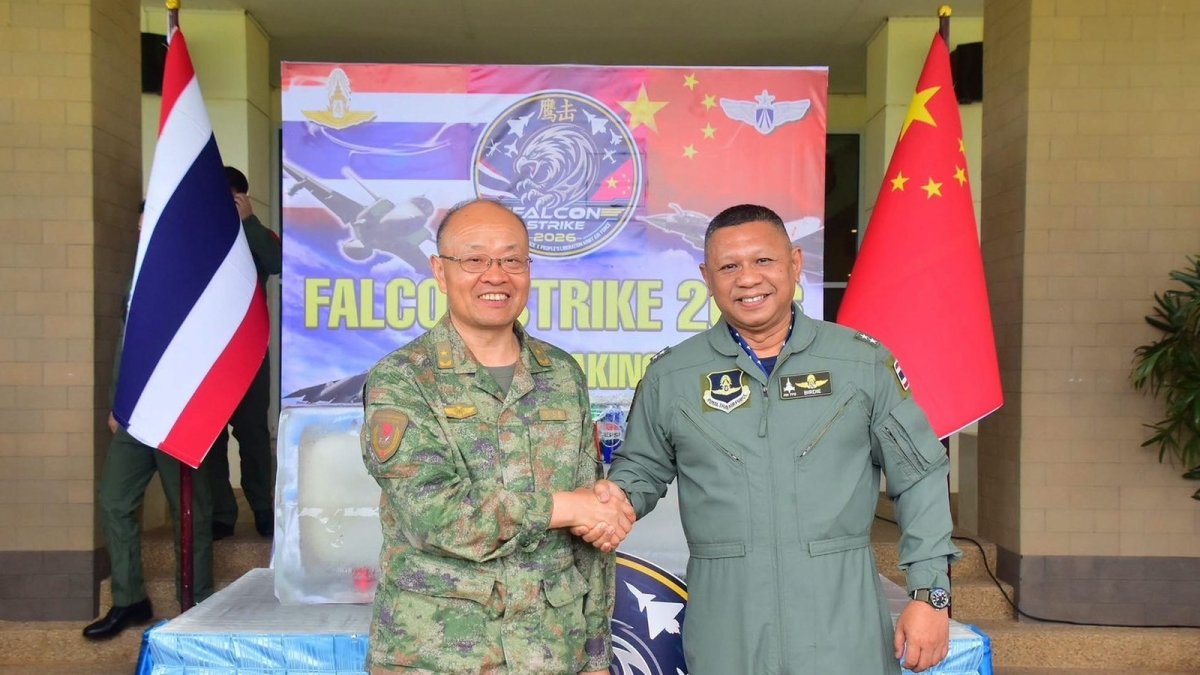
Falcon Strike 2026 Takes Flight Over Udon Thani
The skies over northeastern Thailand have grown busier this week as the Royal Thai Air Force and the People's Liberation Army Air Force of China launched the ninth edition of their joint Falcon Strike exercise. The opening ceremony took place on Monday at Wing 23 in Udon Thani province, a base that has become a familiar gathering point for this biennial display of aerial cooperation between Bangkok and Beijing.
This year's iteration, designated Falcon Strike 2026, brings together fighter jets, an airborne early warning and control aircraft, and aerial refuelling drills that will stretch the capabilities of both air forces. For the people of Isaan, the sight of Chinese KJ-500 AWACS aircraft and KJ-200 radar planes sharing tarmac space with Royal Thai Air Force squadrons is a reminder that their region sits at the crossroads of a changing regional security landscape.
The exercise, confirmed by China's Ministry of National Defence spokesperson Jiang Bin in late July, represents a deepening of a partnership that began in 2015. Since that first edition, Falcon Strike has grown from a modest exchange into a sophisticated drill involving ground-based air defence units, joint command operations, and humanitarian assistance coordination. The choice of Udon Thani as the host location is no accident — this is a base with deep roots in regional security cooperation, and its proximity to both Laos and Cambodia gives the exercise strategic resonance for the wider Mekong subregion.
A Delicate Balance in Thai Defence Diplomacy
For Thai observers, the timing and scale of Falcon Strike 2026 carry particular significance. Thailand has long pursued what analysts call a "balancing strategy" in its defence relationships, maintaining its historic alliance with the United States through the annual Cobra Gold exercise — the largest multilateral military drill in the Asia-Pacific region — while simultaneously cultivating deeper security ties with China, its largest trading partner.
This dual-track approach is not merely a matter of diplomatic convenience. It reflects a pragmatic recognition that Thailand's geographic position, economic dependencies, and security interests require engagement with multiple great powers. The Falcon Strike series, held roughly every other year at Wing 23, serves as the clearest symbol of the Chinese track, while Cobra Gold, hosted annually with American forces, anchors the traditional alliance track.
The 2022 edition of Falcon Strike ran for ten days in August at the same base, and this year's exercise follows a similar format. But the inclusion of the KJ-500 airborne early warning and control aircraft marks a notable escalation in sophistication. These aircraft provide a comprehensive picture of the battlespace, coordinating fighter operations and aerial refuelling missions with a level of integration that was absent in earlier editions of the exercise.
What the Exercise Involves
According to details released by both air forces in recent days, the training syllabus for Falcon Strike 2026 covers four main areas: joint air defence operations, aerial refuelling procedures, fighter combat operations, and humanitarian assistance and disaster relief cooperation. The last category is particularly relevant for Thailand, a country that regularly faces natural disasters ranging from monsoon floods to cyclonic storms.
The humanitarian component of the exercise reflects a broader trend in regional military cooperation, where disaster response has become a bridge-building mechanism between armed forces that might otherwise view each other with suspicion. For the Royal Thai Air Force, the ability to coordinate with Chinese aircraft in relief scenarios could prove valuable in real-world emergencies, particularly those affecting the Mekong basin where China, Laos, Myanmar, and Thailand share hydrological vulnerabilities.
Chinese ground-based air defence units have also deployed to Udon Thani for the exercise, adding a layer of complexity to the training. These units will work alongside their Thai counterparts in scenarios that test integrated air defence networks — a capability that has become increasingly important as regional airspace grows more crowded with civilian and military traffic.
Udon Thani: A Strategic Crossroads
Wing 23 in Udon Thani is more than just a convenient airfield. It is a facility with a storied history in regional security, having served as a major United States Air Force base during the Vietnam War era. The base's long runways and robust infrastructure made it a critical logistics hub for American operations in Indochina, and those same qualities now make it an attractive venue for Chinese participation in joint exercises.
For the local community in Udon Thani, the arrival of Chinese air force personnel brings both economic activity and cultural exchange. The province, known for its archaeological sites at Ban Chiang — a UNESCO World Heritage location — and its vibrant markets, has become accustomed to hosting international military delegations. The presence of Chinese airmen in the city's restaurants and shops during the exercise period is a familiar sight for residents who have witnessed this biennial ritual since 2015.
The Isaan region more broadly has emerged as a focal point for Thailand-China cooperation. The high-speed rail project linking Bangkok to Nong Khai on the Lao border passes through Isaan provinces, and Chinese investment in agricultural processing and logistics has grown steadily. The Falcon Strike exercise, therefore, sits within a wider web of connectivity that binds northeastern Thailand to its northern neighbour.
Regional Implications for ASEAN
For ASEAN observers, Thailand's management of its defence relationships offers a model of what analysts call "regional hedging" — the practice of maintaining diversified security partnerships to avoid overdependence on any single power. In a region where the United States and China compete for influence, Thailand's ability to host both Cobra Gold and Falcon Strike without alienating either side is viewed with considerable interest.
Other ASEAN members face similar pressures. Malaysia, Vietnam, and the Philippines all maintain security relationships with both Washington and Beijing, though each calibrates the balance differently. Thailand's experience suggests that such dual-track diplomacy is feasible, provided that the exercises are framed as capacity-building rather than alliance-building, and that the focus remains on non-traditional security threats alongside conventional military training.
Economic and Diplomatic Dimensions
The Falcon Strike exercise cannot be separated from the broader economic relationship between Thailand and China. China has been Thailand's largest trading partner for over a decade, with bilateral trade exceeding 100 billion US dollars annually. Chinese tourists constitute the largest single group of visitors to Thailand, and Chinese investment in Thai infrastructure, manufacturing, and digital economy sectors continues to expand.
This economic interdependence creates a foundation for security cooperation that transcends any single exercise. The Royal Thai Air Force's engagement with the People's Liberation Army Air Force is, in many ways, a natural extension of the two countries' intertwined fortunes. When Chinese AWACS aircraft land at Udon Thani, they arrive in a country where Chinese language signs are common in tourist districts, where Chinese-built trains run on Thai tracks, and where Chinese smartphones dominate the consumer market.
Yet the exercise also carries diplomatic signals that extend beyond the bilateral relationship. By hosting Chinese air force units in northeastern Thailand, Bangkok demonstrates its capacity for independent foreign policy — a message that resonates not only in Washington but also in Hanoi, Vientiane, and Phnom Penh. Thailand's position as ASEAN's second-largest economy gives its defence choices outsized significance in the region.
Looking Ahead
As Falcon Strike 2026 unfolds over the coming days, the people of Udon Thani will watch Chinese and Thai aircraft trace patterns across the Isaan sky. For the airmen involved, the exercise represents an opportunity to build trust, share techniques, and prepare for contingencies that neither nation hopes to face. For the wider region, it is a reminder that security cooperation in Southeast Asia is becoming increasingly pluralistic.
The Royal Thai Air Force has indicated that the exercise will continue through the week, with the most complex scenarios — involving coordinated fighter operations supported by AWACS aircraft and aerial refuelling tankers — scheduled for the latter half of the training period. Ground-based air defence units will also conduct live-fire exercises at ranges in the surrounding provinces.
For Thailand, the successful execution of Falcon Strike 2026 alongside its ongoing participation in Cobra Gold demonstrates that the country's defence diplomacy remains agile and adaptive. In a world of great power competition, Thailand's ability to engage with multiple partners without sacrificing its sovereignty or its regional standing is a valuable asset — one that the Royal Thai Air Force is showcasing this week over the plains of Udon Thani.
By Ann Srisawat, Staff Writer
This article was produced with AI-assisted research and editorial support. Sources: Khaosod English, Xinhua, China's Ministry of National Defence, Bangkok Post.
What's Your Reaction?
 Like
0
Like
0
 Dislike
0
Dislike
0
 Love
0
Love
0
 Funny
0
Funny
0
 Wow
0
Wow
0
 Sad
0
Sad
0
 Angry
0
Angry
0

Southeast Asia Correspondent at Global1.News. Based in Bangkok, covering Thai and Southeast Asian politics, economy, technology, and culture. Deep regional perspective on one of the world's most dynamic regions.















Comments (0)