
The AI Buildout Is 16 Miles From Mar-a-Lago — and the Everglades Could Pay the Price
Palm Beach County rejected Project Tango, a 600MW AI data center planned on 202 acres beside the Everglades, 16 miles from Mar-a-Lago. The developer spent $20 million on approvals and has two more applications pending — and a county moratorium vote comes next month.
The AI Buildout Is 16 Miles From Mar-a-Lago — and the Everglades Could Pay the Price
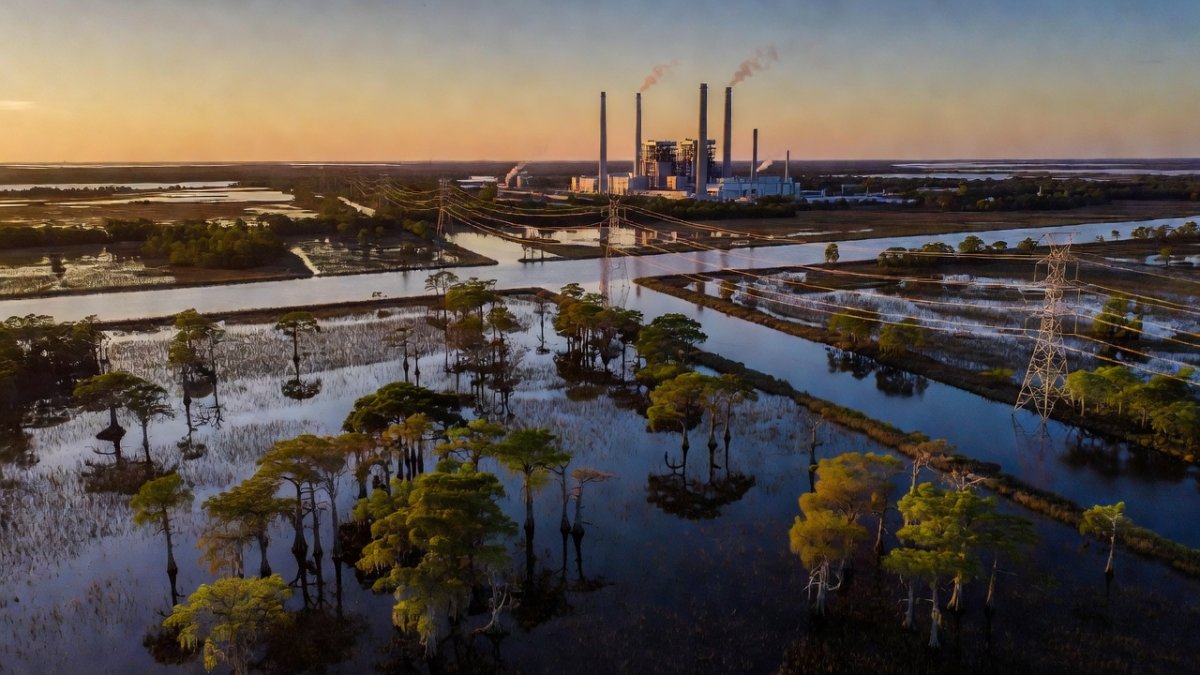
Let me show you the most Florida thing I've seen all year. A 202-acre parcel, surrounded by water on almost every side, sitting on President Donald J Trump Highway about 16 miles west of Mar-a-Lago. It's at the northern edge of the Florida Everglades, right across the street from a pump station that pushes freshwater into the southern Everglades. And an investment firm called PBA Holdings wants to park a 600-megawatt hyperscale data center there.
That's the news peg — the Guardian had it yesterday. But I've been sitting with this one since the county hearing, because it's not just another NIMBY fight. This is the AI buildout walking into one of the most ecologically fragile places in America, next to the president's own backyard, with a tenant nobody is legally allowed to name. And the county already voted it down 5-1 — and the developer is still coming.
The Project — Eight Times Bigger Than the Original Plan
Here's what's actually on the table. In 2016, the county approved a light-industrial site in Loxahatchee for 206,000 square feet of data storage. That was the deal: a modest server farm on an industrial parcel next to Florida Power & Light's West County Energy Center, one of the largest natural-gas power plants in the country — three units, 3,750 megawatts, enough for 750,000 homes.
Then AI happened. In December 2025, PBA Holdings came back with a revised plan: 1.79 million square feet of data center space — more than eight times the original — plus another 1.9 million square feet of warehouse space. Total buildout, 3.7 million square feet. At peak, this thing would draw 600 megawatts, which by US Energy Information Administration estimates is about half a million American homes' worth of power. The parking variance tells you everything about the facility's headcount: required spaces went from 7,168 down to 896, a ten-to-one cut for a campus that mostly runs itself.
And here's the part that should bother you no matter where you live: the operator — the actual company that will own the servers inside — is confidential. Shielded under a 2017 Florida statute, section 288.075, designed to "protect the state's competitive edge." Nobody at the county, nobody in the community, and nobody on the record can legally say who's moving in. County filings estimate the facility would use about 1.7 million gallons of water a month, and the exact cooling method hasn't been fully disclosed.
Why This Site — Power First, Nature Never
Let me be fair to the developer's logic, because it isn't stupid. A hyperscale data center needs massive, continuous, uninterruptible power. This parcel sits directly east of the FPL plant. That adjacency isn't a coincidence — it's the entire reason the site exists. If you're building a 600MW facility in 2026, you build next to generation, period.
That's the part I understand. I've been running hosting infrastructure for over a decade, and power proximity is the first question I ask about any facility. But here's the part I can't square: the generation is adjacent, and so is the Everglades. This is the same watershed that the federal government and the state of Florida have spent a combined $6 billion restoring after a century of drainage and development. Power adjacency got the developer to the table. It should never have gotten them a permit to build in a swamp.
And the tenant question makes it worse. Oracle co-founder Larry Ellison's family bought Lion Country Safari — 1.8 miles from this site — for $30 million in November 2025, which set off a guessing game analysts haven't stopped playing. Amazon, Microsoft, Google, Meta, Oracle — take your pick; nobody knows, and under the statute, nobody can force them to say.
The Environmental Math Nobody Wants to Do
Here's what the developer's own health-and-safety assessment admits, and what it conveniently doesn't. The assessment concedes the data center could heat the air one to two degrees Celsius around the cooling equipment. It then dismisses the idea that heat would reach the nearby community or school, because prevailing winds would carry it the other way. And it says nothing — nothing at all — about what that heat does to the water.
That's the gap that should scare everyone. The Everglades is already in trouble. Lake Okeechobee feeds into this watershed, and in recent summers, blue-green algae blooms have covered nearly half the lake. The cyanobacteria produce a toxin called microcystin that can make people and animals sick and contaminate drinking water. On July 30, the Florida Department of Health issued a health alert about cyanobacteria in the lake. The ingredients for blooms — phosphorus and nitrogen from decades of sugarcane fertilizer runoff — are already sitting in the canals. Warm the water even a couple of degrees, and you're adding fuel to a fire that's already burning.
Reinaldo Diaz grew up here and runs Lake Worth Waterkeeper, the nonprofit defending the watershed. He put it better than any consultant could: "Our watershed is really complex. Ours is more like a spiderweb. That's why the impacts would be far reaching." The developer says the facility would use closed-loop cooling that recirculates water. Fine. Closed-loop still dumps heat, and heat is the one variable this ecosystem can't absorb.
Remember what's at stake: the project site sits across the street from a pump station that's the first step in pushing freshwater to the southern Everglades. You don't need a degree in hydrology to see the problem with a 600MW heat source sitting across the road from a freshwater pump.
The Community Fight — 12 Hours, 5-1, and They Still Won't Quit
Now here's where this story stops being environmental and becomes political. At the county zoning hearing in July, residents testified about the elementary school roughly 1,200 feet from the site — noise, traffic, heat pollution, property values, power bills. After more than twelve hours of testimony, the commissioners voted 5-1 to deny the expansion. Sue Ellen Loyzelle, who lives in the neighboring planned community of Arden, told the Guardian what everyone in that room was thinking: "We don't want our bills to go up, but it's more than that. What is all of this going to do?"
And then there's the elephant in the room — or the man in the mansion, depending on how you look at it. Last month, President Trump held a press conference to double down on his non-binding Ratepayer Protection Pledge — the promise that data center developers should bear their own electricity costs. When the conversation turned to community opposition, he told residents essentially to get with the program: "You have to convince your community how great these things are. You can't fight it. You have to go with it."
Here's the thing, though: the county just showed you can fight it. And the fight isn't over. The July denial was "without prejudice," which in zoning terms means the developer can revise and refile. PBA Holdings has already said it's "taking time to evaluate our options moving forward." Two more administrative applications that could add square footage are still on the table. And PBA has spent $20 million on county approvals and power reliability — that is not the behavior of a company that's walking away.
The Regulatory Wave Is Coming to Florida
Next month, Palm Beach County commissioners vote on a moratorium against large-scale data centers. Several other Florida counties have already adopted similar measures. And here's the pattern I want you to notice: every one of these fights starts with one project pushing too hard in the wrong place, and ends with a blanket ban that makes life harder for every developer who plays by the rules.
That's the real cost of Project Tango. It's not just 600 megawatts and a couple million gallons of water. It's the Florida market telling every hyperscaler and every independent operator: you want to build here? You'll need a year of hearings, a public records fight over who you even are, and a commissioner vote that can go sideways at any moment. The opposition list reads like a civic roll call — the Arden homeowners association, the city of Westlake, the town of Loxahatchee Groves, the Everglades coalition, the county classroom teachers association, the school board, a state representative and a state senator.
Diaz said it best: "There's nowhere in Palm Beach county where it would be acceptable to put one of these. But the place they are choosing is egregious."
What This Means for Independent Hosting Providers
So what does a swamp in Palm Beach County have to do with your colo bill? Everything, if you're reading the room correctly.
First, power adjacency is no longer enough. Every hyperscaler already knows to build next to generation. The new differentiator is water and environmental adjacency — watershed boundaries, flood zones, wetland buffers, and the health of the water system you're about to heat. Build your siting checklist like a hydrologist, not just a network engineer.
Second, learn what "denied without prejudice" means: the project isn't dead, it's in revision. A 5-1 vote after twelve hours of testimony still leaves two more applications pending and a developer with $20 million sunk into approvals. Never assume a loss is a loss. Assume it's a pause, and plan your timelines accordingly.
Third, demand to know who the tenant is before you sign anything. The anonymity statute here is an extreme case, but the lesson is universal: if a deal hides the end customer behind legal shields, the risk lands on you when the project hits resistance. Vet the operator. Always.
Fourth, watch the moratorium wave. Florida counties are starting to say no, and that means supply in one of the country's biggest colo markets is about to tighten. If you're planning capacity in Florida — or any state where the backlash is spreading — lock space early, before the bans make it a seller's market.
The Bottom Line
The AI buildout doesn't need my permission, and it doesn't need yours. But it does need land, power, and water — and the places that have all three are exactly the places where communities are starting to say no. Project Tango is the clearest example yet: a 600MW facility in the Everglades watershed, 16 miles from Mar-a-Lago, with a tenant nobody's allowed to name, and a county that voted it down and is still bracing for the next round.
You can't fight it, they said. The people of Palm Beach County just spent twelve hours proving you can. The question now is whether the industry learns the lesson, or waits for the moratoriums to teach it the hard way.
— Allan Ali, Founder
This article was produced with AI-assisted research and editorial support. Sources: The Guardian (Aug 12, 2026), FloridaDataCenters.org, Business Insider, Insurance Journal, EnviroLink.
What's Your Reaction?
 Like
0
Like
0
 Dislike
0
Dislike
0
 Love
0
Love
0
 Funny
0
Funny
0
 Wow
0
Wow
0
 Sad
0
Sad
0
 Angry
0
Angry
0

Publisher of Global1.News. Automation architect, systems builder, and the guy making sure the truth gets published.















Comments (0)