
Chinese, Indonesian Navies Hold First Joint Drill East of Taiwan, Signaling New Phase in Regional Maritime Posture
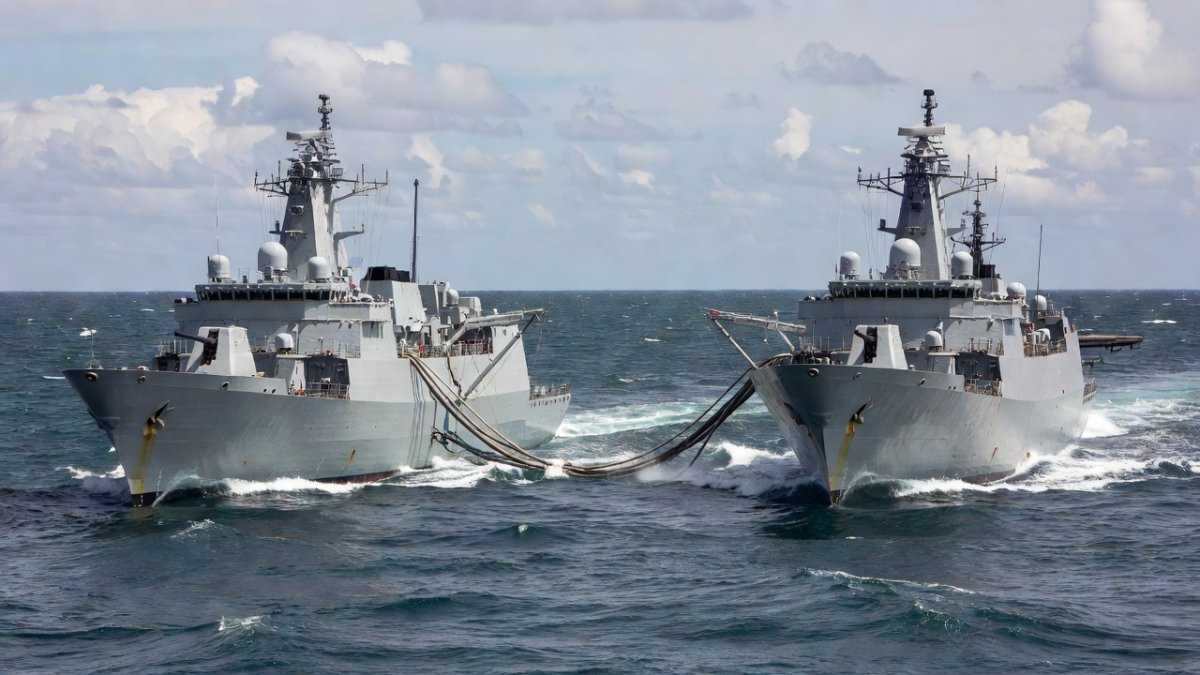
In a recent CGTN report, the Chinese and Indonesian navies were shown conducting a joint navigation exercise in waters east of Taiwan Island on Wednesday, August 12, 2026. The footage, released by China's PLA Eastern Theater Command, depicted the Chinese Navy's Type 054A guided-missile frigate Honghe and the Indonesian Navy's KRI I Gusti Ngurah Rai-332 frigate maneuvering in formation.
In a recent CGTN report, the Chinese and Indonesian navies were shown conducting a joint navigation exercise in waters east of Taiwan Island on Wednesday, August 12, 2026. The footage, released by China's PLA Eastern Theater Command, depicted the Chinese Navy's Type 054A guided-missile frigate Honghe and the Indonesian Navy's KRI I Gusti Ngurah Rai-332 frigate maneuvering in formation. While the drill itself—covering maritime communications, formation maneuvering, and underway replenishment—was tactically modest, its geographic location marks a significant strategic development. This marks the first time Beijing has conducted a bilateral naval exercise with a foreign power specifically in the waters east of Taiwan, transforming what might otherwise be routine seamanship into a potent geopolitical signal.
An Unprecedented Location: The Strategic Significance of the Eastern Corridor
The choice of location is the most consequential aspect of this exercise. For decades, the Taiwan Strait has been the primary focus of cross-strait military monitoring, a narrow and heavily surveilled waterway. However, the waters east of Taiwan represent the island's principal maritime depth—its strategic backyard and a critical corridor for the first island chain. According to regional defense analysts, including those at Defence Security Asia, this is the first Chinese exercise with a foreign navy specifically in this contested maritime zone.
By moving the exercise to the eastern approaches, Beijing is signaling a shift in its military calculus. The PLA Eastern Theater Command's announcement on Tuesday, August 11, framed the operation as a "navigation exercise," but the subtext is clear: China is demonstrating its ability to project power and coordinate with allied navies in areas that have traditionally been dominated by US-Japan naval presence. The location transforms limited seamanship drills into strategic signalling, suggesting that Beijing views the entire island of Taiwan—not just the strait—as within its operational sphere. This is a direct challenge to the notion that the eastern seaboard offers Taiwan a sanctuary for resupply or reinforcement in a crisis.
Beijing's Calculus: Normalizing and Multilateralizing Military Activity
For China, the exercise serves a dual purpose: normalizing its military presence around Taiwan and multilateralizing its sovereignty claims. Chinese military commentator Zhang Junshe characterized the event as "highly significant," arguing that inviting a foreign warship into waters under Chinese jurisdiction demonstrates Beijing's sovereign rights over the exclusive economic zone, continental shelf, and territorial waters east of Taiwan. This framing is deliberate. By having an Indonesian frigate participate, Beijing seeks to manufacture a semblance of international acceptance for its jurisdictional claims.
This is a strategic evolution from the daily deployments of warships, fighter jets, and coast guard vessels that Beijing already conducts around Taiwan. Those unilateral actions can be dismissed by Taipei and Washington as coercive pressure. A bilateral exercise, however, introduces a third-party element, creating a narrative that China's claims are not just self-asserted but recognized by other nations. The PLA Eastern Theater Command's statement emphasized that the exercise aimed at "enhancing operational capabilities, deepening practical cooperation, and jointly safeguarding regional peace and stability." The phrase "jointly safeguarding" is key—it implies a shared responsibility and a shared endorsement of China's maritime posture.
Jakarta's Balancing Act: Strategic Autonomy in a Contested Region
Indonesia's participation is a masterclass in strategic ambiguity, reflecting President Prabowo Subianto's "free and active foreign policy" (bebas aktif). Jakarta's framing of the event as a "Passing Exercise (Passex)" is designed to minimize its political weight. First Admiral Tunggul, head of the Indonesian Navy Information Service, emphasized that Passex is a "routine naval tradition" and "not war-fighting in nature," describing it as a "goodwill engagement" common among navies worldwide.
The context of the Indonesian frigate's journey is crucial. KRI I Gusti Ngurah Rai-332 was returning home from Vladivostok, Russia, where it had participated in Exercise Orruda 2026 with the Russian Navy. The ship's path home took it through waters east of Taiwan, where it encountered the Chinese frigate Honghe. For Jakarta, this was an opportunity to demonstrate its non-aligned credentials—showing that it can cooperate with Russia, China, and the United States in rapid succession without committing to any bloc.
However, the episode exposes the inherent tension in this approach. While Indonesia has no formal diplomatic ties with Taiwan (adhering to the One-China policy), it hosts over 300,000 Indonesian migrant workers on the island. Taipei's request for clarification from Jakarta highlights the diplomatic tightrope Indonesia walks. By participating in a drill that Taiwan's Mainland Affairs Council called a "military provocation" and "dangerous behaviour that undermines the status quo," Jakarta risks alienating a significant economic partner while simultaneously deepening ties with Beijing. The recent flurry of China-Indonesia engagements—including a think tank forum in Jakarta, a cultural exchange program celebrating Zheng He's legacy, and a Chinese navy task group visit—suggests that Prabowo is deliberately accelerating the bilateral relationship, but the Taiwan drill reveals the geopolitical costs of that acceleration.
Taipei's Reaction: Condemnation and the Struggle for Narrative Control
Taiwan's response was swift and unequivocal. The Ministry of Foreign Affairs "sternly condemned" what it described as China's "arbitrary and irresponsible" behavior, arguing that Beijing had "further increased tensions in the region." The Mainland Affairs Council went further, characterizing the exercise as a "military provocation" and "dangerous behaviour that undermines the status quo," asserting that Beijing was using foreign participation to "manufacture international acceptance of Chinese jurisdiction east of Taiwan."
Taipei's concern is not merely the military drill itself but the precedent it sets. Taiwan has long argued that its sovereignty extends to the waters east of the island, and it has actively patrolled these areas to assert its claims. The presence of a foreign navy in these waters, even in a limited Passex capacity, undermines Taipei's narrative of exclusive control. The MOFA's pledge to "actively safeguard" its sovereignty and "work with regional partners to ensure freedom of navigation" reflects a recognition that Taiwan cannot counter this multilateralization alone. The reported US urging of China to halt military pressure on Taiwan after the drill underscores that Washington views this as a significant escalation, but it also highlights the limits of US leverage in preventing third-party navies from engaging with Beijing.
Implications for the First Island Chain and ASEAN Unity
The broader implications of this exercise extend far beyond the immediate participants. The first island chain—a strategic concept encompassing Japan, Taiwan, the Philippines, and Indonesia—has long been the backbone of US containment strategy in the Indo-Pacific. By conducting a drill with Indonesia in waters east of Taiwan, Beijing is effectively driving a wedge into this chain, demonstrating that not all its links are aligned against China.
For ASEAN, this presents a profound challenge. The bloc has traditionally sought to maintain unity and neutrality in great-power competition. However, Indonesia's participation in this drill, even under the guise of a routine Passex, creates a precedent that other member states may be pressured to follow. If Beijing can secure similar "navigation exercises" with Malaysia, Vietnam, or the Philippines, it would fundamentally alter the security architecture of the region. The fact that Indonesia had just completed a drill with Russia in Vladivostok further complicates the picture, suggesting that Jakarta is willing to engage with all major powers simultaneously, a posture that may not be sustainable in the long term.
Strategic Assessment: A New Normal in the Taiwan Strait's Eastern Approaches
The China-Indonesia naval exercise east of Taiwan is a watershed moment in the Indo-Pacific's evolving security landscape. It represents Beijing's successful effort to internationalize its military activities around Taiwan, moving beyond unilateral coercion to bilateral cooperation. For China, the drill is a strategic victory: it has demonstrated that at least one ASEAN member is willing to operate alongside the PLA in contested waters, lending a veneer of legitimacy to its claims.
For Indonesia, the exercise is a calculated risk. Jakarta's "free and active" policy allows it to engage with any country, but the optics of a Chinese-Indonesian formation east of Taiwan may prove costly in terms of its credibility as a neutral arbiter in regional disputes. The balancing act between China, the US, and Russia is becoming increasingly precarious, and this drill may force Jakarta to more clearly define its strategic priorities.
For Taiwan, the message is stark: the waters east of the island are no longer a sanctuary. The daily patrols by Chinese vessels are now augmented by the potential for joint operations with foreign navies. As Beijing continues to deploy its forces around Taiwan on an almost daily basis, the international community must grapple with a new reality—one where the first island chain is not a barrier to Chinese power projection but a corridor for it. The drill on August 12 may have been small in scale, but its strategic resonance will be felt for years to come.
By Prof. Marcus Chen, Staff Writer
This article was produced with AI-assisted research and editorial support. Reporting is based on sources cited in the article.
What's Your Reaction?
 Like
0
Like
0
 Dislike
0
Dislike
0
 Love
0
Love
0
 Funny
0
Funny
0
 Wow
0
Wow
0
 Sad
0
Sad
0
 Angry
0
Angry
0

World Politics Analyst at Global1.News. Based in Beijing, covering US-China relations, global trade, and geopolitical strategy. Brings deep analytical perspective to the power dynamics shaping international affairs.














Comments (0)