
Evan Gershkovich Says His Arrest in Russia Was Carefully Planned FSB Sting
The account, published by The Moscow Times on 25 September 2026, sheds fresh light on the Kremlin’s use of the security apparatus to manufacture espionage cases against Western journalists, and it underscores the broader strategy of silencing independent reporting through legal pretexts.
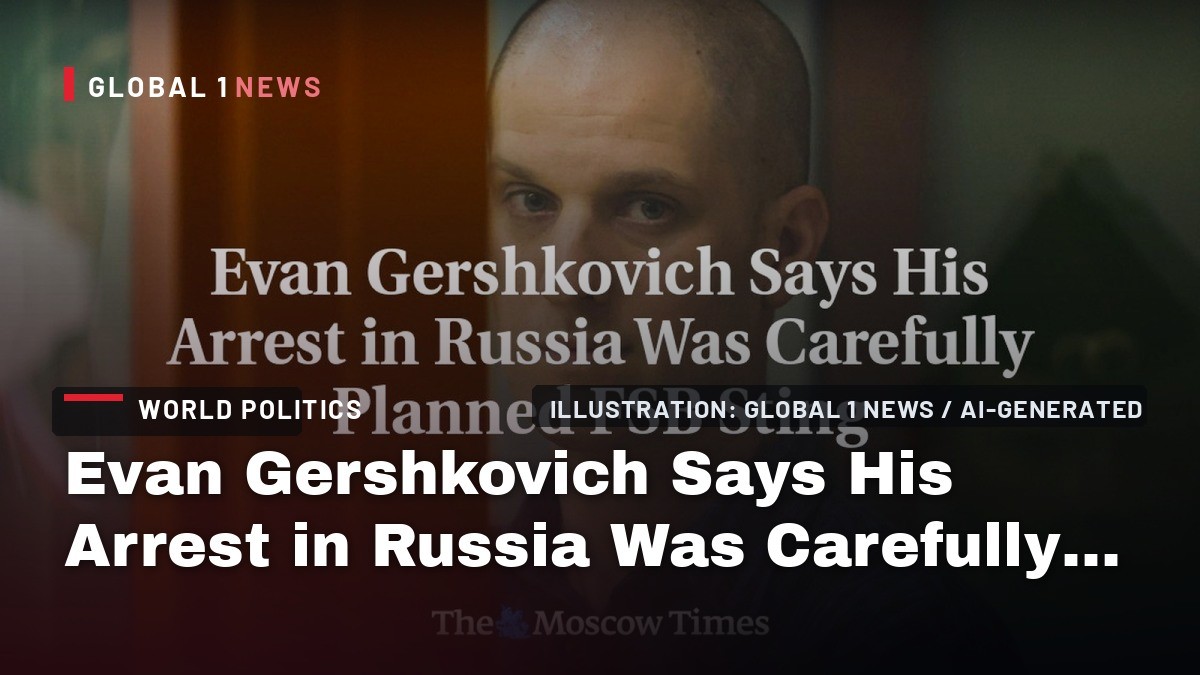
In a stark new excerpt from his memoir, former Wall Street Journal correspondent Evan Gershkovich recounts the moment he was seized by the Federal Security Service (FSB) in Yekaterinburg, confirming that his 2023 arrest was not a spontaneous raid but the culmination of a meticulously staged sting. The account, published by The Moscow Times on 25 September 2026, sheds fresh light on the Kremlin’s use of the security apparatus to manufacture espionage cases against Western journalists, and it underscores the broader strategy of silencing independent reporting through legal pretexts.
The Yekaterinburg Encounter: A Trap in Plain Sight
Gershkovich describes two meetings with a union boss from a defense‑industry factory in Yekaterinburg, a city that serves as a key hub for Russian tank production. During the second meeting, held in a steakhouse, the source produced hand‑copied tables of production figures and thrust the papers into the journalist’s hands despite prior instructions that no documents should be exchanged. As Gershkovich took notes, a group of masked men approached, and he was abruptly seized, handcuffed, and placed in a chokehold before being forced into a van.
The reporter’s narrative emphasizes the deliberate nature of the operation: “the source produced papers… thrust the papers into my hands,” he writes, suggesting that the source’s cooperation was part of an FSB‑orchestrated scenario designed to provide the security service with “evidence” of espionage. The timing of the arrest—immediately after the source handed over the documents—implies that the meeting itself was a pre‑arranged trap rather than a routine journalistic encounter.
From Detention to Prison Sentence: The Legal Trajectory
Following his capture, Gershkovich, then 31, became the first U.S. reporter arrested on espionage charges in Russia since the Cold War. He was subsequently sentenced to 16 years in a penal colony, a charge he and his editors have consistently denied, insisting that his work was legitimate journalism. The sentence was later commuted in an East‑West prisoner swap in August 2024, a diplomatic maneuver that highlighted the political weight of the case.
Gershkovich notes that the FSB had a “backup plan” to arrest him on a later trip to Siberia had the Yekaterinburg operation failed. This admission points to a broader, pre‑meditated strategy within the security services to secure a high‑profile espionage case, reinforcing the notion that the arrest was part of a larger Kremlin‑driven agenda rather than an isolated incident.
Putin’s Narrative and the Official Response
In a February 2024 interview with U.S. television host Tucker Carlson, President Vladimir Putin asserted that Gershkovich had been “caught red‑handed” while collecting confidential information, thereby endorsing the espionage narrative. The Kremlin has not offered a direct comment to The Moscow Times’ request for comment on the new memoir excerpt, maintaining the official line that the journalist was a spy.
Gershkovich’s claim that “Putin, it seems to me, fully bought into this narrative” suggests that the President’s public endorsement was not merely rhetorical but reflected a genuine belief—or at least a public acceptance—of the FSB’s fabricated case. This alignment between the security services and the highest office underscores the political utility of espionage charges as a tool for controlling foreign media narratives.
The “Unspoken Rule” of Diplomatic Immunity for Journalists
According to Gershkovich, there existed an “unspoken rule” that foreign correspondents, while not immune from expulsion, were generally spared from criminal prosecution. He writes that this tacit understanding was shattered by his arrest, marking a turning point in how the Russian state treats Western journalists. The breakdown of this convention signals a hardening of the Kremlin’s stance toward independent reporting, especially when coverage touches on sensitive defense‑industry topics.
The shift can be linked to broader legislative actions: the Prosecutor General’s Office has designated The Moscow Times as an “undesirable” organization and previously labeled it a “foreign agent.” These designations criminalize the outlet’s work and expose its staff to prosecution, effectively eroding the limited protections previously afforded to foreign correspondents.
Implications for the Russian Media Landscape
The targeting of Gershkovich and the subsequent branding of The Moscow Times illustrate a systematic approach to stifle dissenting voices. By framing journalistic activity as espionage, the Kremlin can justify harsh penalties while projecting an image of defending national security. This tactic dovetails with the broader crackdown on independent media, which has seen a cascade of legal and administrative pressures aimed at silencing critical reporting.
For Russian journalists, the message is clear: even well‑established foreign outlets are now vulnerable to criminal prosecution. The “undesirable” label carries severe penalties, including fines and imprisonment, and it further isolates independent media from the public sphere, limiting the flow of information that counters official narratives.
International Repercussions and Diplomatic Calculus
Gershkovich’s case has become a flashpoint in U.S.–Russia relations, illustrating how individual detentions can be leveraged in broader diplomatic negotiations. The 2024 prisoner swap that secured his release demonstrates that the Kremlin is willing to use high‑profile detainees as bargaining chips. However, the willingness to stage elaborate sting operations suggests a willingness to risk international condemnation in order to achieve domestic political objectives.
The episode also raises questions about the future of press freedom in Russia and the safety of foreign correspondents operating there. As the Kremlin tightens legal constraints, diplomatic channels may become the only viable avenue for securing the release of detained journalists, further politicizing the issue and intertwining it with broader geopolitical tensions.
Conclusion: A Cautionary Tale for Foreign Correspondents
Gershkovich’s memoir excerpt provides a rare, first‑hand glimpse into the mechanics of an FSB‑engineered espionage case. The deliberate hand‑off of documents, the coordinated raid, and the pre‑planned backup arrest plan reveal a calculated effort to manufacture a narrative that justifies the removal of a foreign journalist. This episode marks a decisive erosion of the “unspoken rule” that once protected foreign correspondents from criminal prosecution, signaling a new era of heightened risk for those covering Russia’s defense sector and other sensitive topics.
For the international press community, the lesson is stark: operating in Russia now demands heightened vigilance, rigorous risk assessments, and an awareness that the Kremlin may employ the security services to fabricate espionage charges as a tool of state control. As the case of Evan Gershkovich demonstrates, the line between legitimate reporting and alleged espionage can be deliberately blurred, with profound consequences for both individual journalists and the broader principle of press freedom.
This article was produced with AI-assisted research and editorial support. Reporting is based on the source material cited below. Sources: The Moscow Times; themoscowtimes.com; Global1.News (28 September 2026).
By Irina Volkov, Staff Writer
What's Your Reaction?
 Like
0
Like
0
 Dislike
0
Dislike
0
 Love
0
Love
0
 Funny
0
Funny
0
 Wow
0
Wow
0
 Sad
0
Sad
0
 Angry
0
Angry
0
Russia/Eastern Europe Correspondent at Global1.News. Covering Russian politics, energy, security, and the shifting dynamics of the post-Soviet space. Provides clear-eyed analysis on one of the world's most opaque regions.











Comments (0)