
Ecuador's Ex-President Moreno Sentenced for Corruption
Ecuador's former President Lenín Moreno sentenced to five years for bribery in the Coca Codo Sinclair dam scandal. He will appeal under house arrest. Third ex-leader convicted, highlighting regional anti-corruption trends and the project's troubled legacy.
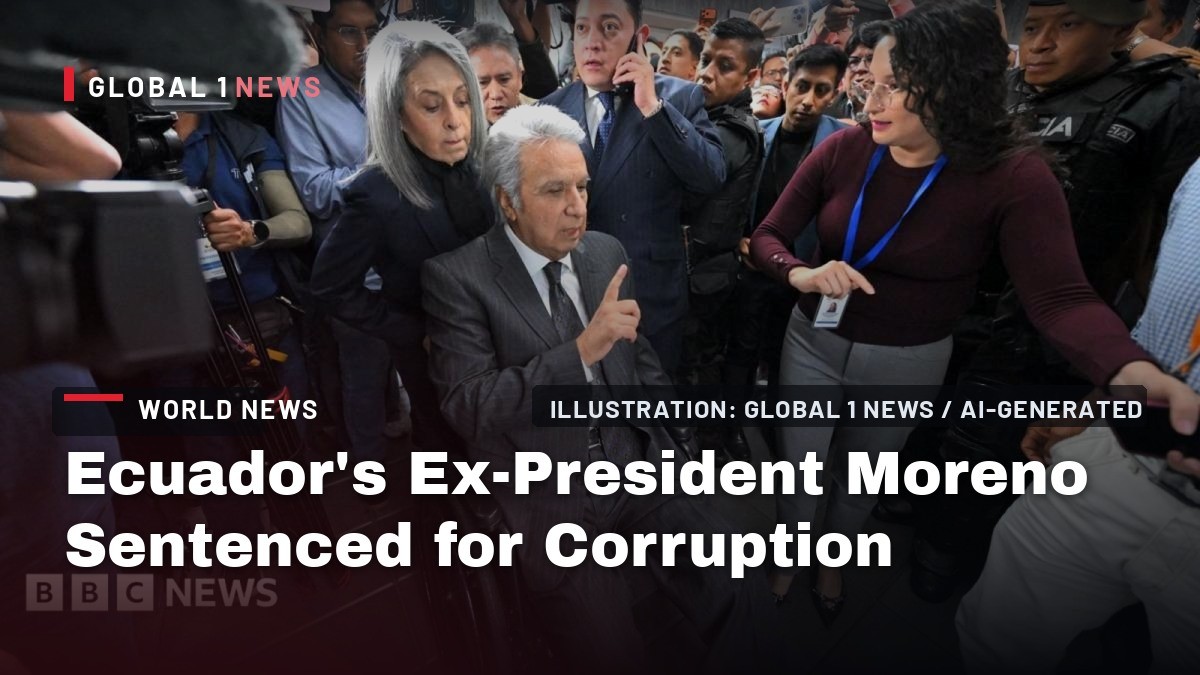
Ecuador's judicial reckoning with its recent political past reached a new milestone this week as a Quito court sentenced former President Lenín Moreno to five years in prison for his role in a sprawling bribery scheme tied to one of the country's largest infrastructure projects. The 73-year-old, who led the nation from 2017 to 2021, becomes the third former Ecuadorian president convicted of corruption in the past decade—a striking pattern in a region where anti-corruption prosecutions have reshaped political landscapes. Moreno, who suffers from a disability and will serve his sentence under house arrest, has already signaled his intention to appeal the verdict, prolonging a legal saga that has captivated the Andean nation.
Quito, Ecuador — The ruling, delivered by a court in the capital, found Moreno and 19 other defendants guilty of corruption charges stemming from the construction of the Coca Codo Sinclair hydroelectric dam, a massive project that was meant to transform Ecuador's energy grid. The court's decision marks the culmination of a years-long investigation that exposed how Chinese state-owned firm Sinohydro allegedly funneled millions of dollars through shell companies to secure the lucrative contract. Moreno's wife, daughter, and brother were also handed prison sentences, along with former plant managers, Sinohydro representatives, and even a former Chinese ambassador to Ecuador, according to court documents and prosecutors' statements.
A $76 Million Scheme Unraveled
Prosecutors alleged that Sinohydro paid a total of $76.1 million—approximately £56.2 million—through a network of shell companies to individuals involved in the deal to guarantee the dam's construction. The payments, which spanned several years, were designed to lubricate the approval and execution of the Coca Codo Sinclair project, a hydroelectric facility located in the Amazonian foothills of Napo Province that was touted as a cornerstone of Ecuador's energy independence.
While Moreno himself was alleged to have received relatively little from the scheme, prosecutors said his family members received tens of thousands of dollars in bribes. The court ordered all those convicted of bribery to repay three times the amount they received, a punitive measure intended to strip illicit gains and deter future corruption. Moreno was additionally barred from holding public office, a sanction that effectively ends any political comeback for the former leader.
Moreno's Defense and the Shadow of Correa
From the outset, Moreno has denied any involvement in the alleged bribery scheme, insisting he never took money from Sinohydro. In his defense, he has pointed the finger at his predecessor and former ally, Rafael Correa, under whom he served as vice president from 2007 to 2013. Moreno argued that Correa had personally signed off on the Coca Codo Sinclair project and that he himself had launched an investigation into construction issues when he assumed the presidency in 2017.
Correa, who now lives in exile in Belgium, was sentenced to eight years in prison in a separate bribery case in 2020, a conviction that has deepened the rift between the two men who once shared a political movement. Moreno's legal team has framed the current verdict as a politically motivated attack, echoing Correa's own claims of judicial persecution. However, prosecutors and anti-corruption watchdogs have pointed to the extensive documentary evidence and witness testimony that underpinned the case, arguing that the convictions reflect a pattern of systemic graft that plagued Ecuador's public contracting for years.
A Pattern of Presidential Convictions
Moreno's sentencing places him in an unenviable club of Ecuadorian leaders convicted of corruption. Before him, Correa received his eight-year sentence in 2020 for accepting bribes from construction companies in exchange for government contracts. Earlier, former President Abdalá Bucaram, who led the country briefly in the 1990s, was convicted and fled to Panama to avoid imprisonment. The succession of convictions has sent a powerful signal across Latin America, where anti-corruption efforts have gained momentum in countries like Brazil, Peru, and Guatemala, often targeting the highest echelons of political power.
For Ecuador, the cases have become a defining feature of its recent political history, reflecting a broader regional trend where citizens and courts have demanded accountability from leaders once considered untouchable. The trials have also exposed the intricate web of relationships between foreign corporations, local intermediaries, and political families—a dynamic that resonates deeply in a region where infrastructure megaprojects have frequently become vehicles for illicit enrichment.
The Coca Codo Sinclair Dam's Troubled Legacy
The dam at the center of the scandal has itself become a symbol of the project's troubled legacy. Shortly after its completion, cracks appeared in the structure, and other technical failures emerged, raising questions about the quality of construction and oversight. In 2021, the Ecuadorian government launched legal proceedings against Sinohydro over these defects, seeking compensation for the damage and the cost of repairs.
Earlier this year, the government reached a $400 million settlement with the firm's owner, a resolution that provided some financial relief but did little to restore public confidence in the project. The dam, located on the Coca River in the province of Napo, was designed to generate approximately 1,500 megawatts of electricity, making it one of the largest hydroelectric facilities in the country. Its operational problems have forced Ecuador to rely on imported energy at times, undermining the very goals of energy sovereignty that the project was supposed to achieve.
Regional Implications and the Fight Against Graft
The Moreno verdict arrives at a moment when Latin American governments are grappling with how to institutionalize anti-corruption measures without descending into political vendettas. In Ecuador, the judicial system has been under intense scrutiny, with critics on both sides accusing courts of bias depending on the political affiliation of the defendant. The Moreno case, like Correa's before it, has polarized public opinion, with supporters of the former president decrying the verdict as a miscarriage of justice and opponents hailing it as a victory for the rule of law.
Beyond Ecuador's borders, the case serves as a cautionary tale for foreign investors and state-owned enterprises operating in the region. Sinohydro, a subsidiary of China's PowerChina, has faced increased scrutiny in other Latin American countries where it has secured contracts, and the Ecuadorian case may prompt stricter due diligence requirements from governments seeking to avoid similar scandals. The Chinese embassy in Ecuador and Sinohydro have been approached for comment, though neither has issued a public response to the verdict as of this writing.
What Comes Next for Moreno and Ecuador
Moreno's appeal will now move through Ecuador's judicial system, a process that could take months or even years. Under the terms of his house arrest, he will remain confined to his residence in Quito, where he has lived since leaving office. His age and disability—he has used a wheelchair since a 1998 shooting that left him partially paralyzed—were cited by the court as reasons for the lenient custodial arrangement, a decision that has drawn both sympathy and criticism.
For Ecuador, the verdict closes a chapter but opens new questions about the extent of corruption in public contracting and the effectiveness of judicial remedies. The government has pledged to continue pursuing corruption cases, and prosecutors have indicated that additional investigations into other infrastructure projects may be forthcoming. As the nation watches the appeal unfold, the Moreno case stands as a reminder that in Latin America, the fight against graft is often a long and contentious battle—one that tests the resilience of democratic institutions and the patience of citizens demanding accountability.
This article was produced with AI-assisted research and editorial support. Sources: BBC News.
By Elena Vasquez, Staff Writer
What's Your Reaction?
 Like
0
Like
0
 Dislike
0
Dislike
0
 Love
0
Love
0
 Funny
0
Funny
0
 Wow
0
Wow
0
 Sad
0
Sad
0
 Angry
0
Angry
0

Latin America Correspondent at Global1.News. Based in Mexico City, covering politics, economics, energy, and culture across the region. Brings an on-the-ground perspective to stories spanning from the Rio Grande to Patagonia.












Comments (0)