
Crowds welcome Venezuela's María Machado after months in exile
María Corina Machado stepped onto Venezuelan soil on Sunday, ending more than ten months of exile that began with a midnight escape on a speedboat. From exile to homecoming: the journey back Machado’s return was not a spontaneous decision.
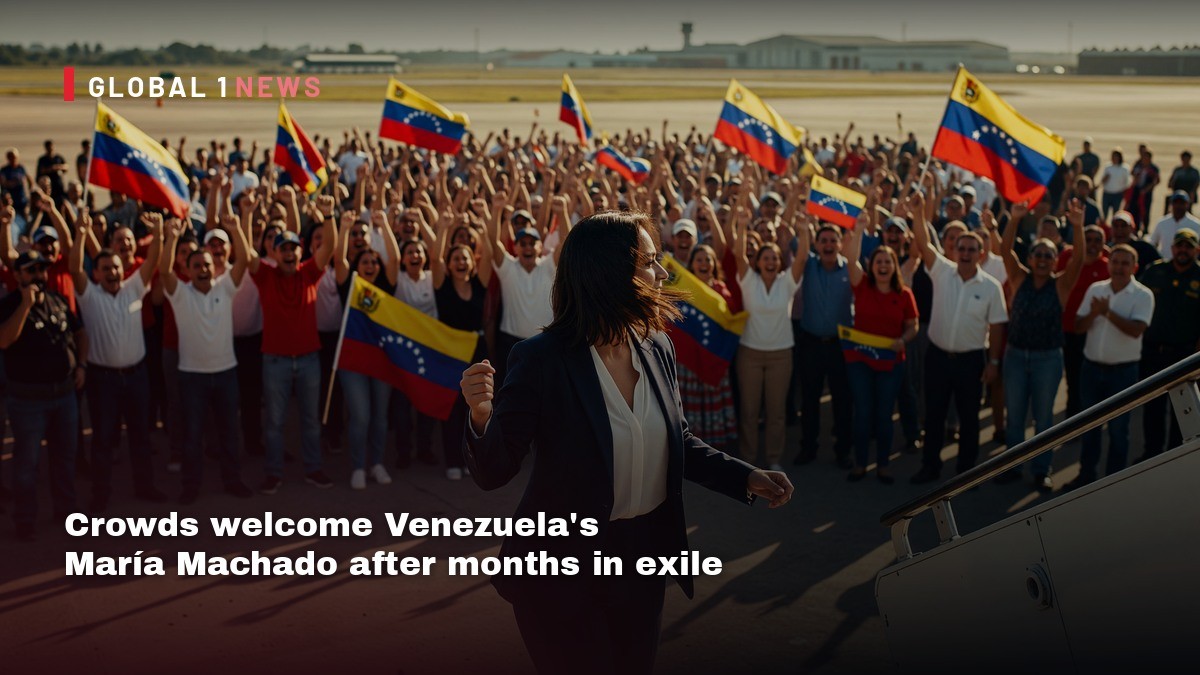
María Corina Machado stepped onto Venezuelan soil on Sunday, ending more than ten months of exile that began with a midnight escape on a speedboat. Her arrival was marked by a sea of supporters in Lara and a massive procession through Caracas, a visual testament to the deep yearning for political alternatives in a nation still grappling with authoritarian rule.
From exile to homecoming: the journey back
Machado’s return was not a spontaneous decision. After fleeing the country under cover of darkness to attend the Nobel Peace Prize ceremony in Norway, she spent nearly a year navigating a precarious existence abroad. The BBC reported that her exile lasted “more than 10 months,” a period during which she remained a vocal critic of President Nicolás Maduro from afar.
Her re‑entry began with a solemn Mass in the state of Lara, where she was greeted by jubilant supporters. The choice of a church ceremony underscored the intertwining of faith and politics in Venezuela, where religious gatherings often serve as safe spaces for dissent. From there, Machado joined a procession that wound through the capital, flanked by crowds whose chants echoed the hope for change.
The political backdrop: Maduro, the US, and the interim government
The context of Machado’s exile is inseparable from the broader power struggle that has defined Venezuelan politics for years. In January of the previous year, the United States seized President Nicolás Maduro, a move that intensified diplomatic tensions. That same month, Machado escaped the country, a timing that suggests her departure was partially motivated by the heightened risk of repression following the US action.
Following Maduro’s seizure, the Trump administration backed Delcy Rodríguez, Maduro’s deputy, as the interim president. Rodríguez’s swearing‑in was presented as a transitional step, yet the move was widely viewed as a continuation of the regime’s grip on power, merely reshuffling the same inner circle. Machado’s return, therefore, arrives at a moment when the opposition’s prospects remain uncertain, but the symbolic weight of her presence cannot be dismissed.
Why Machado matters to the opposition
Machado is more than a name on a ballot; she embodies a strand of the Venezuelan opposition that combines legal expertise, civil‑society activism, and a willingness to confront the regime directly. Her exile amplified her profile internationally, especially after her appearance at the Nobel ceremony, which highlighted Venezuela’s humanitarian crisis on a global stage.
Supporters in Lara and Caracas greeted her with chants and banners, signaling that her personal narrative resonates with ordinary citizens who have endured shortages, inflation, and political repression. The crowds’ enthusiasm suggests that Machado remains a rallying point for those yearning for a democratic transition, even as the opposition grapples with internal divisions and external pressures.
The symbolism of the mass and the streets
The decision to attend Mass before marching through the capital carries deep cultural resonance. In a country where the Catholic Church has historically mediated between the state and the populace, a public worship service can be read as a plea for moral legitimacy. It also signals a peaceful approach, contrasting with the violent confrontations that have marked many recent protests.
When Machado’s convoy moved through Caracas, the “huge crowds” that lined the route turned the city’s streets into a living tableau of dissent. The visual impact of thousands gathering under a single banner of support sends a powerful message to both the regime and the international community: the opposition still commands a significant base of popular backing.
International reactions and the US stance
The United States’ decision to seize President Maduro earlier in the year was a bold diplomatic maneuver, reflecting Washington’s continued involvement in Venezuelan affairs. While the source does not detail subsequent US statements regarding Machado’s return, the broader pattern suggests that Washington will likely view her homecoming as an opportunity to press for democratic reforms.
Nevertheless, the region’s history of foreign intervention fuels a cautious skepticism among many Venezuelans. The legacy of external meddling, whether from the United States or other powers, has often been invoked by the regime to delegitimize opposition figures. Machado’s return, therefore, must navigate the fine line between leveraging international support and maintaining a home‑grown legitimacy.
Challenges ahead for Machado and the opposition
While the crowds’ enthusiasm is palpable, the practical hurdles facing Machado are formidable. The regime’s security apparatus remains entrenched, and the interim government led by Delcy Rodríguez has not signaled any willingness to open political space. Moreover, the opposition’s fragmented nature—ranging from moderate reformists to radical activists—poses internal challenges in forming a unified front.
Machado’s next steps will likely involve re‑establishing her political network, engaging with grassroots movements, and possibly seeking legal avenues to challenge the regime’s legitimacy. Her ability to translate symbolic support into concrete political leverage will determine whether her return marks a turning point or remains a poignant moment of hope.
What the homecoming means for ordinary Venezuelans
For many Venezuelans, the sight of Machado walking among them is a reminder that opposition voices can survive exile and return home. In a country where daily life is marked by scarcity and uncertainty, such moments of collective affirmation can bolster morale and inspire renewed civic participation.
Yet, the reality on the ground remains harsh. While the crowds celebrated, the underlying economic and humanitarian crises persist. The challenge for Machado and her supporters will be to channel the emotional surge into sustained action that addresses the material needs of the population, not merely symbolic victories.
This article was produced with AI-assisted research and editorial support. Reporting is based on the source material cited below. Sources: BBC News Latin America; bbc.co.uk; Global1.News (28 October 2026).
By Elena Vasquez, Staff Writer
What's Your Reaction?
 Like
0
 Dislike
0
 Love
0
 Funny
0
 Wow
0
 Sad
0
 Angry
0
Latin America Correspondent at Global1.News. Based in Mexico City, covering politics, economics, energy, and culture across the region. Brings an on-the-ground perspective to stories spanning from the Rio Grande to Patagonia.










Comments (0)