
Colombia and Brazil deadliest countries for environmental activists, report says
Colombia and Brazil have once again emerged as the most lethal battlegrounds for those who stand up to protect the land and its people, according to the latest Global Witness report.
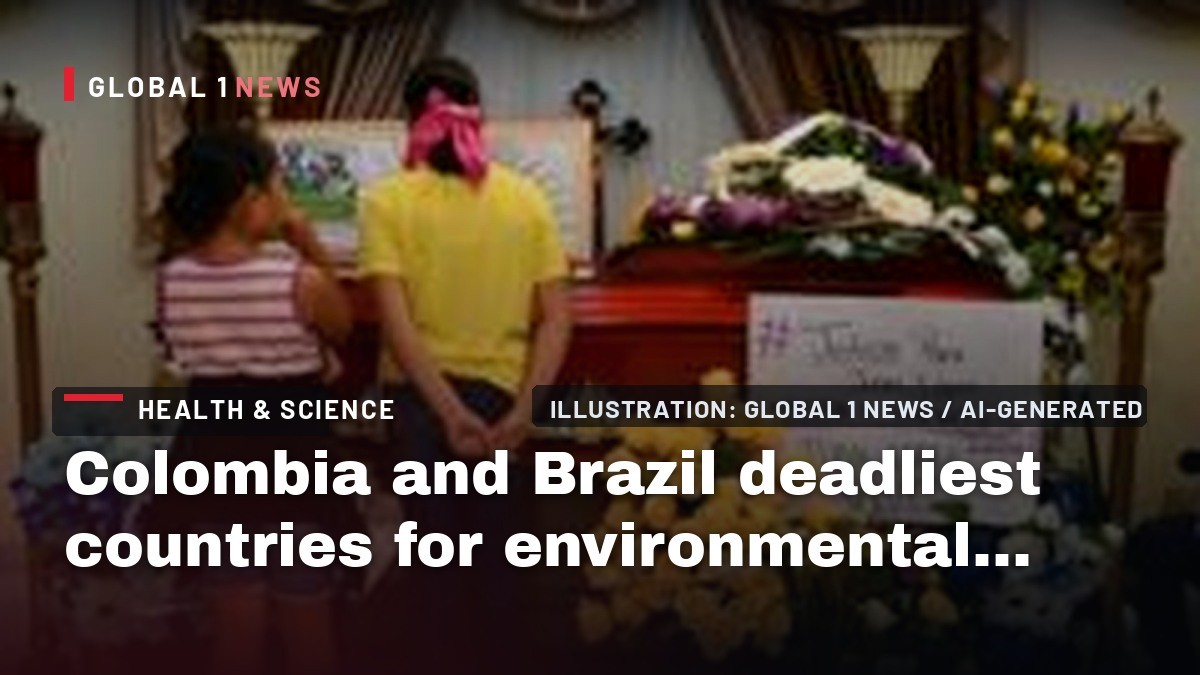
Colombia and Brazil have once again emerged as the most lethal battlegrounds for those who stand up to protect the land and its people, according to the latest Global Witness report. In 2025, the two nations together accounted for more than half of all documented murders of environmental activists worldwide, a stark reminder that the fight for the forest, the river and the soil is increasingly a fight for life itself.
The grim statistics of 2025
Global Witness recorded at least 124 killings of land and environmental defenders across the globe last year. Of those, 39 victims were in Colombia and 26 in Brazil, meaning the two countries together were responsible for 52 percent of the worldwide total. The report also highlighted that 85 percent of all documented murders took place in Latin America, cementing the region’s reputation as the deadliest for activists since the organization began publishing its annual findings in 2012.
While the global tally fell from 146 recorded killings in 2024 to 128 in 2025, the agency cautioned that the numbers are likely an underestimate. Many cases remain hidden, especially in remote or conflict‑ridden areas where families fear retaliation and authorities are reluctant to investigate.
Colombia’s relentless pattern
Colombia has topped the list for the past four years, and 2025 was no exception. The country’s 39 slain defenders represent a significant portion of the global total, and the victims are not a random cross‑section. Almost half of those killed belonged to indigenous communities, while many of the remainder were small‑scale farmers whose livelihoods depend on the land they defend.
These activists are often caught in the crossfire of illegal armed groups seeking to expand coca cultivation or illegal mining operations. The report notes that indigenous guards—unarmed volunteers who patrol their territories—are increasingly targeted. The recent murder of Jacob Guachetá Zambrano, a member of an indigenous guard in Cauca, underscores the heightened risk faced by those who simply try to watch over their own lands.
The surge in Brazil
Brazil saw a stark increase in defender killings, with the number of documented murders doubling in 2025 compared with the previous year. The 26 victims recorded by Global Witness were largely linked to land conflicts, mirroring the pattern seen in Colombia. As Brazil’s Amazon and other ecosystems face mounting pressure from illegal logging, mining and agribusiness expansion, the violence against those who oppose such exploitation has intensified.
Although the report does not break down the profiles of Brazil’s victims, the similarity to Colombia’s situation suggests that many are likely small‑scale farmers and community leaders who stand in the way of powerful interests seeking to appropriate land for profit.
Land disputes as the engine of violence
Both countries share a common driver behind the killings: land disputes. In Colombia, illegal armed groups are eager to push into territories traditionally held by indigenous peoples and small farmers, often to plant coca or to extract minerals without regard for the environment or local rights. In Brazil, the conflict revolves around similar pressures—deforestation, illegal mining and the encroachment of agribusiness onto lands claimed by rural communities.
These disputes are not merely legal battles; they are fought with guns, intimidation and, increasingly, with hired hitmen. The Global Witness report emphasizes that many of the murders were carried out by professional killers or members of organized crime gangs, indicating a level of coordination and impunity that makes the threat to activists both systematic and relentless.
Indigenous protection networks under fire
In response to the growing danger, many indigenous groups in Colombia have formed their own protection networks, known as indigenous guards. These volunteers patrol their territories, often on foot, and do so without weapons, relying on the moral authority of their communities. Yet the report shows that this very visibility makes them prime targets for illegal armed groups seeking to intimidate or eliminate resistance.
The murder of Jacob Guachetá Zambrano, a guard from Cauca, illustrates the brutal calculus of these groups. While investigators are still probing the motive, indigenous leaders have long warned that threats, forced disappearances and killings are routine in regions where illegal actors vie for control. The guards’ unarmed status underscores the asymmetry of power and the desperation of communities trying to defend their ancestral lands.
Regional context and global comparison
Latin America’s share of 85 percent of activist killings starkly contrasts with other regions. Outside the continent, Asia accounted for 12 percent of the documented murders, with the Philippines leading that tally at 12 cases. The disparity highlights how the continent’s entrenched land conflicts, combined with powerful illegal economies, create a uniquely lethal environment for defenders.
Even as the overall global count of documented killings fell from 146 in 2024 to 128 in 2025, the concentration of violence in Latin America signals that progress elsewhere is being offset by a deepening crisis at home. The Global Witness report warns that the numbers likely understate the true scale, as many cases go unreported due to fear, corruption or lack of investigative capacity.
Looking ahead: what the data tells us
The patterns emerging from the 2025 data paint a bleak picture for environmental defenders in Colombia and Brazil. The persistence of land‑related violence, the targeting of indigenous guards and the surge in Brazil’s murder rate suggest that without decisive action, the trend will continue. The report’s emphasis on organized crime involvement points to a need for stronger law enforcement and protection mechanisms that can confront well‑armed illegal groups.
For the communities on the front lines, the stakes are existential. Protecting the forest, the river and the soil is not an abstract cause; it is a daily struggle for survival against forces that view the land as a commodity to be seized. As the numbers reveal, the cost of that struggle is measured in lives—lives that the world cannot afford to lose if we are to preserve the ecosystems and cultures that define Latin America.
This article was produced with AI-assisted research and editorial support. Reporting is based on the source material cited below. Sources: BBC News Latin America; bbc.co.uk; Global1.News (16 September 2026).
By Elena Vasquez, Staff Writer
What's Your Reaction?
 Like
0
Like
0
 Dislike
0
Dislike
0
 Love
0
Love
0
 Funny
0
Funny
0
 Wow
0
Wow
0
 Sad
0
Sad
0
 Angry
0
Angry
0

Latin America Correspondent at Global1.News. Based in Mexico City, covering politics, economics, energy, and culture across the region. Brings an on-the-ground perspective to stories spanning from the Rio Grande to Patagonia.













Comments (0)