
Citi Turns 6.5 Billion Card Transactions Into an Advertising Business
Citi's U.S. Consumer Cards business launched Citi Commerce Media on September 23, an advertising platform that lets brands target the bank's 70 million U.S. customers using 6.5 billion annual transactions. Customers must opt out.
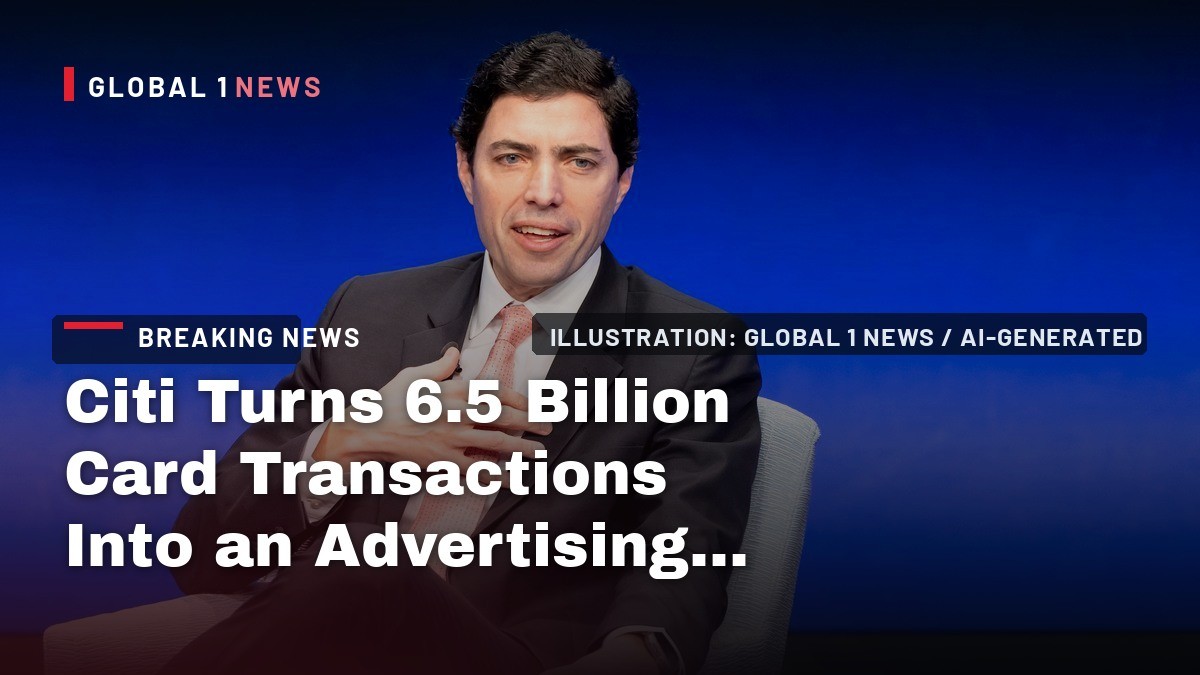
Your credit card stopped being just a way to pay. It is now the inventory. Citi's U.S. Consumer Cards business launched Citi Commerce Media on September 23, a platform that lets brands aim advertising at the bank's more than 70 million U.S. customers using their spending histories as the targeting signal.
Citi Turns 6.5 Billion Card Transactions Into an Advertising Business
New York, United States - The bank that issues your card is now the company selling brands access to your shopping habits. Citi says the new network draws on 6.5 billion annual transactions across more than 700 spending categories, and that early pilot campaigns delivered measurable lifts in spending for the advertisers who used it.
A Media Business, Not a Loyalty Program
Citi Commerce Media is a media business, structured like one, with three named capabilities the bank is pitching to brand marketers. The first is audience discovery. Citi says it uses first-party transaction data to help brands identify high-intent audiences and spot emerging consumer needs as purchase decisions begin to take shape. The second is distribution, with ads placed across Citi.com, the Citi Mobile app and what the bank describes as additional paid media properties. The third is measurement, which Citi calls closed-loop, meaning campaign performance is scored against actual transaction outcomes and converted into return on ad spend. "Citi Commerce Media is an important step in advancing Citi's strategy to create more connected, personalized experiences across our commerce ecosystem," said Abhinav Anand, Citi's head of value cards, lending and commerce. The scale claim is the headline. More than 70 million U.S. customers. More than 700 spending categories. And the number a media buyer cares about most: 6.5 billion transactions a year.
The Pitch: Your Spending Pattern Is the Product
What Citi is selling is not a billboard. It is a decision. The bank's own example is blunt. A customer with a history of spending on expensive vacations could see a 10 percent off offer from a travel company while scrolling on Facebook. Citi said it ran pilot campaigns across retail, payments, technology, and health and beauty brands. Two of those campaigns produced an average 15 percent lift in spending compared with customers who were not shown the ads. At least one online retailer, Citi said, saw up to five times incremental return on ad spend. "We are focusing primarily based on your spending pattern, and that's what the advertisers care the most about," Anand said. That sentence is the entire business model. Not who you say you are. Not what you told a survey you wanted. What you bought, and when.
The Bank Sees What the Retailer Cannot
Retail media has spent a decade being built by companies that sell things. Walmart, Amazon and the large grocers run ads against what shoppers browse and buy inside their own ecosystems. A bank with a large card portfolio sees a different shape entirely. Transactions are not confined to a single storefront. As PYMNTS put it, a retailer can see what customers buy from that firm's own channels, while a bank can see spending across a much wider range of merchants. Anand said he sees an opportunity to take spending share from retail media networks that have more limited data. That framing is generous to himself and also correct on the structural point. A card issuer watches money move across travel, dining, entertainment and retail in one ledger. There is a real limit, though. A card transaction identifies the merchant and the amount. It does not necessarily show every product in the basket, which is exactly the gap other companies are now rushing to fill.
Citi Is Late and Knows It
Citi is not first. JPMorgan Chase launched Chase Media Solutions in 2024, drawing on transaction information from roughly 80 million consumers. PayPal opened an ads business that same year. Mastercard and American Express followed with commerce media moves in the fall of 2025. FIS runs an adjacent offers network called Smart Basket. Anand acknowledged the field is crowded. He said he is not overly concerned about arriving after the first wave, pointing to Citi's credit card customer base and the fact that earlier entrants had already demonstrated advertiser demand. Kasha Cacy, chief media officer at the agency Known, gave a measured read. "Citi certainly should have a lot of purchase behavior, maybe not to Amazon's scale but not insignificant, and if you can target off that, it could become very interesting, especially as an alternative to Amazon," she said. Being an alternative to Amazon is a real position. Being the fourth bank to try it is not automatically a win.
The Money Behind the Move
Follow the revenue. EMARKETER, a Business Insider sister company, forecast that financial media networks would pass $1 billion in U.S. ad spend by 2026 and grow at a compound annual growth rate of over 66 percent through 2027. The timing matters. Interchange, the fee a bank collects when a card is used, remains large but is under pressure. The Federal Reserve Bank of St. Louis estimated that U.S. banks collected about $66 billion in interchange fees in 2025, up from $64 billion in 2024, and regulation of debit interchange for large issuers remains under debate. Commerce media offers economics that do not depend on the swipe. Brands pay for advertising, customer acquisition and measurable sales. For a bank, that is a second revenue line attached to an asset it already owns, which is the cardholder relationship. PYMNTS notes that the interchange link is economic rather than causal, since neither Citi nor Chase has cited interchange pressure as its reason for launching. The logic of the pivot is still hard to miss.
Kard Is the Missing Piece
The platform is running without one of its planned components. Citi agreed in August to acquire Kard, a commerce media and rewards platform. The deal has not yet closed. When it does, Citi expects Kard to do two things. First, give the new network a built-in market of merchants to sell advertising to, which addresses the cold-start problem that kills most new ad platforms. Second, expand the platform's targeting and loyalty capabilities. Anand said Citi is also betting on a feature that lets advertisers reach customers at different points in the purchase cycle rather than only at the moment of intent. This sits inside a broader restructuring. Citi chief executive Jane Fraser has consolidated the bank's card businesses into a single U.S. Consumer Cards division, and the bank has been telling investors that returns are improving. At a September conference, chief financial officer Gonzalo Luchetti said Citi expects full-year 2026 return on tangible common equity to come in above 11 percent, at the top end or slightly beyond its earlier guidance range.
The Fine Print Is an Opt-Out, Not an Opt-In
Here is the part every Citi cardholder should read twice. As Business Insider reported, Citi customers must opt out if they do not want to see these ads. That is the default architecture of U.S. financial privacy. Participation unless you object. It is not consent in the way most people understand the word. Anand defended the design. "We have built our business on years of history of Citi being a very trusted financial advisor," he said. "And we continue to bring those principles forth. Also, the ads and offers we are going to present to you in the Citi ecosystem would be highly personalized to you and not just willy-nilly showing up." The risk is not hypothetical, and Business Insider said so directly. Given the level of information financial companies hold about their customers, entering advertising requires them to be transparent about how they use that data.
Why Regulators Have Not Stopped It
The legal foundation is the Gramm-Leach-Bliley Act of 1999. Section 502 of that law generally prohibits a financial institution from disclosing nonpublic personal information about a consumer to nonaffiliated third parties unless the institution satisfies notice requirements and the consumer has not elected to opt out. Notice first. Objection second. Silence equals permission. Then there is the exemption problem. Financial institutions subject to the federal law have largely been carved out of state comprehensive privacy laws, which typically exempt regulated entities outright or exempt the data those entities already handle. A Consumer Financial Protection Bureau report noted that 18 states had passed comprehensive privacy laws and that financial information processed by financial institutions is, in large part, exempted from them. That is beginning to shift. Montana enacted a law in May 2025 that eliminated the broad financial-institution exemption. Connecticut followed with a measure effective October 1, 2025, that removed the entity-level exemption and replaced it with a narrower one covering only data actually subject to the federal law. The consumer bureau has also argued that the 1999 law's preemption provision would not prevent states from applying their own privacy rules to financial data. For now, most of that fight is still ahead.
What Your Card Data Actually Shows
Advertising pitches tend to overstate what a data set contains, so it is worth being precise about the raw material. A card transaction tells a firm which merchant you paid and how much. It does not necessarily tell the firm which items were in your basket. That is why FIS, through its Smart Basket product, is matching offers to individual items at checkout using real-time purchase information and receipt-backed measurement. The commercial case for closing that gap comes from PYMNTS Intelligence. An April study of 2,754 U.S. consumers found that half of the offers available at checkout went unseen, tying $42.4 billion, or 34 percent of the $125.4 billion in grocery, retail and restaurant spending examined, to missed or unredeemed offers. On the merchant side, an August PYMNTS Intelligence study found that 58 percent of 60 surveyed grocers, retailers and restaurants had used checkout-integrated promotions in the past year, while 65 percent said limits on data access constrained their ability to personalize. In July, 90 percent of surveyed issuers said they were very or extremely interested in embedded checkout promotions.
What This Means for You
Three things, and none of them require panic. First, know which side of the default you are on. If you hold a Citi card, you are inside the ad-targeting pool unless you opt out. The same logic applies to Chase, Mastercard, American Express and PayPal customers in their respective programs. Second, go read the privacy notice you almost certainly never opened. It has to tell you what is shared and with whom, and the notice is boring on purpose. Third, assume the notice will change. Financial media networks are forecast to grow fast in the next few years, and every new entrant rewrites its disclosures to accommodate the new business. The uncomfortable truth in this story is not that a bank wants to sell ads. It is that your transaction history, the boring and unglamorous record of every gas station and grocery run, turned out to be the most valuable asset you never knew you were generating. Find the opt-out. Read the notice. Make them ask.
By Jessica Ali, Staff Writer
This article was produced with AI-assisted research and editorial support. Sources: Citi press release, Citi U.S. Consumer Cards, Business Insider and CMO Insider, PYMNTS and PYMNTS Intelligence, EMARKETER, MediaPost, PaymentsJournal, Fintech Garden, MarketScreener, Federal Reserve Bank of St. Louis, Consumer Financial Protection Bureau, FDIC, Orrick client alert on state privacy laws.
What's Your Reaction?
 Like
0
Like
0
 Dislike
0
Dislike
0
 Love
0
Love
0
 Funny
0
Funny
0
 Wow
0
Wow
0
 Sad
0
Sad
0
 Angry
0
Angry
0

Editor-in-Chief at Global1.News. Atlanta-based journalist who cuts through the BS and tells it like it is. Lead anchor, host, and the voice you hear when the spin stops and the truth starts.












Comments (0)