
Chinese Robot Fleet Reshapes British Warehouses as Beijing's Automation Drive Goes Global
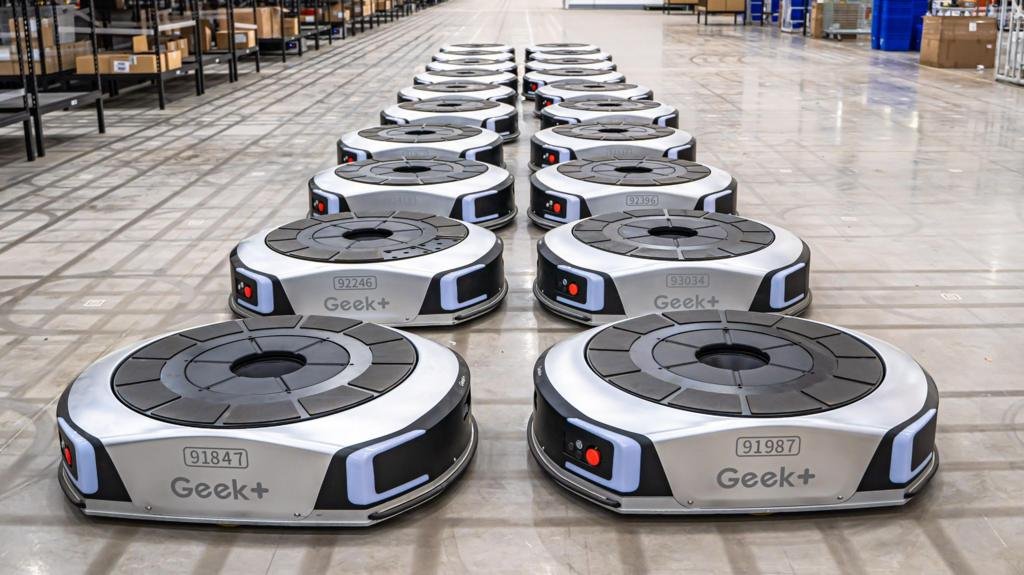
LONDON — The quiet hum of thousands of squat, silver robots gliding beneath storage racks in British retail warehouses marks more than a logistics upgrade. It is the visible edge of a strategic convergence: Beijing's push for technological self-sufficiency, the UK's decade-long productivity stagnation, and an escalating US-China competition over the future of industrial automation.
Chinese Robot Fleet Reshapes British Warehouses as Beijing's Automation Drive Goes Global
LONDON — The quiet hum of thousands of squat, silver robots gliding beneath storage racks in British retail warehouses marks more than a logistics upgrade. It is the visible edge of a strategic convergence: Beijing's push for technological self-sufficiency, the UK's decade-long productivity stagnation, and an escalating US-China competition over the future of industrial automation.
Geek+, the Chinese warehouse robotics company that listed in Hong Kong last year in one of the largest robotics share sales of 2025, has become the world's largest supplier of autonomous mobile robots. Britain has emerged as its biggest European market, with more than 2,000 robots now operating across 10 warehouse sites for retail giants including Tesco, Asda and Next. The deployment, facilitated by UK partner MotionTech, is being phased in as British businesses grapple with acute labour shortages and what the OECD has called "surprising" low adoption of robotics given the nation's manufacturing heritage.
By Prof. Marcus Chen, Staff Writer
A Strategic Export in Beijing's 'New Quality Productive Forces'
The Geek+ expansion into the UK is not merely a commercial success story; it is a direct manifestation of President Xi Jinping's doctrine of "new quality productive forces." This policy framework, central to Beijing's economic strategy, prioritises high-tech innovation as the engine of growth, moving beyond traditional manufacturing towards automation, artificial intelligence, and advanced robotics. With China's working-age population shrinking, policymakers in Beijing increasingly view automation as essential to maintaining the country's manufacturing advantage. The robotics sector is being cultivated with the same strategic intensity previously reserved for electric vehicles (EVs), semiconductors, and green energy. The Geek+ factory in Hefei, which the BBC visited, is a testament to this industrial policy, churning out fleets of robots destined for warehouses from Manchester to Munich. The strategic calculus is clear: by exporting automation solutions, China is not only securing revenue but also embedding its technology standards and supply chains into foreign economies. For Beijing, this is a soft-power lever that extends its influence into the operational fabric of Western retail and logistics, a point not lost on policymakers in Washington.The UK's Productivity Puzzle and the Robotics Opportunity
The United Kingdom has struggled with weak productivity growth for more than a decade, a persistent economic ailment that economists attribute to chronic underinvestment in capital equipment and technology. The OECD's 2026 report, SME Technology Adoption in the United Kingdom, highlighted that while UK firms have embraced mature digital technologies, they lag significantly in robotics and automation. This gap presents a lucrative opportunity for Geek+. The UK boasts one of Europe's largest e-commerce and logistics sectors, yet many of its warehouses remain in the early stages of automation. Unlike traditional fixed conveyor systems, Geek+'s autonomous mobile robots can be deployed rapidly using QR code floor markers and safety fencing, offering a flexible, scalable solution that appeals to retailers under pressure to meet online demand. "Customers want fast deployable solutions," Barry Pemberton, Account Director at MotionTech, told the BBC. "They want high volume, high storage, fast picking... ultimately on a smaller footprint with a reduced headcount." He added, "We seem to have a very big shortage of labour in the UK at the moment. These technologies are really important to keep businesses thriving and meet demand."Labour Unions Demand a Human-Centric Approach
The rapid deployment of robotics has not gone unnoticed by organised labour. The Trades Union Congress (TUC), representing nearly 6 million UK workers, has urged caution, insisting that automation must be used to raise productivity and improve job quality, not merely to slash headcounts. In its response to the government's consultation on a new AI and innovation strategy, the TUC argued that workers must be involved in decisions about automation and that employers should invest heavily in retraining. "Working with technologists, workers and unions can help steer the UK's research and innovation towards workers' priorities for automation... avoiding job-cutting, low-productivity automation," the TUC stated. This tension between efficiency gains and workforce displacement is a defining feature of the automation age. For the UK government, which is seeking to stimulate growth without exacerbating social inequality, the challenge lies in harnessing the productivity benefits of Chinese robotics while ensuring a just transition for British workers.China's EV Ecosystem: The Crossover into Robotics
China's rise as a robotics leader is not an isolated phenomenon; it is built directly on the foundations of its electric vehicle ecosystem. Kyle Chan, a researcher at the Brookings Institution, notes that batteries, electric motors, cameras, sensors, and semiconductors developed for EVs are increasingly being repurposed across China's robotics sector, creating what he describes as "overlapping industrial ecosystems." This crossover is exemplified by XPeng, the Chinese EV maker that unveiled its humanoid robot, Iron, last year. Founder He Xiaopeng no longer views his company as simply a carmaker. "We want XPeng to be a high-tech company," he told the BBC. "In the future, any car company will transform into a car and robotics company." The synergies are profound. China's dense supplier networks, manufacturing prowess, and rapid product development cycles— honed in the fiercely competitive EV market—are now being applied to robotics. Analysts suggest China's robotics push could follow a similar trajectory to its global EV success, establishing an early lead through scale and cost efficiency.US Protectionism vs. UK Openness: A Geopolitical Divergence
The Geek+ expansion into Britain highlights a stark geopolitical divergence in how Western nations are responding to China's technological ascent. This week, the United States banned the import of new foreign-made advanced robots, citing national security concerns. The move is a direct attempt to curb China's ambitions to dominate the global robotics industry. The Chinese embassy in Washington responded sharply, stating that Beijing has long opposed the US's "politicising" of trade issues and sanctions based on "groundless pretexts." This tit-for-tat dynamic underscores the broader technological decoupling between the world's two largest economies. In contrast, the UK has adopted a more open, pragmatic approach. By welcoming Chinese robotics into its retail supply chain, London is prioritising economic efficiency and productivity gains over geopolitical alignment with Washington's protectionist stance. This divergence could have significant second-order effects, positioning the UK as a testing ground for Chinese technology within the Western sphere, much to the chagrin of US policymakers who view such integration as a strategic vulnerability.The Next Frontier: End-to-End Automation and the Humanoid Question
Geek+ is not resting on its current success. The company's next goal is to automate everything beyond moving goods. "We are working on... end-to-end unmanned warehouse solutions," says Yanyu Liu, head of communications at Geek+. This ambition encompasses automating picking, handling, and eventually packing goods, creating a fully autonomous logistics chain. Beyond wheeled robots, Chinese companies including AgiBot and Unitree are investing billions in humanoid robots. However, the business case for humanoids remains less clear than for today's warehouse robots. If wheeled robots move goods cheaply and reliably, and robotic arms handle other tasks, what specific problem does a humanoid solve? Developers argue that factories, hospitals, and offices are designed around people, so humanoids could eventually work in these environments without requiring workplaces to be redesigned around automation. Yet, experts agree that current technology is not yet suitable for repetitive tasks requiring high dexterity. "I don't think [humanoids] will change the landscape of the types of technology or the automation that's going to be put into place," says Pemberton. "They're definitely going to be complementary."Strategic Implications for Global Supply Chains and Regional Stability
The deployment of Chinese robotics in British warehouses is a microcosm of a larger global shift. For the European Union and the Global South, the UK's experience offers a case study in the trade-offs between technological adoption and geopolitical risk. As Chinese firms like Geek+ expand their footprint, they are becoming integral nodes in global supply chains, creating dependencies that could be leveraged in times of geopolitical tension. For Beijing, the UK market serves as a crucial validation of its robotics industry's global competitiveness. It demonstrates that Chinese technology can meet the rigorous demands of Western retailers, potentially opening doors to other markets in Europe and beyond. The contrast between US protectionism and UK openness is likely to be a defining feature of the coming decade, as nations navigate the complex terrain of technological interdependence. For Britain, the immediate benefits are tangible: improved productivity, reduced labour costs, and enhanced competitiveness in e-commerce. But the long-term strategic implications are profound. By embracing Chinese automation, the UK is betting that economic pragmatism will outweigh geopolitical risk. Whether this bet pays off will depend on the evolution of US-China relations, the resilience of global supply chains, and the ability of British policymakers to manage the social consequences of widespread automation. The robots gliding through British warehouses are more than machines; they are harbingers of a new economic order, one where China's technological ambitions and the West's productivity needs are inextricably linked.This article was produced with AI-assisted research and editorial support. Sources: BBC News (China/Asia Business), OECD, Trades Union Congress, Brookings Institution.
What's Your Reaction?
 Like
0
Like
0
 Dislike
0
Dislike
0
 Love
0
Love
0
 Funny
0
Funny
0
 Wow
0
Wow
0
 Sad
0
Sad
0
 Angry
0
Angry
0

Marcus Chen
World Politics Analyst at Global1.News. Based in Beijing, covering US-China relations, global trade, and geopolitical strategy. Brings deep analytical perspective to the power dynamics shaping international affairs.













Comments (0)