
Beyond China's Humanoid Robots, a Quieter Machine Revolution Is Unfolding
While the world watched robots box and sprint at China's World Humanoid Games last weekend, a far more consequential transformation is taking place behind factory doors.
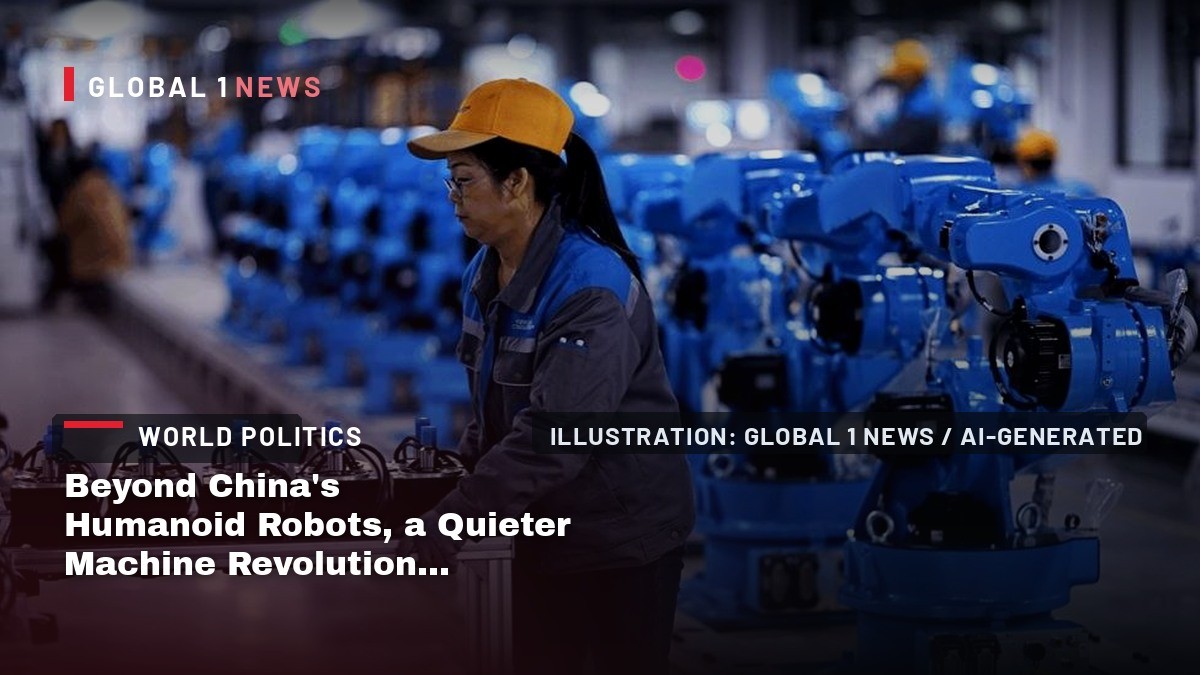
While the world watched robots box and sprint at China's World Humanoid Games last weekend, a far more consequential transformation is taking place behind factory doors. From Chengdu assembly lines to Hangzhou classrooms, Beijing is quietly deploying millions of industrial robots to reshape its manufacturing base, address a looming demographic crisis, and outmaneuver the United States in the race for technological supremacy.
China's Robot Workforce: The Quiet Industrial Revolution Reshaping Global Manufacturing
Hangzhou, China — Article continues...
A Classroom Built for the Coming Wave
At the Hangzhou Technician Institute, a sprawling vocational campus on the outskirts of the former imperial capital, 28-year-old teacher Chen Tianyu watches his students with a mixture of urgency and pride. Around 30 college students are bent over code, one typing furiously as his eyes dart between the screen and a waiting industrial robot. "The idea is it will grab that cylindrical piece and move it over there," the student explains.
Chen, who spends his spare time visiting factories switching to automation so he knows what to prioritize in his AI and robotics classes, delivers a stark warning to his pupils: "If you are not needed by the world of AI and robotics, then you'll definitely be among those eliminated." For the people in this room, this is a leap toward a future that China is meticulously building — Xi Jinping's $20bn (£14.7bn) plan to put the country at the forefront of innovation and in direct competition with the US.
The Scale of the Machine Revolution
The evidence of this transformation is staggering. Across China, more than two million robots now work in factories — more than anywhere else on Earth — and they are scaling up at extraordinary speed. More than half of the world's industrial robots are now made in China, and the country is shipping them across the globe.
This is a commitment that will surely change the world, much like the last time the Chinese economy underwent a massive transformation. But what is less clear is the impact of such sweeping automation in a country that sits at the heart of global manufacturing, trade, and innovation. What does this mean for China's human workforce? And how would we be able to truly measure the cost of this transformation in a regime that controls information so tightly?
Inside the Factories: Old and New Working Side by Side
On a factory floor in the southern city of Chengdu, the old and the new are working side by side. An assembly line of around 30 middle-aged men and women is screwing, drilling, and polishing CRP Technology's signature product: a robotic arm that performs various industrial tasks. Also in the room are four young engineers crowded around a console, trying to crack the code for a prototype — a new robot that they hope will help build other robots.
One of them, 31-year-old Pang Kai, part of the research and development team, pushes the sleek skeleton across the room. For now, it can only do simple repetitive movements, such as scan a QR code. "Maybe in another half year, it can do another task," Pang says, smiling wistfully. CRP Technology, which employs around 300 people, has been building robot arms for nine years. Each arm can be tailored to a factory's needs to help build cars, electronics, or wind turbines. The firm says a single arm can be programmed to perform more than 90% of repetitive tasks.
The Demographic Imperative Behind Automation
The engineers also wonder if, one day, they can replace the company's workforce. "We want our new robot to be like human beings. We hope it can think by itself," says Pang. "We need these kinds of robots because maybe in 10 years, we won't have enough workers in China."
A shrinking population and an ageing workforce is another reason Beijing is in a hurry to revolutionise its factories. By 2035, more than a third of China's population will be over 60, according to official estimates. The country will also lose nearly 60 million people in the next decade — almost equivalent to the population of France — according to some estimates. The hope is that increased automation will fill this looming gap in the workforce before it starts to affect an already sluggish economy.
The Human Cost of Speed
But the speed of the transition is key. Around 120 million people still work in the manufacturing sector. If China moves too quickly, job losses could follow, dealing a catastrophic blow to millions who depend on factory wages. The calculus is delicate, and industry leaders are acutely aware of the trade-offs.
"In theory, machines can work 24 hours a day, which is certainly an advantage compared with human workers. But machines also require maintenance. Every day we need time for that, and each month the production line also requires inspection and repair," says Cao Li, vice-president of EV maker Leapmotor. The company, increasingly popular in Europe and the UK, assembles its budget-friendly, tech-focused cars at a Hangzhou factory with robots aiding the process at every step.
Leapmotor has more than 25,000 workers, and hundreds of them make the final checks as sparkling new vehicles roll past. Will there be a day when they are no longer needed? "It's entirely possible," Cao says. "And it may come relatively quickly. In workshops, including stamping, welding, and painting, we've basically achieved 100% automation."
The Geopolitical Edge: Bodies vs. Brains
China has the edge over the US due to its enormous manufacturing base. Motors, batteries, electronics, gears, sensors — everything needed to build the body of a robot is all at hand. "China also has an idea. It has a plan. They know where they want to be in five years. They plan at a top level, but they break it down to the regions, to the municipalities," says Dr Susanne Bieller, General Secretary of the International Federation of Robotics.
"If you want to build a robot in Shenzhen — there's an entire ecosystem. It takes you less than one hour to source the components you need to make a robot. In Europe it can take you up to a week." However, she acknowledges that while China is good at building the body, the US is still leading at building the "brain," which includes developing the AI to programme robots.
Yet Chinese firms, from DeepSeek to Moonshot, have been unveiling new AI models that they say can compete with top US firms. Driven by an "open-source" approach, where AI start-ups share their code, Chinese innovation has been able to catch up faster than expected, despite US export controls over critical advanced chips. Analysts now believe that the next leg of this race will be determined not by who has the best language model, but who can put this intelligence into millions of machines.
Training the Next Generation of Tech-Savvy Engineers
That is why China is also investing in producing a generation of students learning to imagine what could come next. At the Hangzhou Technician Institute, children can start from the age of 15. The scale of what is being taught can feel staggering. There is an entire building dedicated to engines and aeronautics, and a restricted floor for students who will work to keep China at the forefront of processing rare earths — another crucial commodity in the battle with Washington.
Some see this as a solution to China's stubbornly high youth unemployment rate, with one in five struggling to find a job. "Our students are in demand and can even be pre-booked by companies. They don't need to worry about employment at all, and we hold competitions as part of their training," Chen, the young teacher, says. "It's better to find your position within the technological wave. In the process of progress, structural changes are bound to occur, and these structural changes are exactly where students' future employment opportunities lie."
An Uncertain Future Amid Economic Headwinds
But China still faces serious economic challenges, from a property crisis that continues to drag on to huge local government debt and persistently low consumption. It is unclear if and how the revolution Beijing is touting will fix these, and it is hard to gauge how those whose jobs are threatened feel about the change that is coming. Will robots create prosperity for them, or simply take many of their jobs?
"My students ask me what will happen in the future," Chen says. "I say I don't know. Technology is changing so fast. But we can't just stand still and sleep here. We have to move forward to see what we are capable of doing."
By Prof. Marcus Chen, Staff Writer
This article was produced with AI-assisted research and editorial support. Sources: BBC News.
What's Your Reaction?
 Like
0
Like
0
 Dislike
0
Dislike
0
 Love
0
Love
0
 Funny
0
Funny
0
 Wow
0
Wow
0
 Sad
0
Sad
0
 Angry
0
Angry
0

World Politics Analyst at Global1.News. Based in Beijing, covering US-China relations, global trade, and geopolitical strategy. Brings deep analytical perspective to the power dynamics shaping international affairs.















Comments (0)