
China's First Mandatory Self-Driving Rules Tighten the Road for Tesla
Beijing's first mandatory L3/L4 autonomous-driving standard, effective July 2027, imposes a 10-second handover rule and data-localisation hurdles that leave Tesla's FSD approval a distant prospect, analysts say.
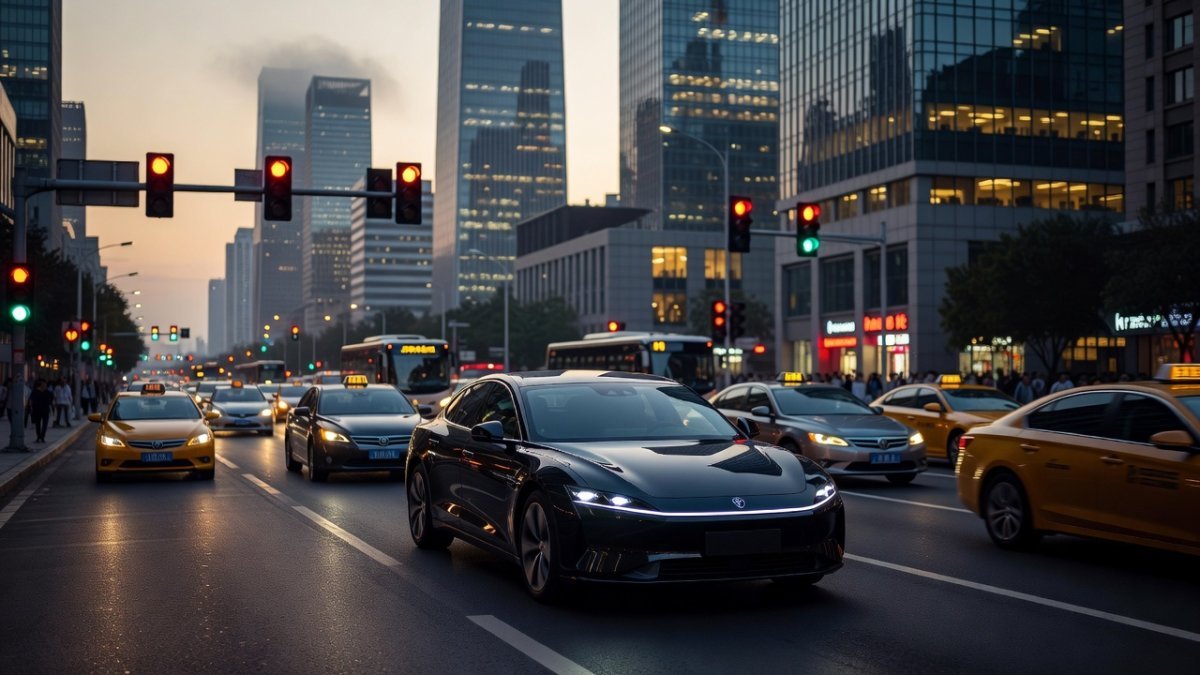
Beijing's 2027 Autonomous-Driving Mandate Raises the Bar for Tesla
Beijing has outlined its first mandatory national standards for autonomous driving, a regulatory milestone that analysts say leaves Tesla's hopes of securing approval for higher-level self-driving in China a distant prospect. The rules, unveiled by the Ministry of Industry and Information Technology (MIIT) and set to take effect on July 1, 2027, impose safety and accountability requirements on vehicles with Level 3 (L3) and Level 4 (L4) functions — and they come as the US electric vehicle giant scrambles to turn its Full Self-Driving (FSD) system into a fully approved product in the world's largest auto market.
Tags: China autonomous driving, Tesla FSD, L3 L4 standards, MIIT, self-driving rules, electric vehicles, data regulation, Changan BAIC, Xpeng, China EV market
China's First Mandatory L3/L4 Safety Standard
The new framework, designated GB 44721-2026, marks a shift from voluntary technical guidance to enforceable market-access requirements for autonomous driving in China. Under the standard, carmakers will be held accountable for accidents that occur while an automated driving system is active, and systems must give drivers at least 10 seconds to retake control before a potential collision — a threshold stricter than the global standard set by the United Nations in June, according to MIIT.
The standard also requires a safety-assurance system covering the full product lifecycle, including a 17-page safety archive appendix, and establishes China-specific third-party testing and certification for any automaker selling L3 or L4 vehicles in the country. Industry analysts in Hong Kong and Shanghai described the move as Beijing's attempt to create a unified national baseline for autonomous driving products while retaining domestic oversight of a technology that touches both automotive safety and data security.
Tesla's FSD Remains at L2+ as Approval Stalls
Tesla's FSD system currently operates at the L2+ level — capable of highway and city-road driving assistance, Navigation on Autopilot, automatic on- and off-ramp manoeuvres and memory parking, but still classified as L2, where the driver remains fully responsible. That places the US company below the threshold of China's new mandatory standard, said Xing Lei, an independent analyst and founder of automotive platform AutoXing.
Tesla announced in May that FSD Supervised was available in China, a step toward full entry, and the company has recently hired personnel to test the system on mainland roads. But Xing said the fundamental obstacle is regulatory: "The foundation [of the approval] would be the regulations over data." Tesla may choose to prioritise full FSD entry over seeking L3 or higher approvals, he added, given the distance between its current capability and the new requirements.
The Data Bottleneck: Training, Computing and Cross-Border Rules
Beyond the safety standard itself, analysts point to data regulation as the decisive barrier. Data collected in mainland China is not yet permitted to be sent overseas, and Tesla's technological dominance currently relies on its advanced model trained and running in the United States, said Yale Zhang, managing director of Shanghai-based consultancy Automotive Foresight.
"Tesla's driving assistance function was not familiar with the roads on mainland China due to insufficient data training," Zhang said, noting that the company's system needs local road data to perform reliably. "The key to Tesla's licences in China will be subject to whether it has the determination to add compute and training to its data centre in the mainland." Tesla has been expanding its Shanghai data centre footprint, but analysts say the scale of local training infrastructure remains well short of what full FSD deployment would require under China's data rules.
The regulatory picture is layered: MIIT sets the safety standard, while the Cyberspace Administration of China (CAC) polices how vehicle data is collected, stored and transferred. Beijing's framework for intelligent connected vehicles requires automakers to store sensitive data — including maps and driving records — inside China, and to pass security assessments before certain features can be activated. That dual oversight means an FSD-style system trained primarily on American road behaviour must be substantially retrained on Chinese conditions before approval, a process that analysts estimate takes years rather than quarters. Tesla has complied with the data-localisation requirement by running its mainland operations on Shanghai-based servers, but the compute capacity available there is a fraction of what its US operations command.
Domestic Rivals Move Ahead: Changan, BAIC, Xpeng and Momenta
Chinese manufacturers, meanwhile, are already operating within the emerging regulatory framework. Beijing granted L3 licences to two models from state-owned automakers Changan Automobile and BAIC in December, giving domestic champions an early run at the approvals Tesla is still pursuing. The L2 market in China is intensely competitive, with carmakers such as Xpeng and third-party suppliers like Momenta doubling down on research and development of navigation-assisted driving systems.
The domestic push extends beyond passenger cars: Chinese self-driving firms are also courting global capital, with Momenta securing regulatory approval for a Hong Kong listing earlier this year. The combination of state-backed testing approvals and a deep pool of local training data gives Chinese companies a structural advantage as Beijing's mandatory standards take shape.
Japan and the Regional Autonomy Race
For Japan's automotive industry, the implications are immediate. Toyota, Honda and Nissan all sell vehicles in China with assisted-driving features, and the new standard will apply equally to their L3 and L4-capable models from July 2027. Japanese carmakers have been cautious in deploying higher-level autonomy at home — Japan allowed Level 4 operations in limited areas under its 2023 revised road traffic law, and Toyota's Woven by Toyota unit has been testing autonomous shuttles — but China's mandatory framework now sets a concrete compliance timetable for any automaker, foreign or domestic, that wants to sell advanced self-driving vehicles in the country.
The divergence between the UN's June global standard and China's stricter 10-second handover rule also matters for Tokyo, which has traditionally aligned its automotive regulations closely with UN WP.29 processes. Japanese manufacturers exporting to China will need to meet a standard that is more demanding than the international baseline, potentially forcing them to develop China-specific system configurations. At the same time, the China market remains strategically vital: Toyota and Honda have both deepened their China electrification programmes, and Nissan has flagged autonomous-driving assistance as a differentiator in the region.
The regulatory gap also creates an opening for Chinese suppliers in Japan's backyard. As Beijing's standards mature, Chinese technology firms are increasingly pitching their assisted-driving stacks to Southeast Asian and Japanese partners, offering a compliance path already validated in the world's most demanding market. For Japanese component makers and software vendors, the question is whether to build China-specific versions of their own systems or integrate Chinese technology under licence — a choice that will shape the regional supply chain for years.
What to Watch For
The runway to July 1, 2027 gives automakers just under a year to certify their L3 and L4 systems against GB 44721-2026. Watch for three developments: whether MIIT issues more domestic L3 licences in the coming quarters; whether Tesla commits the computing and training capacity to its mainland operations that analysts say approval would require; and how Japan's automakers reconcile the stricter Chinese standard with the UN framework they have long followed.
For Asia-Pacific readers, the takeaway is that China is no longer merely the world's largest EV market — it is becoming the first major economy to turn autonomous-driving safety into a mandatory, China-specific certification regime. Foreign automakers that treat the market as an afterthought in their self-driving roadmaps will find the door closing well before 2027.
By Kenji Tanaka, Staff Writer
This article was produced with AI-assisted research and editorial support. Sources: South China Morning Post (Themis Qi, Aug 11, 2026), China EV Home, TechTimes.
What's Your Reaction?
 Like
0
Like
0
 Dislike
0
Dislike
0
 Love
0
Love
0
 Funny
0
Funny
0
 Wow
0
Wow
0
 Sad
0
Sad
0
 Angry
0
Angry
0

Japan Correspondent at Global1.News. Tokyo-based voice covering Japanese politics, technology, economy, and culture. Tracks the intersection of tradition and innovation in one of the world's most dynamic societies.












Comments (0)