
China tells Israel to stop 'forced establishment' of West Bank settlements
In the shifting landscape of Middle‑East diplomacy, Beijing’s recent admonition to Israel over West Bank settlements underscores China’s ambition to position itself as a credible mediator in a region long dominated by United States influence.
In the shifting landscape of Middle‑East diplomacy, Beijing’s recent admonition to Israel over West Bank settlements underscores China’s ambition to position itself as a credible mediator in a region long dominated by United States influence. The exchange, held on the sidelines of a conference in Azerbaijan, reflects a broader strategic calculus: by championing the Palestinian cause and warning against settlement expansion, China seeks to deepen its diplomatic capital with Arab states, reinforce its narrative of a “fair‑play” foreign policy, and subtly counterbalance Washington’s entrenched alliances. Understanding the significance of this development requires tracing China’s evolving engagement in the Israeli‑Palestinian conflict, the historical grievances it invokes, and the geopolitical stakes that shape its outreach.
Historical framing of the “Palestinian question” in Chinese diplomacy
Foreign Minister Wang Yi’s description of the “Palestinian question” as “the greatest historical injustice of this century” aligns with a long‑standing Chinese rhetorical tradition that frames the conflict in moral and historical terms. Since the early years of the People’s Republic, Beijing has positioned itself as a supporter of anti‑colonial struggles, portraying the Palestinian plight as a symptom of broader Western‑led injustices. This narrative serves two purposes: it legitimises China’s calls for a two‑state solution, and it provides a moral platform from which Beijing can engage with Arab publics and governments that view the United States with suspicion.
The emphasis on “historical injustice” also resonates with China’s domestic discourse on sovereignty and territorial integrity, reinforcing a consistent message that external interference in sovereign affairs—whether in the Middle East or in Xinjiang and Tibet—is unacceptable. By invoking this language, Wang links China’s external diplomatic posture with its internal narrative of defending national unity, thereby presenting a coherent ideological stance to both domestic and foreign audiences.
China’s recent diplomatic initiatives in the region
Wang’s remarks did not emerge in a vacuum; they follow a series of high‑profile Chinese interventions that have elevated Beijing’s role as a broker. In 2023, China facilitated the rapprochement between Iran and Saudi Arabia, a breakthrough that reduced sectarian tensions and opened avenues for broader regional cooperation. Earlier this year, Beijing, together with Pakistan, proposed a ceasefire in the US‑Israel confrontation with Iran, signalling its willingness to act as a neutral interlocutor amid great‑power rivalry.
These initiatives illustrate a pattern: China leverages its economic clout—particularly as a major purchaser of Iranian oil—to gain political leverage, while simultaneously presenting itself as a stabilising force willing to engage all parties. The success of the Iran‑Saudi deal, in particular, has bolstered Beijing’s confidence to pursue more ambitious mediation efforts, such as its attempt to convene Palestinian factions into an interim “national reconciliation government” in 2024. Although that proposal was never implemented, it demonstrated Beijing’s readiness to intervene in intra‑Palestinian politics, a domain traditionally dominated by regional actors.
The current Israeli‑Palestinian stalemate
Since the US‑brokered ceasefire in October 2025, Gaza has experienced a precarious calm punctuated by daily Israeli strikes, resulting in more than 1,400 Palestinian deaths according to Hamas‑run health authorities, figures deemed reliable by the United Nations. While large‑scale bombardments have ceased, the humanitarian situation remains dire, with persistent displacement, food insecurity, and the looming threat of renewed violence.
The ceasefire was intended as the first phase of a broader peace settlement triggered by Hamas’s 7 October 2023 attack on Israel. Yet progress toward the second phase has stalled, as both sides accuse each other of violations. This impasse has left the region vulnerable to escalation, creating a diplomatic opening for actors like China to propose alternative pathways to de‑escalation and political resolution.
China’s specific demands on settlement activity
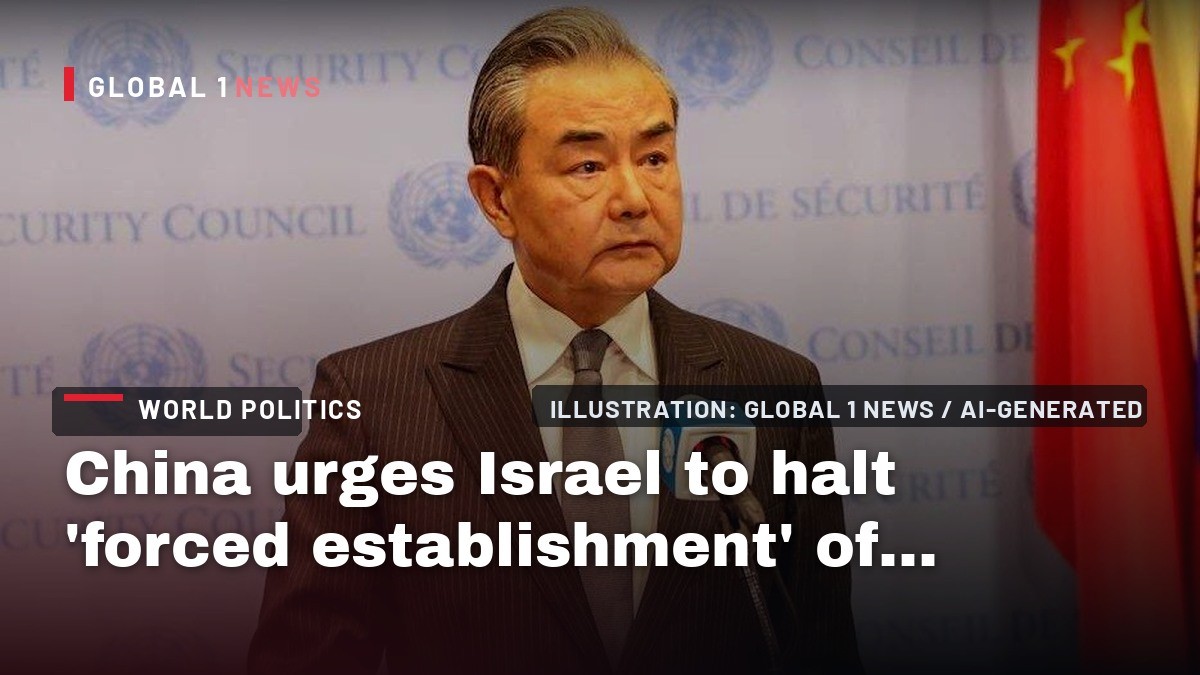
In his conversation with Israeli President Isaac Herzog, Wang explicitly called on Israel to halt the “forced establishment” of settlements in the West Bank and to reverse such actions. By framing settlement expansion as “forced,” Beijing casts it as a unilateral, coercive measure that undermines prospects for a two‑state solution—an issue that has long been a flashpoint in international negotiations. The demand to reverse settlement activity signals a willingness to confront Israel directly, a stance that diverges from the more cautious language traditionally employed by Beijing.
Wang also identified the immediate priority as fully opening access to Gaza and stopping the spread of a “humanitarian catastrophe.” This emphasis on humanitarian access dovetails with China’s broader narrative of responsible great‑power conduct, positioning Beijing as a champion of human security while implicitly critiquing Israel’s restrictive policies.
Implications for Sino‑Israeli relations
Herzog’s public response on X, expressing pleasure at meeting Wang and noting that the discussion covered bilateral relations alongside regional security concerns, suggests a pragmatic approach from Israel. By engaging with China, Israel may be seeking to diversify its diplomatic portfolio, especially as it confronts strategic threats from Iran and its proxies—a concern Herzog highlighted. Nonetheless, Israel’s core strategic alignment with the United States remains a limiting factor; any substantive shift in settlement policy would likely require broader pressure from Washington and its allies.
The interaction also reflects Israel’s recognition of China’s growing influence in the Middle East. While Israel maintains strong security ties with the United States, it has cultivated economic and technological partnerships with China, particularly in areas such as infrastructure and high‑tech. Beijing’s admonition on settlements, therefore, tests the resilience of this bilateral relationship, probing whether economic interdependence can translate into political concessions.
Strategic calculus for China in the broader Middle‑East arena
By foregrounding the Palestinian issue, China reinforces its appeal to the Arab world, where anti‑Western sentiment remains potent. The articulation of settlement concerns dovetails with Beijing’s broader strategy of presenting itself as a counterweight to US influence, particularly in regions where Washington’s policies are perceived as heavy‑handed. Moreover, China’s deep energy ties with Iran—being the largest buyer of Iranian oil—provide it with leverage to influence Tehran’s regional posture, while simultaneously signalling to Riyadh and other Gulf states that Beijing can act as a neutral arbiter.
China’s mediation efforts also serve domestic political purposes. By highlighting its role in “peace‑building,” Beijing can bolster the Communist Party’s narrative of responsible global stewardship, reinforcing internal legitimacy. The emphasis on “political solutions” and “dialogue” aligns with the Party’s broader diplomatic doctrine of non‑interference coupled with active participation in multilateral processes.
Future trajectories and geopolitical ramifications
The immediate impact of Wang’s settlement warning will depend on Israel’s response and the degree of international backing for Beijing’s position. If Israel resists, China may intensify diplomatic outreach to Arab states, leveraging its recent successes in Iran‑Saudi rapprochement and Palestinian reconciliation attempts to build a coalition that pressures Israel through economic and political channels. Conversely, a receptive Israeli stance could open a channel for Sino‑Israeli cooperation on security and technology, potentially reshaping the regional balance of power.
In the longer term, China’s involvement in the Israeli‑Palestinian conflict reflects a broader ambition to embed itself in the architecture of Middle‑East peace processes, traditionally dominated by the United States, the United Nations, and the European Union. By positioning itself as a mediator willing to confront settlement expansion and champion humanitarian access, Beijing not only seeks to expand its diplomatic footprint but also to test the limits of US influence in a region where strategic competition is intensifying. The evolution of this dynamic will be a key indicator of how great‑power rivalry adapts to the multipolar realities of the mid‑2020s, with the Palestinian question remaining a pivotal barometer of international legitimacy and influence.
This article was produced with AI-assisted research and editorial support. Reporting is based on the source material cited below. Sources: BBC News China; bbc.co.uk; Global1.News (18 October 2026).
By Prof. Marcus Chen, Staff Writer
What's Your Reaction?
 Like
0
Like
0
 Dislike
0
Dislike
0
 Love
0
Love
0
 Funny
0
Funny
0
 Wow
0
Wow
0
 Sad
0
Sad
0
 Angry
0
Angry
0

World Politics Analyst at Global1.News. Based in Beijing, covering US-China relations, global trade, and geopolitical strategy. Brings deep analytical perspective to the power dynamics shaping international affairs.











Comments (0)