
PUK leader Talabani withdraws from regional government, deals blow to Kurds globally
In a move that threatens to splinter the semi‑autonomous Kurdistan Region of Iraq, Bafel Talabani, president of the Patriotic Union of Kurdistan (PUK), announced on Thursday that his party is withdrawing from the coalition government led by the Kurdistan Democratic Party (KDP).
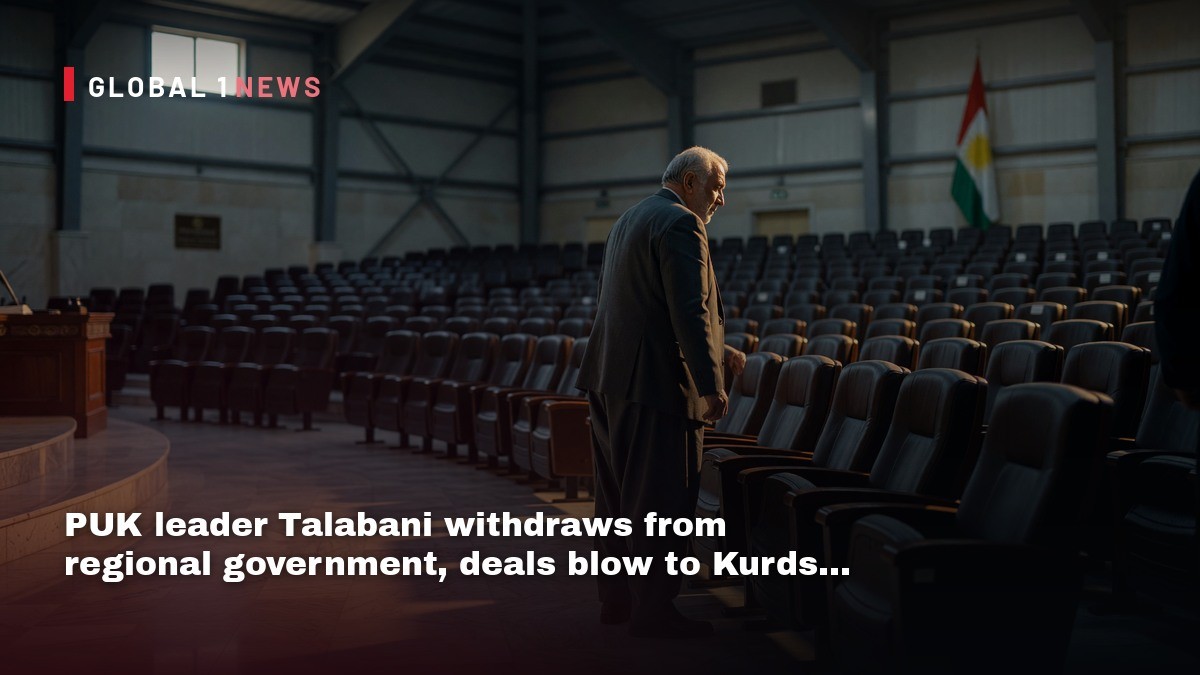
In a move that threatens to splinter the semi‑autonomous Kurdistan Region of Iraq, Bafel Talabani, president of the Patriotic Union of Kurdistan (PUK), announced on Thursday that his party is withdrawing from the coalition government led by the Kurdistan Democratic Party (KDP). The decision follows a protracted power‑sharing standoff that has left the region without a functioning cabinet more than two years after the October 2024 parliamentary elections. The fallout reverberates far beyond Erbil and Sulaymaniyah, touching on the fragile federal arrangement recognized in Iraq’s 2005 constitution and the broader Kurdish aspirations across the Middle East.
Background to the crisis
The Kurdistan Regional Government (KRG) has long operated as a coalition between the KDP, the senior partner, and the PUK, its junior ally. The partnership has been tested repeatedly, but the current deadlock stems from the failure to form a new cabinet after the 2024 elections. While the KDP has pressed ahead, reconvening the Kurdistan parliament on 4 November to elect a speaker, the PUK chose to boycott the session. Three PUK defectors nonetheless participated, allowing a quorum and the election of Vala Farid as the parliament’s first female speaker.
Talabani’s withdrawal statement, delivered after a two‑hour meeting with senior PUK leaders, framed the coalition as a “failed government.” He warned that the PUK would not recognise any parliamentary outcomes and hinted at establishing a separate administration if the KDP proceeded with its own appointments. The immediate trigger— the KDP’s unilateral move to elect a speaker— underscores the deep mistrust between the two parties, a mistrust that now threatens the very fabric of the Kurdish federal entity.
Constitutional ambiguities
The Iraqi Constitution of 2005 granted federal status to the Kurdistan Region, but it did not provide a clear roadmap for internal splits. Article 117 enshrines the region as a federal entity, while Article 119 outlines a referendum mechanism for a governorate to separate from a region. The latter requires either a one‑third request from the Sulaymaniyah Provincial Council or a petition signed by one‑tenth of registered voters in Sulaymaniyah province. Both thresholds are technically attainable, yet the constitutional language does not address whether a governorate already part of a recognised federal region can invoke the same procedure to break away.
Legal scholars, such as Ramzy Mardini of Geopol Labs, note that the situation would likely require a judicial interpretation. The question is not merely academic: a successful referendum could create a “breakaway governorate of an established federal region,” a scenario the constitution does not explicitly contemplate. The lack of a regional constitution for the KRG compounds the uncertainty, leaving the parties without internal rules to manage a potential split.
Political calculations within the KDP
The KDP’s resolve to push ahead with parliamentary proceedings is bolstered by its strong performance in the November 2025 national elections in Iraq. The party secured over one million votes, nearly double the PUK’s tally of roughly half a million. This electoral advantage has reinforced the Barzani family’s belief that they deserve a larger share of power within the Kurdish administration, including control of key ministries such as the interior portfolio.
Rebar Ahmed, a close ally of KRG Prime Minister Masrour Barzani, currently holds the interior ministry. The portfolio is pivotal because it oversees the appointment of governors, mayors and police chiefs, giving the holder substantial influence over security and local governance. The PUK’s insistence on taking over the interior ministry reflects its desire to balance the KDP’s dominance, but the Barzanis have refused to concede, citing the party’s electoral mandate as justification for maintaining the status quo.
Economic implications and the KAR Group incident
Beyond politics, the crisis has already begun to affect the region’s economy. Early signs of PUK frustration emerged when dozens of employees from the KAR Group—an energy conglomerate with close ties to the KDP—were expelled from offices in Chamchamal. The KAR Group was overseeing the extension of a natural gas pipeline from Khor Mor, the region’s largest gas field located in PUK‑controlled territory, to Erbil. No official reason was given for the expulsions, but the timing suggests a possible retaliation linked to the political dispute.
The pipeline project is critical for the KRG’s energy revenues, which fund public services and infrastructure development. Disruptions to the project could strain the region’s fiscal outlook, especially as the KRG already grapples with budgetary pressures from reduced oil prices and delayed federal transfers. A prolonged political stalemate could deter foreign investment and complicate negotiations with multinational energy firms that rely on stable governance to secure contracts.
Regional reverberations
The potential fragmentation of Iraqi Kurdistan carries symbolic weight for Kurdish movements across the Middle East. The Kurdistan Region represents the closest the Kurds have come to statehood, and any weakening of its unity would be a blow to Kurdish aspirations in Syria, Turkey and Iran. The collapse of the Syrian Kurdish semi‑state earlier this year already left the broader Kurdish cause on shaky ground; a split in Iraq could further diminish Kurdish leverage in regional negotiations.
Analysts such as Victoria Taylor, former US deputy assistant secretary for Iraq, warn that a divided Kurdistan could see Sulaymaniyah and Erbil operating as separate governments. Such a scenario would undermine the KRG’s ability to act as a unified interlocutor with Baghdad and with external partners, including the United States, which has historically played a mediating role in Kurdish politics.
US involvement and diplomatic prospects
The United States, once a key broker in Kurdish intra‑regional disputes, has adopted a more hands‑off stance under the current administration. Taylor attributes part of the current impasse to this reduced engagement, noting that US diplomatic pressure has historically helped bridge gaps between the PUK and KDP. With less active US mediation, the parties are left to navigate the crisis on their own, increasing the risk of escalation.
Nechirvan Barzani, the KRG president and a member of the Barzani family, has attempted to mediate but with limited success. His marriage ties to the Barzani clan and his diplomatic experience have not been enough to overcome the entrenched power struggle. The lack of a clear compromise path suggests that any resolution will likely require renewed external facilitation, perhaps from the United Nations or a reinvigorated US diplomatic effort.
Outlook and possible scenarios
Three plausible trajectories emerge from the current deadlock. First, the KDP could concede to PUK demands on the interior ministry and agree to a power‑sharing formula that respects both parties’ electoral strengths, thereby preserving a unified regional government. Second, the PUK could proceed with a referendum to separate Sulaymaniyah, triggering a legal and political battle that could last months, if not years, while the KRG operates in a fragmented state. Third, a negotiated settlement might involve the creation of a dual‑administration framework, effectively acknowledging two semi‑autonomous entities within the broader Kurdistan Region—a compromise that would be unprecedented but could avert outright division.
Regardless of the path taken, the immediate priority for Iraqi Kurdistan is to restore functional governance to address pressing economic and security challenges. The ongoing stalemate hampers the region’s ability to manage public services, maintain security forces, and negotiate with Baghdad over budgetary allocations. As the political earthquake continues to ripple through Erbil, Sulaymaniyah and beyond, the eyes of the Kurdish diaspora and regional stakeholders remain fixed on whether the KRG can weather this internal crisis without fracturing the fragile federal arrangement that has underpinned its relative stability for two decades.
This article was produced with AI-assisted research and editorial support. Reporting is based on the source material cited below. Sources: Al-Monitor; al-monitor.com; Global1.News (06 November 2026).
By Hannah Berg, Staff Writer
What's Your Reaction?
 Like
0
 Dislike
0
 Love
0
 Funny
0
 Wow
0
 Sad
0
 Angry
0

Israel Correspondent at Global1.News. Based in Tel Aviv, covering Israeli politics, security, technology, and society. Provides balanced, deeply-sourced reporting on one of the most closely-watched regions in the world.












Comments (0)