
China's Neighborhood Diplomacy Shift: Lessons from Mongolia for Seoul
China's recent elevation of Shen Minjuan from ambassador in Ulaanbaatar to director-general of the Department of Asian Affairs marks a deliberate recalibration in Beijing's neighborhood diplomacy. The July 2026 promotion rewards her record of advancing stalled infrastructure projects in Mongolia without demanding political concessions on third-neighbor ties.
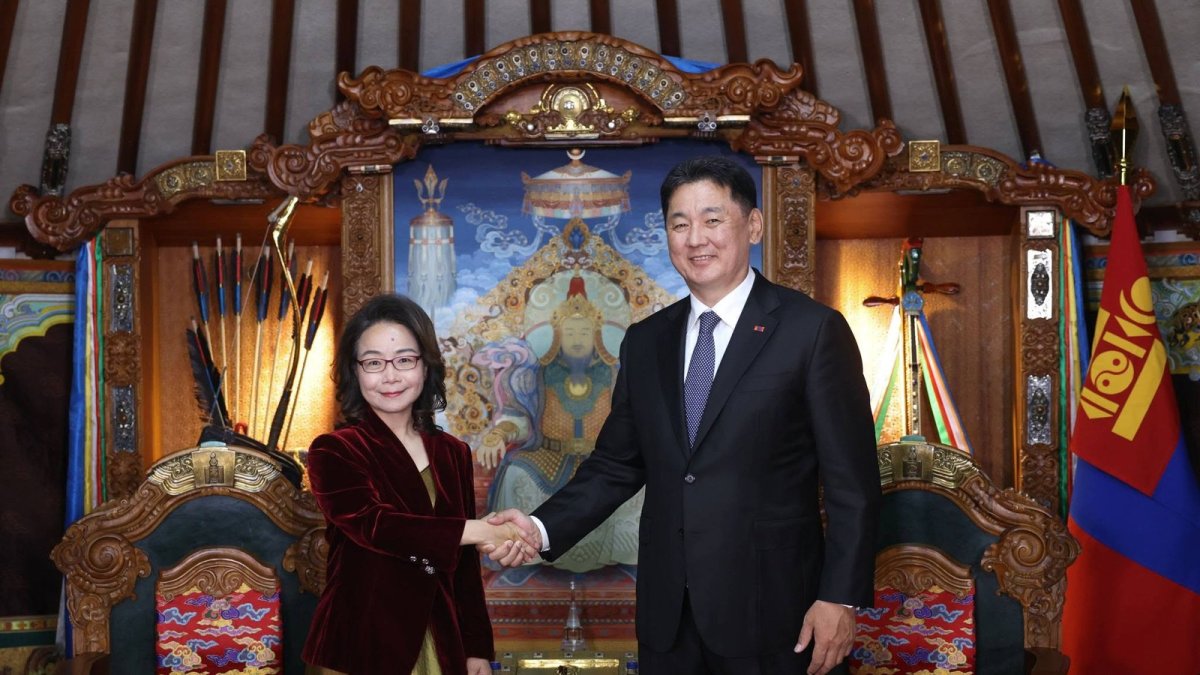
China's recent elevation of Shen Minjuan from ambassador in Ulaanbaatar to director-general of the Department of Asian Affairs marks a deliberate recalibration in Beijing's neighborhood diplomacy. The July 2026 promotion rewards her record of advancing stalled infrastructure projects in Mongolia without demanding political concessions on third-neighbor ties. Seoul's foreign policy community now examines whether this execution-focused approach can translate to the more constrained environment of the Korean Peninsula.
Shen Minjuan Rise Signals China Korea Policy Shift
Seoul, South Korea - Article continues...
The Award and the Promotion
On July 21, 2026, Mongolian President Khurelsukh Ukhnaa conferred the Order of the Polar Star on Shen Minjuan, China's ambassador to Mongolia since 2023. Barely a week later, on July 29, China's Ministry of Foreign Affairs updated its roster to record Shen's appointment as director-general of the Department of Asian Affairs, succeeding Liu Jinsong. The rapid elevation carries clear bureaucratic weight and signals Beijing's intent to adjust the operational tone of its engagement with neighboring states. Seoul's Ministry of Foreign Affairs has monitored these personnel shifts through its Northeast Asian affairs bureaus, noting that the elevation rewards demonstrated capacity to sustain economic cooperation without forcing abandonment of a Third Neighbor orientation. Over 34,000 North Korean defectors now reside in South Korea, giving ROK officials direct exposure to the limits of Chinese leverage on the peninsula and reinforcing the utility of tracking execution-level appointments in Beijing.
Recalibrating Periphery Policy
China's neighborhood diplomacy has historically alternated between assertive and cooperative registers on roughly five-to-seven-year cycles, a pattern traceable to the 2013 Neighborhood Diplomacy Work Conference and reinforced by the 2018 and 2025 rounds of U.S. strategic competition. Shen Minjuan's July 2026 elevation fits this rhythm as an execution-level corrective after the more confrontational Liu Jinsong tenure, prioritizing project delivery over public signaling while core sovereignty positions remain unchanged.
From Ulaanbaatar's perspective, the move reflects Beijing's recognition that sustained assertive diplomacy has produced limited returns across its immediate neighborhood. Smaller states have responded by accelerating diversification strategies. Mongolia's Third Neighbor policy, which explicitly includes South Korea alongside the United States, Japan, the European Union, and Turkiye, exemplifies this pattern. Seoul's Ministry of Foreign Affairs has long tracked such adjustments in Chinese posture, viewing them as potential openings for pragmatic economic cooperation while preserving strategic autonomy. Years of wolf-warrior signaling produced measurable hedging across Southeast Asia and accelerated security coordination between Washington and regional allies. South Korean analysts interpret Shen's promotion as an attempt to arrest this diversification dynamic through more functional engagement, while recognizing that the underlying structural incentives for hedging remain intact.
For Seoul, the appointment carries direct implications for the calibrated engagement-deterrence mix that has defined ROK-China relations since the THAAD episode. The Third Neighbor policy's South Korean component gains relevance as Beijing tests whether functional economic channels can operate alongside continued North Korean nuclear advancement and Russia alignment, without requiring Seoul to adjust its alliance commitments or inter-Korean coordination posture.
The Liu Jinsong Period and Its Reassignment
Liu Jinsong directed the Department of Asian Affairs from 2021 through mid-2026. His approach emphasized deterrence signaling and firm public positioning on sovereignty questions. The November 2025 consultations with Japan's Kanai Masaaki illustrated this style, with photographs showing Liu delivering a protest while keeping his hands in his pockets after Japanese Prime Minister Takaichi Sanae framed a potential Taiwan contingency as an existential security threat. Reports indicate Liu may next serve as ambassador to Australia. That reassignment aligns with Beijing's practice of matching diplomatic temperament to specific theaters. For South Korea, the episode underscored how rigid signaling can complicate regional hedging and reinforce the value of multivector diplomacy.
Shen's Record in Mongolia
Shen arrived in Ulaanbaatar in October 2023 after earlier postings in Malaysia and Indonesia and service as deputy director-general for Southeast Asian affairs. Her academic background includes a master's degree in economics. During her tenure, the Gashuun Sukhait-Gants Mod cross-border railway advanced from prolonged negotiation into active construction, with commissioning scheduled for 2027. Bilateral trade moved toward the $20 billion target established by the two governments. Upstream oil projects progressed to support Mongolia's refinery in Altanshiree soum, Dornogobi province. Humanitarian assistance during dzud conditions further stabilized working ties. Taiwanese media reports from October 2024 alleged embassy pressure to restrict Taiwan's Double Tenth reception and limit access to a Jetsun Dampa event at Gandan Monastery, yet these claims lacked independent Mongolian confirmation. Shen's Mongolia record demonstrates that firmness on core interests can coexist with project-level advances. Scholarly observers caution that this transactional emphasis carries long-term costs by prioritizing infrastructure and commodity flows over sustained societal, educational, and cultural exchange, eroding the public goodwill required for deeper strategic trust. South Korean counterparts have drawn the same lesson from alternating periods of cooperation and friction over THAAD deployment, supply-chain resilience, and North Korea policy under the Yoon administration and its 2026 successor.
Scalability Limits and the Korean Peninsula
Shen now oversees a portfolio that includes several entrenched structural challenges. The South China Sea remains volatile under the Marcos Jr. administration in the Philippines. China-Japan relations stay frozen amid Japan's defense buildup. The China-India border dispute continues despite limited thawing. The Korean Peninsula presents constraints that the Mongolia model does not easily overcome. North Korea's advancing nuclear programs and alignment with Russia limit Beijing's room for maneuver, while South Korea maintains a calibrated mix of engagement and deterrence. Domestic nationalist opinion in China functions as a de facto floor on flexibility, and decisions on sovereignty thresholds and responses to U.S. alliance architecture rest with the Central Foreign Affairs Commission rather than the Department of Asian Affairs. South Korea's Ministry of Foreign Affairs assesses these conditions as less amenable to the Mongolia model. Economic inducements can lower friction in dependent bilateral relationships, yet they encounter stronger resistance where security alliances and territorial claims dominate.
Structural distinctions between Mongolia and harder theaters remain decisive. Mongolia's stable, demarcated border and commodity-dependent economy permitted Shen to advance the Gashuun Sukhait-Gants Mod railway toward 2027 commissioning and approach the $20 billion trade target. In contrast, active U.S. security alliances, competing territorial claims in the South and East China Seas, and the Sino-Indian border introduce domestic nationalist constraints that limit similar transactional flexibility.
These constraints are especially binding on the Korean Peninsula, where North Korea's nuclear trajectory and external partnerships reduce Beijing's leverage and where decisions on alliance responses rest with the Central Foreign Affairs Commission rather than the Department of Asian Affairs. Over 34,000 North Korean defectors in South Korea further underscore Seoul's assessment that the Mongolia model offers limited transferability amid entrenched security dilemmas.
Tactical Adjustment, Not Strategic Change
Shen's authority centers on bureaucratic sequencing, tone management, and functional cooperation within a portfolio that includes the South China Sea under the Marcos Jr. administration, frozen China-Japan relations amid Japan's defense buildup, and the unresolved China-India border. Strategic direction on sovereignty, Taiwan, and responses to U.S. alliance structures rests with the Central Foreign Affairs Commission. These cases involve active security alliances with the United States and competing territorial claims, conditions absent from Mongolia's stable, demarcated frontier and structurally dependent economy. The promotion therefore represents an execution-level calibration rather than a revision of core objectives. For Seoul, this distinction matters. A more geoeconomics-oriented Chinese approach may facilitate project-level dialogue on trade and infrastructure, yet it leaves unchanged Beijing's fundamental positions on regional security architecture and inter-Korean dynamics. Mongolian analysts describe the outlook as cautious pragmatism; South Korean counterparts reach a similar conclusion. Seoul's assessments treat the distinction as structural rather than stylistic.
By Prof. David Park, Staff Writer
This article was produced with AI-assisted research and editorial support. Reporting is based on sources cited in the article.
What's Your Reaction?
 Like
0
Like
0
 Dislike
0
Dislike
0
 Love
0
Love
0
 Funny
0
Funny
0
 Wow
0
Wow
0
 Sad
0
Sad
0
 Angry
0
Angry
0

East Asia/Technology Correspondent at Global1.News. Seoul-based voice covering Korean politics, technology, business, and culture. Analyzes how technology and geopolitics intersect across East Asia.













Comments (0)