
China's July 2026 Trade Figures Reveal AI-Powered Export Momentum Against Domestic Headwinds and Mounting Tariff Pressures
China's July trade rose 19.2% year on year to 4.66 trillion yuan as AI-driven high-tech exports surged over 50%, even as the $112.5 billion surplus and new US tariffs intensify pressure ahead of the September summit.
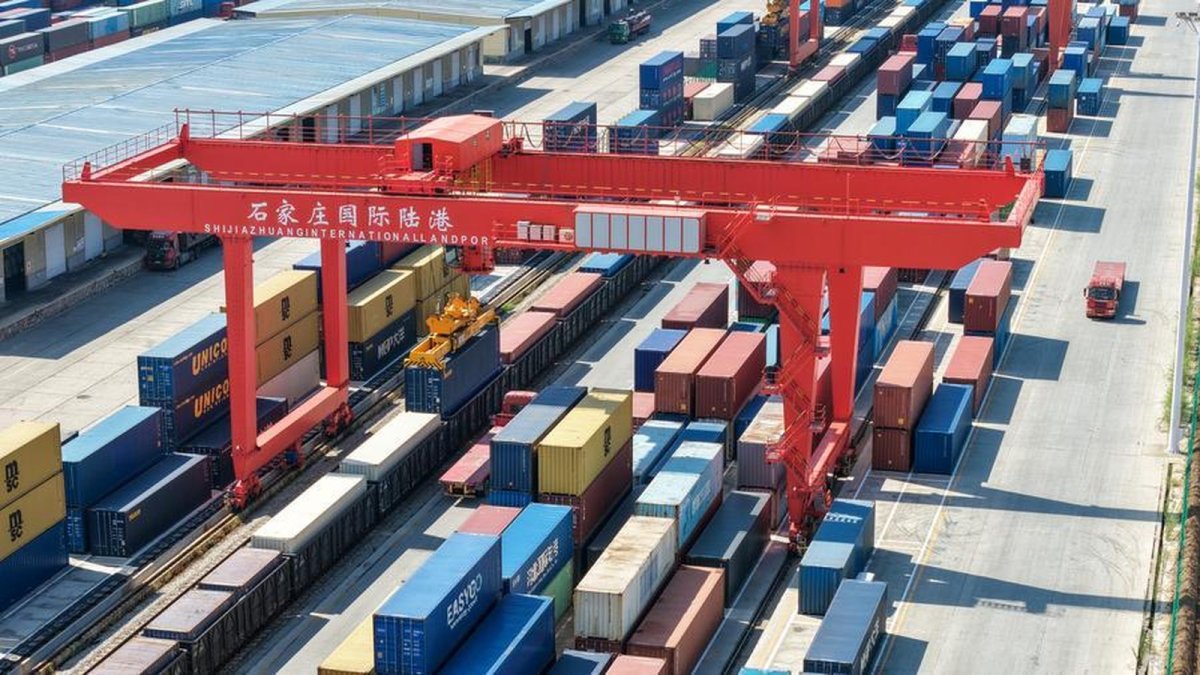
China's foreign trade expanded sharply in July 2026, with total goods trade reaching 4.66 trillion yuan according to General Administration of Customs data released on August 7. Exports rose 17.8 percent year on year in yuan terms while imports climbed 21.2 percent, pushing the monthly surplus to 112.5 billion dollars. These results arrive as Beijing prepares for a September leaders summit with Washington and an October meeting with Brussels, where trade imbalances and new tariff measures will dominate discussions.
July Performance Metrics and Structural Shifts
The General Administration of Customs reported that January-July trade totaled 30.13 trillion yuan, up 17.3 percent from the prior year. High-technology categories accounted for nearly 60 percent of July's export growth, with industrial robots and 3D printers each surging more than 50 percent. Mechanical and electrical products reached 11.12 trillion yuan over the first seven months, representing 63.8 percent of total exports and expanding 21.2 percent year on year.
Transition From Traditional to Advanced Export Trios
China's export composition has moved beyond the original trio of apparel, furniture, and home appliances toward electric vehicles, lithium batteries, and solar panels, and now includes robotics, AI-related goods, and innovative drugs. Semiconductor exports almost doubled in value during the first seven months, while chip shipments alone jumped 117 percent in July. Ceramic shipments fell 28.3 percent and toys declined 9.7 percent, illustrating uneven performance across sectors.
Private Sector and Enterprise Contributions
Private firms handled 17.16 trillion yuan of trade in the first seven months, or 56.9 percent of the national total, growing 17.2 percent. Foreign-invested enterprises expanded 17.6 percent and state-owned enterprises rose 17.3 percent over the same period. Director of the GAC Department of Statistics and Analysis Lyu Daliang noted that the economy's move toward higher quality and better structure has underpinned foreign trade resilience.
Regional Trade Patterns and Belt and Road Expansion
Growth across ASEAN, Africa, and Latin America reveals the geographic reorientation of Chinese trade toward the Global South. January–July shipments to ASEAN rose 20 percent, to Africa 18.9 percent, and to Latin America 15.4 percent, outpacing the 9.5 percent gain with the European Union and contrasting with the 1.6 percent decline with the United States. These patterns indicate that supply-chain diversification is occurring not through relocation away from China but through deeper integration with emerging-market partners that absorb both intermediate and finished goods, particularly in mechanical, electrical, and green-technology categories.
The sharp July increase in trade with South Korea—exports up 46.6 percent and imports up 97.8 percent—further demonstrates intra-Asian high-technology integration. Korean firms supply components that feed Chinese assembly of semiconductors, robots, and electric-vehicle parts, creating mutual dependencies that buffer against bilateral frictions with the United States. This regional density strengthens Beijing’s negotiating leverage by showing that alternative markets and production networks can sustain export momentum even if access to traditional destinations tightens.
Belt and Road trade expanding 15.5 percent aligns with connectivity priorities that will carry into the 15th Five-Year Plan period. The combination of stronger performance in ASEAN and African markets with continued APEC growth of 21 percent provides Beijing with diversified outlets that reduce reliance on any single partner. These regional buffers, in turn, allow Chinese negotiators to approach the September summit and October EU-China meeting from a position of demonstrated resilience rather than defensive adjustment, altering the calculus of both Washington and Brussels regarding the feasibility of further restrictive measures.
US Tariff Actions and Front-Loading Dynamics
The sequence of tariff adjustments in July illustrates a deliberate escalation calibrated to domestic political timelines. After the 10 percent temporary levy expired, the new 12.5 percent rate took effect under the forced-labor framing, prompting exporters and U.S. importers to accelerate shipments before further increases. This front-loading behavior is visible in the July data showing U.S.-bound exports rising 17 percent even as the bilateral surplus narrowed to $28 billion from $28.86 billion the previous month. The narrowing reflects both the timing of orders and the cumulative adaptation of supply chains that began during earlier rounds of tariffs, allowing Chinese firms to maintain volume while absorbing part of the cost increase through efficiency gains in mechanical and electrical products.
A second escalation vector now operates alongside the tariff schedule. The separate excess-capacity investigation opens the possibility of additional duties on a wider range of goods, creating uncertainty that itself accelerates ordering. Exporters have responded by prioritizing high-value categories such as industrial robots and 3D printers, whose July shipments rose more than 50 percent and accounted for roughly 60 percent of the month’s overall export increase. This selective surge demonstrates how firms are concentrating resources in segments less immediately exposed to the new levies while preparing for broader measures.
The narrowed bilateral surplus therefore signals neither capitulation nor victory but a managed adjustment ahead of the expected September leaders’ meeting. Both sides face incentives to avoid further disruption: Beijing seeks to preserve the momentum in semiconductor and electric-vehicle exports, while Washington weighs the domestic inflation impact of higher tariffs. Regional production networks are simultaneously being reconfigured to mitigate direct bilateral exposure, a pattern that will shape the bargaining positions brought to the summit.
EU and Broader Partner Responses Ahead of October Meeting
The European Union recorded a 16 percent rise in imports from China in July while its own exports to China fell 1.4 percent. Brussels is considering additional measures to address the widening deficit. South Korea posted particularly strong figures, with Chinese exports up 46.6 percent and imports surging 97.8 percent. These patterns suggest that supply-chain realignments continue to favor certain Asian partners even as political pressure builds in Brussels.
Domestic Demand Weakness and Policy Calculus
The divergence between factory-gate and consumer prices captures the core imbalance in the current expansion. With the producer price index rising 4.1 percent in June—its strongest reading since July 2022—while the consumer price index advanced only 1 percent and retail sales grew just 1 percent, margins in manufacturing remain supported by external orders even as household spending stays subdued. This K-shaped pattern is evident in the contrast between surging shipments of electric vehicles, lithium batteries, and robotics and the contraction in traditional categories such as ceramics, down 28.3 percent, and toys, down 9.7 percent. The result is a manufacturing sector that continues to absorb labor and investment while older light-industry clusters face structural headwinds.
The Politburo’s late-July call for a faster transition from old to new growth drivers therefore carries direct implications for the sequencing of the 15th Five-Year Plan. By emphasizing quality and structural upgrading over broad stimulus, policymakers are signaling that export performance in high-technology goods can substitute for immediate consumption support. This approach reduces pressure to deploy large-scale fiscal measures that might otherwise target the property sector, consistent with external assessments that stimulus remains restrained while manufacturing and export targets remain within reach. The second-order effect is a prolonged period of uneven regional and sectoral adjustment, with coastal high-tech clusters gaining relative to inland traditional industries.
The policy paradox is that robust external demand simultaneously eases and entrenches domestic imbalances. Strong July trade figures, including mechanical and electrical exports reaching 11.12 trillion yuan for the first seven months, allow Beijing to meet headline growth objectives without accelerating consumption-oriented measures. Yet this reliance also delays the rebalancing required for more durable internal demand, leaving the economy exposed to any future external slowdown. The full-year target range of 4.5–5 percent therefore hinges on continued export resilience rather than a near-term revival in retail or housing activity.
Strategic Implications for the September Summit and Global Order
A second consecutive surplus projected to exceed one trillion dollars intensifies pressure on both Washington and Brussels. The scale of the imbalance, built on gains in electric vehicles, lithium batteries, and semiconductor exports that nearly doubled in the first seven months, underscores China’s entrenched position in global value chains for green-technology and advanced-manufacturing inputs. This outcome directly informs the EU’s ongoing deliberations over defensive instruments, which could extend beyond tariffs to investment screening and procurement restrictions, thereby shaping how Global South partners perceive the durability of Chinese trade partnerships.
Paradoxically, demand for AI-related infrastructure from the United States and its allies is channeling capital into the very Chinese capacities that later become subjects of restriction. July’s 117 percent jump in chip exports and the 50-plus percent rise in industrial robots illustrate how external orders finance technological upgrading even as investigations into excess capacity proceed. The resulting interdependence complicates any abrupt decoupling and raises the stakes for the September summit, where Beijing seeks expanded market access for its upgraded exports while Washington pursues concrete rebalancing commitments.
Both sides therefore approach the meeting with constrained options. Chinese negotiators can point to the narrowed U.S. bilateral surplus and the 17 percent rise in July exports as evidence that existing tariffs have not halted trade momentum. U.S. counterparts, facing the prospect of further escalation through the excess-capacity channel, must weigh the inflation costs of additional duties against the political imperative to address the cumulative surplus. The October EU-China economic meeting will likely test whether similar dynamics produce coordinated or divergent outcomes on either side of the Atlantic.
Outlook for Negotiations and Supply-Chain Realignment
Chief Greater China economist at ING Lynn Song noted that external demand has grown increasingly important amid widening domestic divergence. Pinpoint Asset Management president Zhiwei Zhang expects export momentum to remain firm through the third quarter and anticipates intense bilateral talks before the September summit. The data underscore China's determination to leverage AI and robotics leadership to offset tariff risks and sustain its position in global value chains.
By Prof. Marcus Chen, Staff Writer This article was produced with AI-assisted research and editorial support. Sources: General Administration of Customs (GAC), Xinhua, Reuters, CNBC.What's Your Reaction?
 Like
0
Like
0
 Dislike
0
Dislike
0
 Love
0
Love
0
 Funny
0
Funny
0
 Wow
0
Wow
0
 Sad
0
Sad
0
 Angry
0
Angry
0

World Politics Analyst at Global1.News. Based in Beijing, covering US-China relations, global trade, and geopolitical strategy. Brings deep analytical perspective to the power dynamics shaping international affairs.















Comments (0)