
China’s Green Exports to Europe Surge Amid Climate Crisis and Geopolitical Turmoil
In a summer marked by record-breaking heatwaves, wildfires, and the economic fallout of the ongoing US-Iran conflict, a significant shift is underway in Western Europe’s automotive market. According to data from Schmidt Automotive Research, Chinese-made electric vehicles (EVs) accounted for 14.2 percent of all EVs sold in Western Europe between January and May 2026.
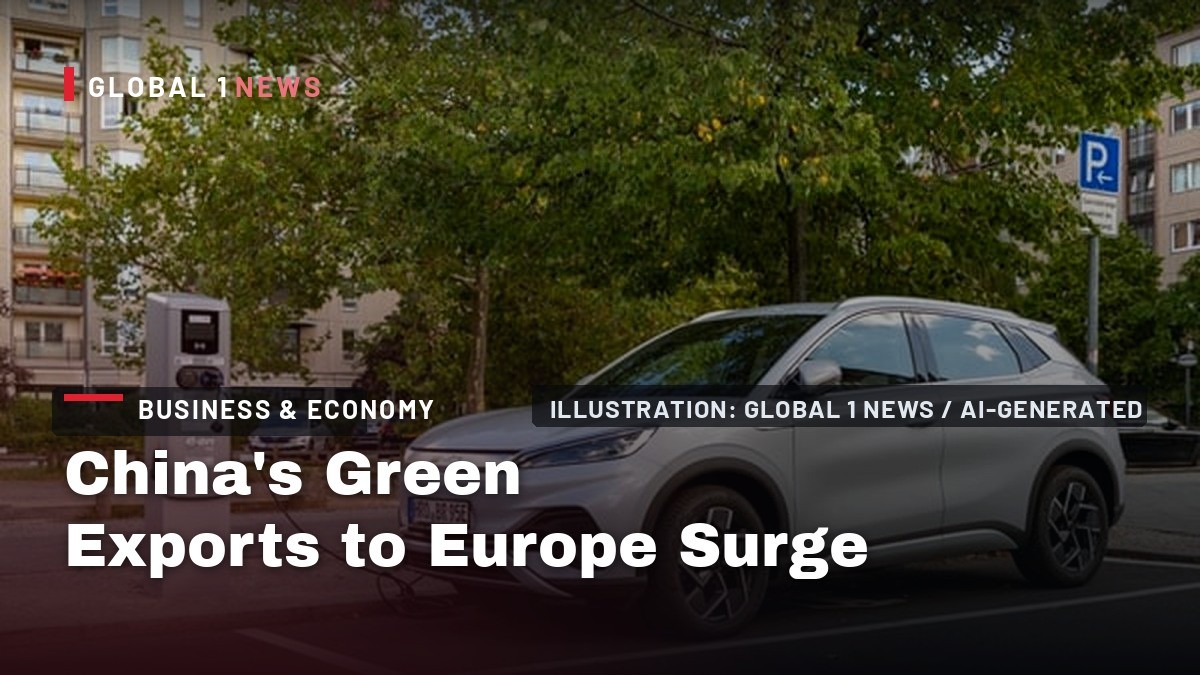
In a summer marked by record-breaking heatwaves, wildfires, and the economic fallout of the ongoing US-Iran conflict, a significant shift is underway in Western Europe’s automotive market. According to data from Schmidt Automotive Research, Chinese-made electric vehicles (EVs) accounted for 14.2 percent of all EVs sold in Western Europe between January and May 2026. This means roughly one in seven EVs sold in the region now bears a Chinese brand, a remarkable penetration rate achieved despite the European Union’s substantial tariff regime on Chinese EV imports, which has been in place since 2024.
The figures, released against a backdrop of China’s own domestic economic stagnation, reveal a paradox: while Beijing’s broader economy shows signs of weakness, its green technology exports to Europe have become a singular bright spot. The surge is not merely a story of trade policy or industrial strategy; it is a narrative driven by two powerful, intersecting forces—climate change and geopolitical conflict. For Korean policymakers, automakers, and battery manufacturers, the implications of this European shift are profound, reshaping competitive dynamics in a market that has long been a cornerstone of Seoul’s export-led growth model.
The Dual Drivers: Heatwaves and the Iran Conflict
The immediate catalysts for the surge in Chinese EV adoption are environmental and geopolitical. Europe is experiencing its most severe summer on record, with soaring temperatures leading to drought, wildfires, and a spike in electricity demand as households and businesses turn to air conditioning. The tangible costs of climate change—mounting insurance premiums, agricultural losses, and infrastructure strain—are accelerating the continent’s transition toward a greener economy. European consumers and firms are increasingly purchasing heat pumps, solar panels, and EVs as a means of decarbonizing their activities and insulating themselves from the volatility of fossil fuel markets.
Simultaneously, the on-again, off-again conflict between the United States and Iran, which reignited in February 2026, has sent European petrol and diesel prices surging. This fuel price shock has fundamentally altered the total cost of ownership calculus for European drivers. Battery-powered vehicles, which are less exposed to crude oil price swings, have become significantly more attractive. Chinese manufacturers, already incentivized by a severe price war in their domestic market, have been quick to respond to this demand surge, flooding the European market with competitively priced models.
Tariff Context and Market Penetration
The 14.2 percent market share is particularly notable given the EU’s tariff structure. Since 2024, the bloc has imposed significant duties on Chinese EV imports, a measure designed to protect the European automotive industry from what Brussels views as unfair state-subsidized competition. However, these tariffs are not replicated in the United Kingdom, which has pursued a more laissez-faire approach to Chinese EV imports. While the UK’s open market accounts for some of the sales surge, the data indicates that Chinese brands are also making substantial inroads in tariff-protected EU markets, suggesting that consumer demand is outpacing protectionist measures.
The scale of Chinese ambition is staggering. Chinese manufacturers have exported over 120 distinct EV designs to Europe this year, compared to roughly 100 designs from European car companies themselves. This design proliferation demonstrates a strategic commitment to the European market that goes beyond simple price competition. Firms like BYD, Chery, SAIC, and Xpeng are expanding their European footprints despite the tariff barriers, indicating a long-term strategic view of the region as a primary growth market.
Europe’s Protectionist Turn and the Industrial Accelerator Act
The EU’s response to this influx has been a mixture of defensive protectionism and strategic recalibration. The proposed Industrial Accelerator Act (IAA) is a key component of this strategy, introducing "Made in Europe" requirements in areas like public procurement. Beijing has consistently complained that the IAA and other EU instruments function as non-tariff trade barriers, aimed squarely at constraining Chinese exporters.
The EU’s growing protectionism is rooted in a deeper anxiety: the long-term danger of over-reliance upon Chinese exports, including clean technology products. European security establishments have increasingly voiced concerns about "weaponized dependencies," cybersecurity risks, and espionage threats. Some European think tanks have gone so far as to claim that China’s clean technology itself presents a national security threat to the bloc. This securitization of trade policy marks a significant departure from the EU’s traditional liberal economic orthodoxy.
The Geopolitical Chessboard: US Pressure and Critical Minerals
The United States is likely to encourage European countries to adopt an even more wary view of Chinese smart and clean technology exports. Washington is leading by example with the Connected Vehicle Security Act, proposed legislation that would ban imports of China-linked smart vehicles, including EVs and components, by 2030. The bill would also block Chinese smart cars from entering the US market via Canada or Mexico, effectively creating a North American firewall against Chinese automotive technology.
While a full EU mimicry of this approach remains a low-probability scenario, it is a high-impact one. Europe’s opposition to China’s current industrial development strategy is growing, as is its fear of becoming even more dependent upon Chinese technology and supply chains. These fears are not abstract. China has already demonstrated its willingness to use its dominance of critical mineral supply chains as a geopolitical weapon, severely constraining Japan’s access to these goods in recent disputes. Beijing has increasingly used its economic leverage to demand concessions on matters ranging from Taiwan and Tibet to maritime boundary disputes in the South China Sea.
The most concrete demonstration of this leverage occurred last year when China restricted automotive chip supplies to Europe. This action came in response to a Dutch government attempt to take over Nexperia, a global semiconductor company that is a subsidiary of Chinese technology firm Wingtech. Beijing’s sharp reaction to this perceived Dutch infringement confirmed Europe’s worst fears about its exposure to Chinese trade and technology pressures. The episode served as a stark warning that China is willing to weaponize its supply chain dominance in response to perceived slights.
The Trade Deficit and Economic Asymmetry
These security concerns are intertwined with Europe’s frustration over its growing trade deficit with China, which reached a record 359.9 billion euros in 2025. Brussels argues that the significant asymmetry in market openings between the EU and China is at least partially to blame for this gap. European companies face substantial barriers to entry in the Chinese market, while Chinese firms enjoy relatively open access to Europe. This asymmetry has become a central grievance in EU-China relations, fueling demands for reciprocity and fair competition.
The combination of security fears and economic frustration has created a volatile policy environment. Europe is not yet engaged in a full-scale trade war with Beijing, but its opposition to China’s industrial development strategy is hardening. The continent is walking a tightrope, seeking to benefit from Chinese green technology while simultaneously protecting its own industrial base and strategic autonomy.
Implications for Korea’s EV and Battery Industry
For South Korea, the Chinese surge in Europe presents a complex strategic challenge. Hyundai and Kia have long been major players in the European automotive market, with a strong reputation for quality and reliability. However, they now face a two-front competitive threat: from established European premium brands on one side and from aggressive, cost-competitive Chinese manufacturers on the other. The Chinese strategy of flooding the market with diverse designs at competitive price points directly challenges the mid-market segment where Hyundai and Kia have traditionally excelled.
Korean battery makers—LG Energy Solution, Samsung SDI, and SK On—face an equally complex environment. These companies have invested heavily in European manufacturing capacity, positioning themselves as key suppliers to European automakers. The growth of Chinese EVs in Europe could have a dual effect. On one hand, if Chinese manufacturers source batteries from Korean suppliers for their European-built models, this could create new opportunities. On the other hand, Chinese battery makers like CATL and BYD are aggressively expanding their own European operations, threatening to displace Korean suppliers in the long term.
Seoul’s broader strategic position is also delicate. South Korea is a key US ally, and Washington is pressuring its partners to adopt a wary view of Chinese technology. However, Korea’s economic interdependence with China remains deep, and Seoul has historically sought to balance its security alliance with the US against its economic relationship with Beijing. The European experience—of being caught between US pressure and Chinese economic leverage—offers valuable lessons for Korean policymakers navigating this same tightrope.
Strategic Outlook: A New Era of Green Tech Competition
The European EV market is becoming a microcosm of the broader geopolitical struggle over green technology dominance. The confluence of climate change and the Iran conflict has created a demand shock that Chinese manufacturers are exploiting with remarkable agility. Europe’s response—a mix of tariffs, procurement requirements, and security scrutiny—reflects a continent grappling with the tension between its climate goals and its strategic autonomy.
For Korea, the lesson is clear: the global green transition is not merely an environmental imperative but a geopolitical battleground. Seoul must accelerate its own technological innovation, deepen its supply chain resilience, and navigate the increasingly fraught relationship between Washington and Beijing. The European experience demonstrates that market access alone is insufficient; strategic positioning, diplomatic agility, and technological superiority are all essential components of success in this new era. As Chinese EVs continue to penetrate Western markets, the competitive landscape for Korean industry will only become more challenging, demanding a response that is both strategic and urgent.
This article was produced with AI-assisted research and editorial support. Sources: The Diplomat, August 28, 2026.
By Prof. David Park, Staff WriterWhat's Your Reaction?
 Like
0
Like
0
 Dislike
0
Dislike
0
 Love
0
Love
0
 Funny
0
Funny
0
 Wow
0
Wow
0
 Sad
0
Sad
0
 Angry
0
Angry
0

East Asia/Technology Correspondent at Global1.News. Seoul-based voice covering Korean politics, technology, business, and culture. Analyzes how technology and geopolitics intersect across East Asia.












Comments (0)