
The Censorship Paradox: How China's Animal Cruelty Outrage Went Global
When footage of four boys in Jieyang, Guangdong province, beating three puppies with sticks before setting their mother dog, Wang Wang, ablaze surfaced on Chinese social media in late June, the reaction was immediate and visceral. Within days, the Communist Party's censorship apparatus moved to scrub the most graphic content, citing the need to protect the minors involved.
When footage of four boys in Jieyang, Guangdong province, beating three puppies with sticks before setting their mother dog, Wang Wang, ablaze surfaced on Chinese social media in late June, the reaction was immediate and visceral. Within days, the Communist Party's censorship apparatus moved to scrub the most graphic content, citing the need to protect the minors involved. Yet three weeks later, the story has not only refused to die in the domestic digital sphere—it has metastasized into an unprecedented transnational campaign, complete with billboards in New York's Times Square and Taipei, AI-translated summaries in over ten languages, and coordinated fundraising from Hong Kong to Macau. The episode has become a case study in the limits of digital authoritarianism, exposing a legal vacuum in China's animal welfare protections and forcing a reckoning with how state-managed outrage can spiral beyond the Great Firewall.
The Official Response: Protection of Minors or Management of Anger?
The authorities' stated rationale for the censorship was clear and, on its face, legally defensible. An official statement urged the public "not to disseminate related information, to reject cyberbullying, and to work together to create a good environment for the growth of minors." Under Chinese law, individuals under 16 do not face criminal liability except for major crimes such as murder and rape, and the boys involved are all younger than 14. The Jieyang authorities announced last month that the boys would be sent to a "specialised school," though they did not elaborate on the nature of that institution or the duration of their stay. This framing is consistent with Beijing's broader governance doctrine, which prioritizes social stability and the protection of minors as a pillar of its "China story" narrative. The regime tightly controls media and the internet to suppress criticism of the state and to manage public anger, and the invocation of child welfare provides a morally unimpeachable cover for content moderation. However, the approach has created a paradox: by scrubbing the video to protect the boys' identities, authorities inadvertently amplified the story's virality. Snippets of the footage with faces visible continue to circulate, and unverified close-ups have emerged, raising the risk of vigilante misidentification. The censorship did not quell the outrage; it redirected it.The Legal Gap: Why China Has No Anti-Cruelty Statute
At the heart of the public fury lies a structural deficiency in Chinese law. Animal cruelty is not punishable by statute in China. The Wildlife Protection Law covers wild animals, but there is no comprehensive national anti-cruelty framework for companion animals. This legal vacuum was exposed again in June when a separate cruelty case in Chongqing sparked protests and renewed demands for stronger protections. The Yulin Lychee and Dog Meat Festival, which ran from June 21-30 in Guangxi, also drew international condemnation, with animal rights groups documenting thousands of animals butchered despite slower-than-usual sales. The absence of legislation is not an oversight but a reflection of policy priorities. For decades, Beijing has prioritized economic development and social order over animal welfare, viewing the latter as a Western import that could disrupt rural livelihoods and traditional industries. The Ministry of Agriculture and Rural Affairs has periodically floated draft regulations on companion animal management, but none have advanced to a national law. The result is a patchwork of local ordinances and a legal system that treats pets as property rather than sentient beings, leaving citizens with no formal recourse when abuse occurs.The Censorship Paradox: Scrubbing Posts, Fueling the Fire
The censorship response has been notably inconsistent, revealing the limits of algorithmic content moderation. Keywords such as "Wang Wang" and "animal protection" trended on Monday, but related posts began disappearing toward the end of the week. Some users reported that their ability to share others' posts had been restricted, a shadowbanning technique that is harder to detect than outright deletion. Posts by celebrities, including Chinese actor Du Jiang and Taiwanese actress Joe Chen, who had called for stronger animal protections, also vanished—though it remains unclear whether the celebrities themselves removed them. This selective enforcement has created a "whack-a-mole" dynamic. Each removal generates new posts referencing the censorship itself, a phenomenon well-documented in studies of Chinese internet governance. The Human Rights Watch reported on July 23 that police had harassed animal protection supporters, calling it the latest in a string of animal abuse cases this summer that spread rapidly online and met a familiar censorship response. The strategy of managing public anger by suppressing its expression appears to be backfiring, as the very act of censorship validates the public's sense that their voices are being silenced.Going Offline: Billboards, Stadiums, and Streetwear
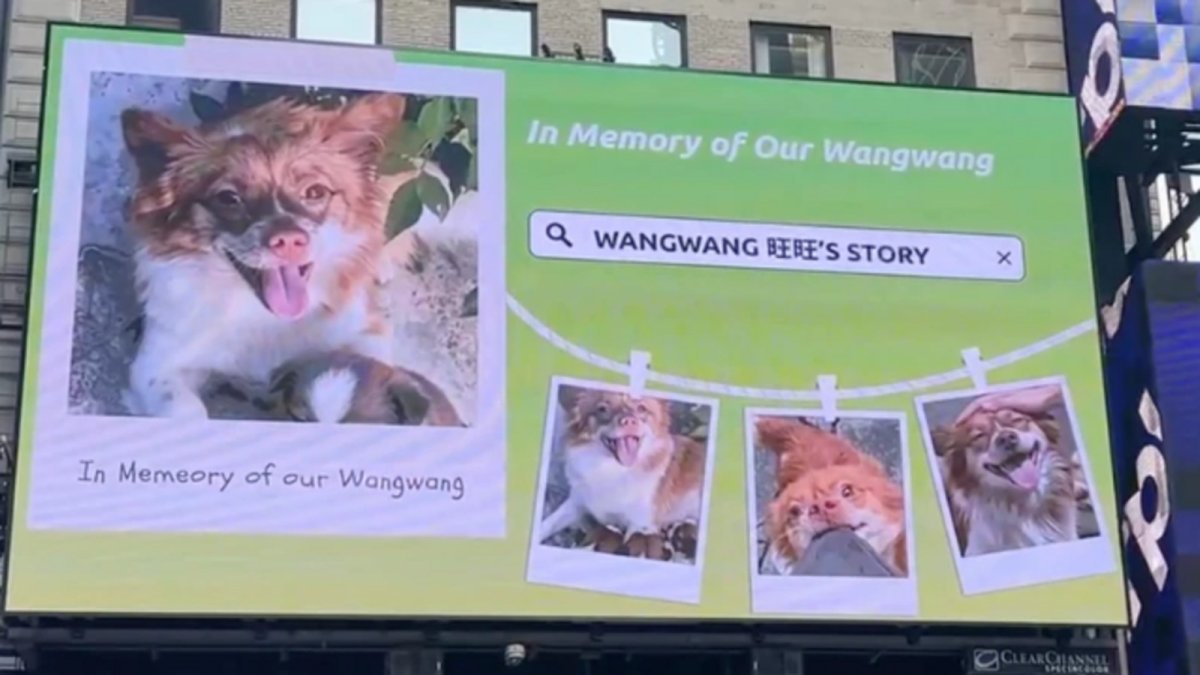
Unable to sustain the conversation on domestic platforms, animal lovers have innovated. In New York City's Times Square, photographs of Wang Wang appear on a gigantic digital screen every 35 minutes, with the caption: "She was loved. She wanted to live. She should still be here." A similar billboard near Taipei 101, featuring Wang Wang nursing her puppies, reads: "This planet is their home too. Justice for Wang Wang." These efforts are funded by private individuals, including CK, a Taiwanese woman who spent NT$30,000 (US$930) on the billboard, hoping to foster "a sense of unity" rather than individual online venting. Within mainland China, the campaign has moved to physical spaces. A striking cartoon of Wang Wang and her puppies was displayed on a huge screen before a domestic football game in Dalian on Saturday, with the message: "Every life deserves respect and kindness." Homegrown businesses, including beauty brand Amortals and streetwear label Wah Yan Ching Nin, have placed ads outside shopping malls across the country. Stickers and car decals featuring Wang Wang are for sale on Taobao, China's largest e-commerce platform. These offline tactics circumvent the censorship apparatus by occupying public spaces that are harder to monitor and regulate.Transnational Solidarity: The Diaspora and the Digital Bridge
The international dimension of this campaign marks a significant escalation. PL, an animal lover in eastern China, told BBC Chinese she found the case "affecting in a particularly severe way," adding: "We can't make our voices heard, so many people [outside China] are actively helping us to share this message." The International Organisation for Animal Protection, based in Italy, says it has received more than 100 reports from people across the world calling for intervention and has sought more information from Chinese authorities. Taiwanese activists have been particularly active. CK has set up accounts on Reddit and X to share the animals' plight, while Elara, another Taiwanese woman, used AI to translate a summary of the incident into more than 10 languages, including Japanese, Portuguese, and Russian. Residents in Hong Kong and Macau have raised funds to put up posters on buses and trains. This transnational network leverages the very tools of globalization—social media platforms, crowdfunding, and AI translation—that Beijing cannot fully control, creating a parallel information ecosystem that operates beyond the reach of domestic censors.State-Society Dynamics: The Limits of Control
The episode reveals a deeper tension in China's governance model. The state's capacity to censor is formidable, but it is not absolute. The persistence of the debate on Weibo, where posts continue to draw thousands of comments three weeks after the incident, suggests that the censorship apparatus is calibrated to manage, not eliminate, dissent. The removal of billboards at Wan Jia Li mall in Changsha, reportedly on government instruction, shows that authorities are willing to intervene in physical spaces, but the employee's uncertainty—"I'm not sure if the notice came from the government, or why we have been asked to take them down"—indicates a diffuse and sometimes contradictory enforcement regime. This is not a simple binary of state versus society. Many Chinese citizens support the censorship of graphic violence, even as they demand legal accountability. The public discourse has largely centered on creating awareness and demanding laws against animal cruelty, a reformist rather than revolutionary agenda. The state's challenge is to channel this energy into acceptable outlets without appearing to capitulate to foreign pressure or domestic agitation. The "specialised school" placement for the boys is an attempt to demonstrate responsiveness while maintaining the principle of juvenile protection.Strategic Implications for Beijing's International Image
For Beijing, the Wang Wang case is a public relations headache with strategic dimensions. The international billboards and the AI-translated summaries have transformed a local incident into a global narrative about China's governance, legal system, and treatment of animals. Commentators have noted that the case has become a "headache" for authorities, precisely because it resonates with Western audiences already skeptical of China's human rights record. The censorship response, framed as child protection, is easily recast as suppression of legitimate public concern. The episode also intersects with Beijing's broader image-management efforts. The "China story" narrative emphasizes harmony, rule of law, and social progress, but the absence of an anti-cruelty statute undermines this framing. The government's reluctance to enact national legislation reflects a fear that doing so would set a precedent for other rights-based claims, from environmental protection to labor rights. Yet the longer the legal gap persists, the more ammunition it provides to critics who argue that China's development model prioritizes economic growth over ethical governance.Conclusion: A Summer of Discontent and the Road Ahead
The Wang Wang case is unlikely to be the last of its kind. The Yulin festival and the Chongqing incident suggest a pattern of summer animal cruelty cases that ignite online outrage and meet a predictable censorship response. The question is whether Beijing will adapt its strategy. Some analysts argue that the regime may eventually support a limited animal welfare law as a pressure valve, allowing citizens to feel that their concerns are heard without conceding broader political space. Others contend that the state's instinct to control will prevail, driving more activism offshore and into the diaspora networks that have proven so effective in this case. For now, the campaign continues. "Let's keep posting. Don't let the heat of discussion cool down," reads a comment on Weibo. The billboards in Times Square and Taipei will keep rotating. The AI translations will keep circulating. And in Jieyang, four boys under 14 will attend a "specialised school," their identities protected by a state that has discovered that protecting them has come at the cost of its own credibility. The censorship paradox is that in trying to silence the outrage, Beijing has ensured that Wang Wang's story will not be forgotten—neither in China nor around the world.This article was produced with AI-assisted research and editorial support. Sources: BBC News, Human Rights Watch, Reuters, South China Morning Post.
By Prof. Marcus Chen, Staff Writer
What's Your Reaction?
 Like
0
Like
0
 Dislike
0
Dislike
0
 Love
0
Love
0
 Funny
0
Funny
0
 Wow
0
Wow
0
 Sad
0
Sad
0
 Angry
0
Angry
0

World Politics Analyst at Global1.News. Based in Beijing, covering US-China relations, global trade, and geopolitical strategy. Brings deep analytical perspective to the power dynamics shaping international affairs.













Comments (0)