
A 17-Year-Old Died From a Brain-Eating Amoeba. The Durham Water Feature That Likely Exposed Him Was Never Permitted
A 17-year-old died from a brain-eating amoeba after splashing water at a Durham mental health nonprofit's water feature. State investigators called it the most likely source, and the county says it was never permitted.

Folks, read this one slowly, because it is not a story about a pond, and it is not a story about bad luck. A 17-year-old named Moises Ponce Mendoza went with his family to a therapy appointment at a mental health center in Durham, North Carolina, in the middle of August. Outside the building there was a man-made creek, with a pump and several fountains, ringed by rocks. He splashed water on his face. Eight days later he was in an emergency room. Ten days after that he was dead.
On September 15, the North Carolina Department of Health and Human Services released the investigation that matters here, and it landed on the water feature outside El Futuro, a community-based nonprofit that serves Latino families on Chapel Hill Road. State investigators called it the most likely source of the Naegleria fowleri infection that killed him. But the finding that should be read twice is the one the Durham County Health Department gave ABC11 in the same week: El Futuro never completed the required application, evaluation, and permitting process for that water feature. Nobody had signed off on the water. And as of this week, the county's "Keep Out" sign was still the only barrier around it.
A 17-Year-Old Died From a Brain-Eating Amoeba. The Durham Water Feature That Likely Exposed Him Was Never Permitted
Durham, North Carolina — A state health investigation has identified an unpermitted man-made creek at a Durham mental health nonprofit as the most likely source of a fatal Naegleria fowleri infection, in a case that has turned a quiet corner of a County green space into a public reckoning over who actually checks the water our families touch.
A Water Feature, a Diagnosis, and Eighteen Days
The chronology, as it stands in the state's own report, is short and brutal. On August 13, the teenager had contact with the water feature in El Futuro's outdoor green space, including splashing water on his face. He developed a severe headache about six days later. He was first treated at an emergency room on August 21, after two days of headaches that would not break, and was admitted the following day.
The North Carolina Department of Health and Human Services was notified of a suspected case of Naegleria fowleri on August 23. Laboratory testing confirmed a Naegleria infection on August 26. On August 27, the department went public with a rare pediatric case in central North Carolina and said only that the patient was critically ill and receiving care, withholding further detail to protect the family's privacy. Durham County closed the water feature on August 28 so the Centers for Disease Control and Prevention could test it.
Moises Ponce Mendoza, 17, of Burlington, died on August 31. His mother, Mónica Mendoza, identified him on a GoFundMe page. He had been days away from the start of his senior year of high school.
What the State Found in the Green Space
When investigators walked the site in late August, they found a man-made creek with a pump and several fountains — and problems around the machinery. NCDHHS inspectors documented algal growth and organic material around the pump system. Testing detected non-viable Naegleria fowleri DNA in water drawn from the fountain's storage tank.
The CDC went further. According to the agency, samples collected from the fountain's storage tank water, from rocks at the site, and from a fire hydrant at El Futuro all tested positive for Naegleria fowleri. State officials concluded the water feature was not effectively disinfected.
El Futuro's own account of its maintenance is now part of the record too. The nonprofit has said the feature was maintained through chlorine treatments and power washing, and that it used a recirculating water system with a pump and multiple fountains. According to the state investigation, El Futuro reported cleaning the creek by power washing and adding chlorine by hand.
The Sentence Durham County Said Out Loud
Here is where this stops being a medical story and becomes an accountability story. The Durham County Health Department told ABC11 that El Futuro never completed the required application, evaluation, and permitting process needed for the water feature. That is a bureaucracy sentence, so let us translate it: the county's routine inspection regime for pools and water features — the one the department says covers every permitted pool and water feature in Durham County as required by the state — had no hook into this water at all.
The gap did not close when the investigation began. WTVD reporters found a Durham County Health Department "Keep Out" sign posted at the feature, and no fence or barrier preventing anyone from walking into the area. WRAL reported the same on September 15: "Keep Out" signs and orange traffic cones marking off a green space that neighbors describe as an everyday gathering place for children.
Fourteen-year-old Zamaya Strickland, who lives nearby, told WRAL what the space normally looks like. "Not even a few weeks ago," she said. "There's kids in the little pond, water fall every single day."
The Clue That Was Sitting in the Grass
Water temperature is not a footnote in a Naegleria case. The amoeba is a single-celled organism that feeds on bacteria in warm freshwater, thrives during prolonged stretches of hot weather, and grows best at higher temperatures — up to 115 degrees Fahrenheit, according to NCDHHS. Reporting on the state investigation recorded water temperatures of about 91.4 degrees Fahrenheit at the El Futuro site during the inspection period. A shallow, recirculating creek in a Carolina August, with algae in it, is close to an ideal habitat.
That is the part that should travel beyond Durham. Naegleria fowleri is naturally present in ponds, lakes, rivers, hot springs, and poorly maintained swimming pools. It is not found in salt water or in properly maintained, chlorinated pools. It cannot be eliminated from the environment. Which means the entire safety margin for a decorative water feature rests on whether somebody is testing the chlorine and cleaning the system — and on whether anyone with authority ever looked at the thing in the first place.

What the Other Sites Showed
Fairness requires the rest of the testing record, because the state has been careful to say it cannot conclusively determine where Moises was exposed. Interviews with the family produced several possible exposure locations across three counties. Investigators sampled eleven water sources the teenager had interacted with, in Alamance, Orange, and Durham counties.
Only the El Futuro feature came back positive. But the others were not clean either. The Orange County apartment complex pool had inadequate chlorine levels. Two Alamance County ponds tested by investigators were stagnant, with visible algae. The pool and both ponds — three separate sites — carried conditions that favor this organism. The state's conclusion — that the El Futuro water feature was the most likely source — rests on the combination of his documented contact with it, its inadequate disinfection, the visible algae, and the DNA finding on site.
NCDHHS put its own uncertainty on the record, and it deserves to be quoted whole: "While this investigation does not allow us to conclusively determine the location of exposure, the epidemiologic, laboratory, and environmental findings suggest that the El Futuro water feature was the most likely source." The report also states that no other potential sources of exposure were identified.
What El Futuro Says
The nonprofit has not disputed the finding, and its statement reads as grief rather than defense. "NC Department of Health and Human Services and Durham County Public Health informed El Futuro that testing identified the presence of Naegleria fowleri in a water feature at our green space," the organization said. "Our hearts are broken for the young boy who lost his life and for his family. We are committed to supporting his family and our community through this devastating loss. We will continue to fully cooperate with public health officials. The water feature has been closed since we were first contacted by county officials."
Context matters here too. El Futuro is the kind of institution a community fights to keep. ABC11 spoke with its organizers in 2020, when they described the outdoor space as a therapeutic garden and a gathering place for community connection. The man-made creek was a feature of that design, not an act of negligence dreamed up overnight. And NCDHHS, in its own first announcement of the case on August 27, extended condolences to the family rather than faulting the site.
The Numbers That Explain Why This Is So Rare
Naegleria fowleri is not a public health emergency, and no official involved in this case has pretended otherwise. According to NCDHHS, only 167 cases of infection were reported nationwide between 1962 and 2024 — roughly two cases a year across six decades, and typically fewer than 10 annually. Cases range from zero to eight in a given year. The organism was first identified by the pathologist Malcolm Fowler, and it is named for him.
North Carolina has seen this before. In 2021, NCDHHS reported a pediatric death from a rare brain infection linked to a swim in a private pond in central North Carolina.
Dr. Rodney Jenkins, Durham County's public health director, made a point of emphasizing the rarity even as his department worked the case, explaining the testing process publicly. Dr. Carl Williams, the state public health veterinarian, struck the same note, saying that people are exposed to fresh water and surface water all the time, and that these infections are extremely rare.
The Five Days That Decide Everything
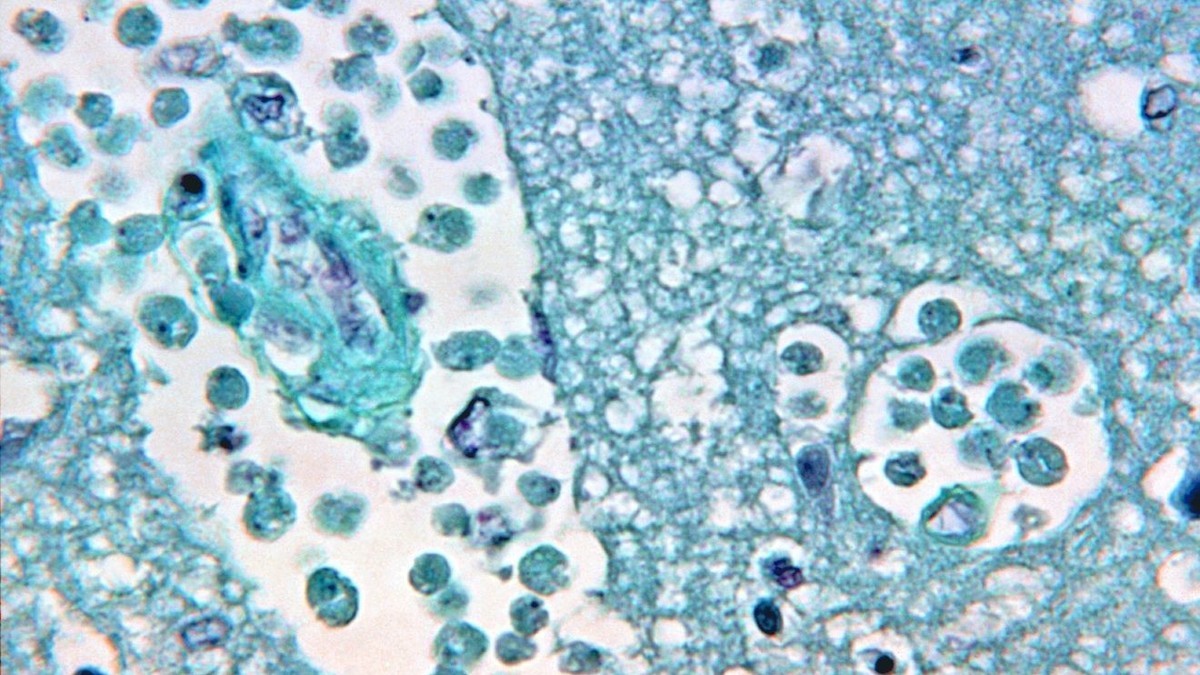
The disease the amoeba causes is called primary amebic meningoencephalitis, or PAM. The mechanism is the reason this case is so hard to prevent and so hard to survive. The amoeba does not cause illness if it is swallowed. It cannot be spread from person to person, and drinking contaminated water does not cause infection. What it needs is a route up the nose. From there it travels along the olfactory nerve into the brain, where it destroys tissue, and once symptoms begin the disease progresses rapidly and usually causes death within about five days.
That is why Williams drew attention to how little force is required. "Any time there's water with the amoeba in it, and it gets up into your nose, that can be an exposure," he said. "That opens up the possibility of less forceful situations, like splashing." A splash pad. A fountain. A hand run across a wet face. That is the transmission route in a case like this one, and it is why the old assumption that these infections only happen to people who dive into warm lakes is dangerously incomplete. Symptoms typically begin one to twelve days after exposure and can include severe headache, fever, nausea, and vomiting, before progressing to a stiff neck, seizures, and coma.
What You Can Actually Do
The prevention guidance is unglamorous and it is specific, and every parent who takes a kid anywhere near warm fresh water should have it memorized. Hold your nose shut, use nose clips, or keep your head above water. Do not put your head underwater in hot springs and thermal waters. Do not jump into warm freshwater during periods of high water temperature combined with low water levels. Do not dig in or stir up sediment in shallow, warm freshwater. And use only distilled, sterile, or appropriately boiled-and-cooled water for nasal and sinus rinsing.
Facilities that do this right can show you their regimen. The Museum of Life and Science in Durham, which operates multiple water features, told ABC11 that each exhibit area has its own filtration system running continuously, with chlorine levels and other readings tested twice a day whenever temperatures climb above 80 degrees. That is what an inspected, permitted water feature looks like from the inside. It is a schedule, a log, and somebody whose job it is to run the test.
The Question Nobody in Durham Has Answered Yet
Officials have not announced whether the man-made creek at El Futuro will reopen. The county says it continues to work with the state on next steps. The nonprofit says it will keep cooperating. The "Keep Out" sign is still there, and so is the gap it represents.
Because the real finding in this report is not that a decorative creek in North Carolina harbored an amoeba. That organism is native, it is everywhere in warm freshwater, and it cannot be eradicated. The finding is that a water feature families treated as a safe, therapeutic green space — one a fourteen-year-old says was full of kids every single day — was never run through the county's permitting process, and therefore never entered the inspection schedule that would have tested its chlorine and cleaned its system on the record. The state can count the DNA it found. It cannot count the inspections that never happened, because there were none.
So here is what I want you to do with this. If you know a splash pad, a fountain, a man-made creek, a hotel pool, or a pond at a complex near you, ask the operator one question: who permitted this, and what is the testing log? If the answer is vague, that is your answer. Ask your county health department whether every public water feature in its jurisdiction is actually on the inspection list or merely supposed to be. And if you take your kids into warm fresh water this month, buy the nose clips, make them wear them, and do not apologize for being the parent who asks.
Moises Ponce Mendoza was seventeen years old with a whole life in front of him. The least we owe him is a straight answer about the water, and a rule that makes sure the next family never has to ask.
By Jessica Ali, Staff Writer
This article was produced with AI-assisted research and editorial support. Sources: North Carolina Department of Health and Human Services (September 15, 2026 investigation report and news release; August 27, 2026 case announcement; August 17, 2021 prior case release); Durham County Health Department; U.S. Centers for Disease Control and Prevention; WRAL News; ABC11 / WTVD; ABC News; WLOS; WCTI News 12; NTD; The Herald-Sun.
What's Your Reaction?
 Like
0
Like
0
 Dislike
0
Dislike
0
 Love
0
Love
0
 Funny
0
Funny
0
 Wow
0
Wow
0
 Sad
0
Sad
0
 Angry
0
Angry
0

Editor-in-Chief at Global1.News. Atlanta-based journalist who cuts through the BS and tells it like it is. Lead anchor, host, and the voice you hear when the spin stops and the truth starts.















Comments (0)