
Australia-China Ties Settle at 'Good Enough' Baseline
After nearly a decade of rupture and repair, China-Australia relations have settled into a good-enough baseline, former ambassador Graham Fletcher says: stable for Canberra, short of Beijing ambitions, with Darwin and Taiwan as flashpoints.
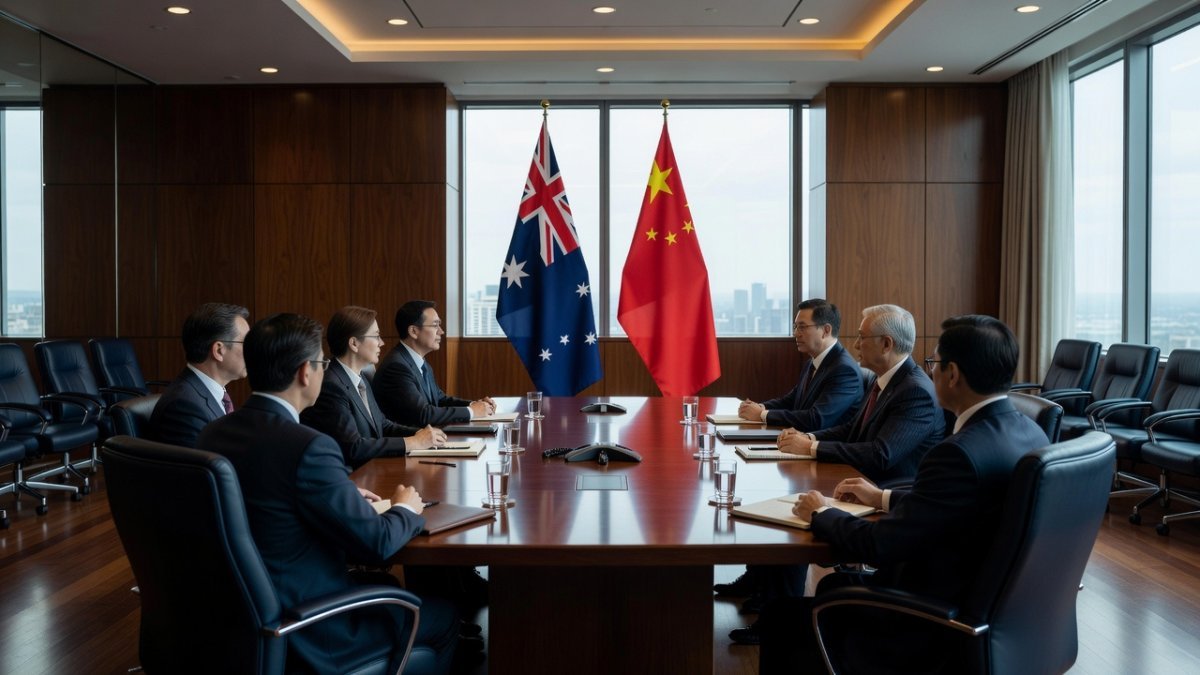
Canberra's New Equilibrium With Beijing: Realistic, Modest, Sustainable
Tokyo — After nearly a decade of rupture and repair, the China-Australia relationship has settled into what a former top Australian diplomat calls a "good enough" baseline — stable enough for Canberra, but still short of the broader ambitions Beijing holds for the partnership.
Graham Fletcher, who served as Australia's ambassador to China from 2019 to 2023 and is now a non-resident fellow at the Lowy Institute, set out the assessment in a report released on Sunday. The two countries are reviewing their decade-old free-trade agreement, and Australia served as guest country of honour at China's International Supply Chain Promotion Expo in Beijing in June — markers of a relationship that has climbed far from its 2020 nadir.
"It was a modest new normal, not a reset," Fletcher wrote, capturing a dynamic that carries direct lessons for Japan and other US allies calibrating their own China policy.
From 2020 Freeze to 2024 Thaw: The Long Road Back
The current equilibrium is best understood against the depth of the earlier breakdown. The relationship fractured in 2017, when Canberra introduced anti-foreign interference legislation and accused Beijing of political infiltration. It widened in 2018 when Australia became the first country to bar Huawei Technologies from its 5G networks.
Ties hit a historic low in 2020 after Canberra called for an independent international inquiry into the origins of Covid-19. Beijing retaliated with trade restrictions on major Australian exports, including barley, wine and lobster — measures that inflicted billions of dollars in damage on Australian producers.
The thaw began in 2022 after Anthony Albanese's Labor government took office. High-level ministerial dialogue resumed, and Albanese visited Beijing in 2023 and again in 2025. Encouraged by sustained engagement, Beijing incrementally lifted its trade barriers, culminating in the full restoration of regular trade for Australian live lobsters and other commodities by late 2024. For Australian exporters, the return of those markets ended one of the costliest episodes of economic statecraft in the region's recent history — and the memory of it continues to shape how Canberra weighs each new Chinese overture.
What Beijing Still Wants — and Why Canberra Won't Bite
Fletcher argues the improvement has not produced the expansion of cooperation Beijing expected. China is keener than Australia to move beyond stabilisation, pressing for cooperation in areas such as developing a non-discriminatory AI environment and guarding the global trading system — proposals that have gained little traction in Canberra.
Beijing's diplomatic push has been explicit. In March, China's then-ambassador to Australia, Xiao Qian, who left the post at the end of last month, reiterated Beijing's willingness to deepen cooperation on high-speed rail, green energy, AI and quantum technology.
According to Fletcher, "Beijing has not given up on hopes of drawing Australia closer into its orbit. Canberra is more focused on consolidating current pillars in the relationship." From Canberra's perspective, going further would carry risks it does not see as worthwhile — including the political hazard of Australian politicians being seen as pro-China, and potential concerns from Washington about Australia's economic interdependence with Beijing.
The Numbers Behind the Stance: Trade Strong, Trust Cautious
Public sentiment has shifted markedly, even as strategic caution persists. The Lowy Institute's 2026 poll, released in June, found 61 per cent of Australians now see China more as an economic partner than a security threat — an 11-point increase from 2025 and one of the largest swings in this year's survey. In 2021 and 2022, by contrast, 63 per cent viewed China primarily as a threat.
The economic reality anchors the warming view: two-way trade between Australia and China reached US$325 billion in 2025, making China Australia's largest trading partner by a wide margin. The survey's overall findings were published against a backdrop of steady diplomatic traffic: during Albanese's second visit to Beijing in July 2025, he and Premier Li Qiang announced a new Policy Dialogue on Steel Decarbonisation, and Climate Minister Chris Bowen followed with a ministerial climate dialogue in October. Yet the poll also found 62 per cent of Australians support doing more to pressure China on human rights, and 54 per cent favour closer work with allies to deter China's use of military force — down six points from a year earlier.
Port of Darwin and the Pacific: Friction Points That Won't Disappear
Fletcher identifies two risk categories for the relationship. The first covers serious disagreements that cannot be successfully managed: Beijing's pushback against foreign restrictions on its technology and investment, the ownership of the Port of Darwin, and political unrest in the Pacific Islands.
The Darwin dispute is a substantial friction point. The port was leased to China's Landbridge Group for 99 years in 2015; citing national security concerns, Canberra has sought to return it to local control. Landbridge responded by launching international arbitration in May, alleging discriminatory treatment under the Australia-China free-trade agreement — a case Australia's Defence Minister Richard Marles called "disappointing" even as the government held its ground.
Taiwan and the Shock Scenarios
The second risk category encompasses major shocks: an upheaval within China, Beijing's possible use of force against Taiwan, or broader regional conflict. Beijing regards Taiwan as part of China to be reunited by force if necessary; Australia does not recognise Taiwan as independent but strongly supports unofficial economic and cultural ties and backs the island's meaningful participation in international organisations — a stance that draws objections from Beijing.
Fletcher also warns that deterioration in the US-China rivalry could leave Australia caught between unacceptable demands from Beijing or Washington, particularly over critical minerals, technology or national infrastructure. The risk is not hypothetical: Lowy's polling shows Australians would support assisting Taiwan in a conflict — 72 per cent would accept Taiwanese refugees, 69 per cent would back diplomatic sanctions on China, and 61 per cent would support sending arms and military supplies — while a slim majority would oppose deploying Australian military personnel to defend the island.
What to Watch For: Lessons for Japan and the Region
For Japan, the Australian experience offers a template for a "modest new normal" that is simultaneously resilient and constrained. Tokyo, like Canberra, maintains deep economic interdependence with China while anchoring its security posture to Washington — and faces the same Beijing playbook of sector-specific cooperation offers designed to pull allies closer. Both governments also operate within trilateral and minilateral structures — AUKUS and the Quad — that Beijing watches with unease, even as trade ties expand.
Fletcher's own verdict is that China's regional dominance is far from guaranteed; in a Lowy analysis in July he noted that Beijing's neighbours — India, Russia, Japan, Vietnam, and both Koreas — "will not be pushovers" and that US allies "are hardly going to be the ones to undo their security ties with Washington." The Australia-China relationship, he wrote, is entering a phase that is "more realistic, less ambitious and probably more sustainable."
The open question is whether that equilibrium holds. "Even so, the relationship remains poised in an international context that could pull or push in unexpected directions," Fletcher said. "Stability will remain a goal, not a given." For Canberra and Tokyo alike, managing the China relationship now means managing the uncertainty around it.
By Kenji Tanaka, Staff Writer
This article was produced with AI-assisted research and editorial support. Sources: South China Morning Post (Carol Yang, Aug 9, 2026), Lowy Institute Poll 2026, Lowy Institute (Graham Fletcher, July 2026), Maritime Executive/ABC News (May 2026).
What's Your Reaction?
 Like
0
Like
0
 Dislike
0
Dislike
0
 Love
0
Love
0
 Funny
0
Funny
0
 Wow
0
Wow
0
 Sad
0
Sad
0
 Angry
0
Angry
0

Japan Correspondent at Global1.News. Tokyo-based voice covering Japanese politics, technology, economy, and culture. Tracks the intersection of tradition and innovation in one of the world's most dynamic societies.













Comments (0)