
Abroad, India’s RSS Speaks of ‘Love.’ At Home, Its Affiliates Attack Christians.
This article analyses the chronology of attacks in West Bengal, the organisational links among the RSS, Vishwa Hindu Parishad (VHP), Bajrang Dal and other affiliates, and the broader implications for India’s constitutional guarantees of religious freedom.
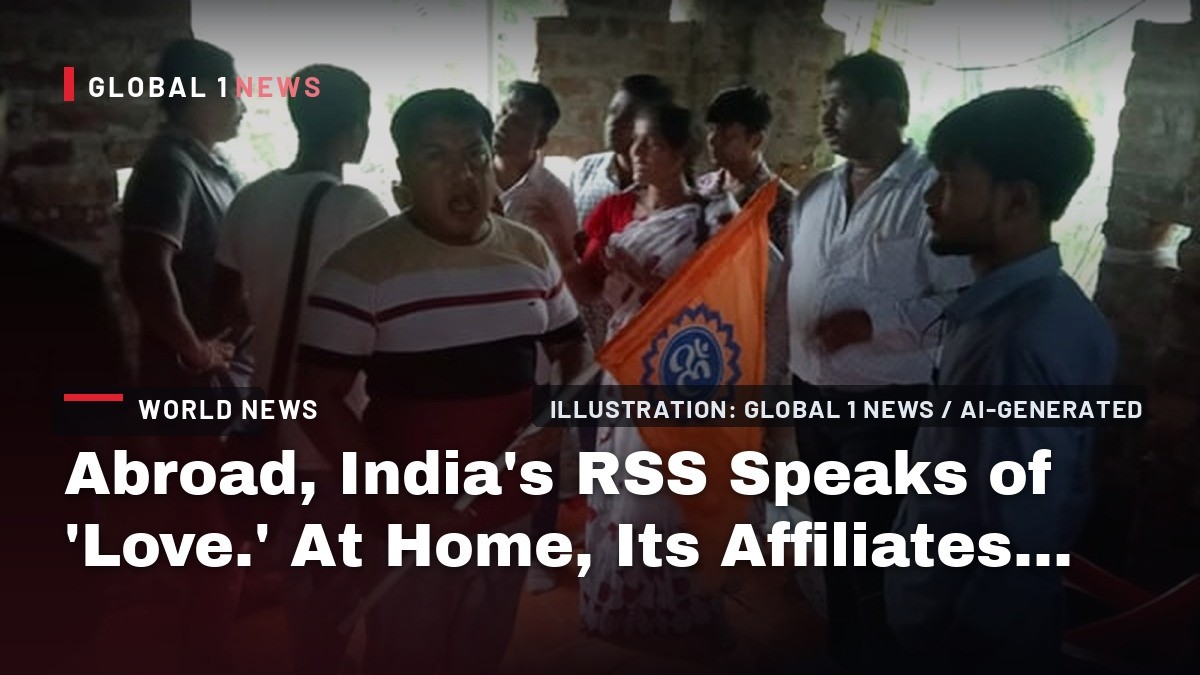
In the wake of the May 2026 state elections that returned Prime Minister Narendra Modi’s Bharatiya Janata Party (BJP) to power in West Bengal, a series of violent interventions against Christian prayer gatherings have drawn stark attention to the divergent narratives advanced by the Rashtriya Swayamsevak Sangh (RSS) abroad and its affiliates on the ground. The incidents, documented in a recent report by The Diplomat, illustrate how the RSS‑linked Sangh Parivar mobilises local cadres to enforce a homogenised Hindu civilizational identity, while its chief Mohan Bhagwat simultaneously projects a message of “pure and divine love” on the international stage. This article analyses the chronology of attacks in West Bengal, the organisational links among the RSS, Vishwa Hindu Parishad (VHP), Bajrang Dal and other affiliates, and the broader implications for India’s constitutional guarantees of religious freedom.
Electoral Context and the Rise of Sangh Parivar Activism in West Bengal
The BJP’s victory in the May 2026 West Bengal elections marked the first time the party secured a majority in the state, a development that has emboldened Sangh Parivar organisations to act more openly. The report notes that the village of Sutahata, in the eastern part of the state, became a flashpoint on 26 August when a house‑fellowship gathering hosted by Pastor Joy Kumar Ghughu was violently disrupted. The gathering, attended by roughly fifty participants—many of whom were Hindus—was perceived by local Hindu supremacist groups as an attempt at conversion, prompting a coordinated assault.
Senior BJP leader Amit Malviya later characterised the episode, along with two other incidents, as “isolated local objections to prayer gatherings… peacefully resolved by the police.” This official framing contrasts sharply with video evidence posted on Facebook and other platforms, which shows saffron‑flag‑bearing mobs, members of the VHP and Bajrang Dal, forcibly entering the home, shouting Hindu slogans, and physically removing attendees. The discrepancy between the party’s public statements and on‑the‑ground realities underscores the tension between the BJP’s electoral legitimacy and the militant activism of its ideological parent, the RSS.
Operational Dynamics of RSS‑Linked Organisations
The incident at Sutahata was executed by individuals who identified themselves as members of the Shree Ram Janmotsab Samity, a local committee that openly affiliates with the RSS. The Samity’s Facebook page regularly circulates invitations to RSS events and to the VHP, confirming a direct organisational pipeline. In one video, a participant from the VHP’s Chaitanyapur unit declares, “Sanatan Dharma is the world’s greatest religion. Whenever you spot people we identified in our videos, just inform us,” signalling a surveillance‑oriented approach to religious minorities.
Further evidence of coordinated action appears in the Bajrang Dal’s social‑media postings, which not only encouraged the physical assault—“Beat them up with brooms whenever and wherever you see them”—but also framed the violence as a defensive measure against “religious propaganda.” Such rhetoric aligns with the RSS’s broader narrative that portrays Christianity as a threat to Hindu cultural hegemony, a stance that has intensified since the BJP’s ascendance in West Bengal.
Chronology of Attacks Across Multiple Districts
Between late August and early September 2026, at least six distinct prayer gatherings were targeted in West Bengal. On 23 August, a mob breached a church in Uluberia (Howrah district), vandalising the prayer room and assaulting attendees. The same day, Bajrang Dal activists disrupted a Christian house‑prayer ceremony in Baniberia (South 24 Parganas). On 30 August, Bajrang Dal members thrashed a lawyer in Baripur (South 24 Parganas) for hosting Christian prayers, while miscreants stormed a Sunday gathering in Jagatballabhpur (Howrah) and vandalised a venue in Hingalganj (North 24 Parganas). Finally, on 1 September, the Hindu Jagran Manch locked up a Christian‑run school in Hasnabad (North 24 Parganas), demanding the removal of Jesus imagery from its walls.
These incidents, concentrated within a single state over a brief period, reveal a pattern of systematic intimidation rather than isolated outbursts. The involvement of multiple RSS‑affiliated groups—VHP, Bajrang Dal, Hindu Jagran Manch—suggests a coordinated strategy to suppress Christian religious expression, leveraging the political cover provided by the BJP’s state‑level governance.
Constitutional Contradictions and Legal Responses
Pastor Ghughu, after being detained and interrogated by police at the Sutahata block primary health centre and later at the police station, invoked Article 25 of the Indian Constitution, which guarantees freedom of conscience and the right to profess, practice and propagate religion. He noted that no monetary inducement was offered for conversion, challenging the premise of the attackers’ grievance. Despite this constitutional safeguard, the police response—detaining attendees for medical checks and interrogations—reflected an ambiguous stance, neither protecting the victims nor prosecuting the aggressors.
The lack of formal complaints filed by the victims, attributed to Christian teachings of forgiveness, further complicates legal accountability. While the BJP’s Amit Malviya described the incidents as “peacefully resolved,” the absence of prosecutions or official investigations signals a tacit tolerance of religious intimidation within the state’s law‑enforcement apparatus.
International Messaging Versus Domestic Reality
During a September 2026 tour of the United States, Canada and the United Kingdom, RSS chief Mohan Bhagwat delivered speeches that emphasised “Shuddha Satvik Prem” (pure and divine love) as the foundation of the Sangh’s work. In New York’s Madison Square Garden, he proclaimed that “all paths lead to the same destination” and that “every human has dignity, with no difference between human beings.” In London, he reiterated that Hindu civilizational identity can accommodate diversity, stating, “We must never lose sight of the fact that we are one.”
These declarations stand in stark contrast to the footage from West Bengal, where RSS‑linked cadres openly chant “Jai Shree Ram,” brandish saffron flags, and physically assault Christian worshippers. The dichotomy underscores a strategic bifurcation: abroad, the RSS seeks legitimacy and soft power by projecting an inclusive, love‑based ethos; domestically, its affiliates pursue a homogenising agenda that marginalises religious minorities.
Implications for Regional Geopolitics and Korean Diplomatic Observations
From a Korean diplomatic perspective, the West Bengal incidents illustrate how majoritarian nationalist movements can destabilise internal pluralism, with potential spill‑over effects on regional stability. South Korea’s Ministry of Foreign Affairs (MOFA) has previously warned that religious intolerance can exacerbate communal tensions, undermining democratic institutions—a concern echoed by think‑tanks such as the Asan Institute and the Korea Development Institute (KDI), which monitor sociopolitical trends in South‑Asian democracies.
Moreover, the RSS’s global branding of itself as the “world’s largest NGO,” as noted by Modi, reflects an attempt to shape international perception while domestic practices diverge sharply. For policymakers in Seoul, understanding this duality is essential when engaging with India on issues ranging from trade to security cooperation, ensuring that human‑rights considerations remain integral to bilateral dialogues.
Forward‑Looking Assessment and Policy Recommendations
Looking ahead, the persistence of RSS‑linked violence in West Bengal suggests that without decisive legal interventions, the pattern of intimidation may expand to other states where the BJP consolidates power. Scholars at the Korea Institute for International Economic Policy (KIEP) recommend that democratic partners, including South Korea, support civil‑society monitoring initiatives and encourage the Indian government to enforce constitutional protections for religious minorities.
In the academic realm, this case underscores the need for comparative studies of nationalist NGOs that simultaneously project soft‑power abroad while fostering exclusionary practices at home. As the Sangh Parivar celebrates its centenary, the juxtaposition of Bhagwat’s love‑centric rhetoric with the on‑ground reality in West Bengal offers a potent reminder that rhetoric alone cannot substitute for the rule of law and the safeguarding of pluralistic freedoms.
This article was produced with AI-assisted research and editorial support. Reporting is based on the source material cited below. Sources: The Diplomat; thediplomat.com; Global1.News (21 September 2026).
By Prof. David Park, Staff Writer
What's Your Reaction?
 Like
0
Like
0
 Dislike
0
Dislike
0
 Love
0
Love
0
 Funny
0
Funny
0
 Wow
0
Wow
0
 Sad
0
Sad
0
 Angry
0
Angry
0

East Asia/Technology Correspondent at Global1.News. Seoul-based voice covering Korean politics, technology, business, and culture. Analyzes how technology and geopolitics intersect across East Asia.














Comments (0)