
A County Approved a Data Center 5-0 on a Three-Year Power Letter
Weld County commissioners approved Global AI's data center 5-0 despite three stop-work orders and a utility letter that commits to only three years of power with no delivery path. The same week, a $580 million Texas project was withdrawn hours before its vote.
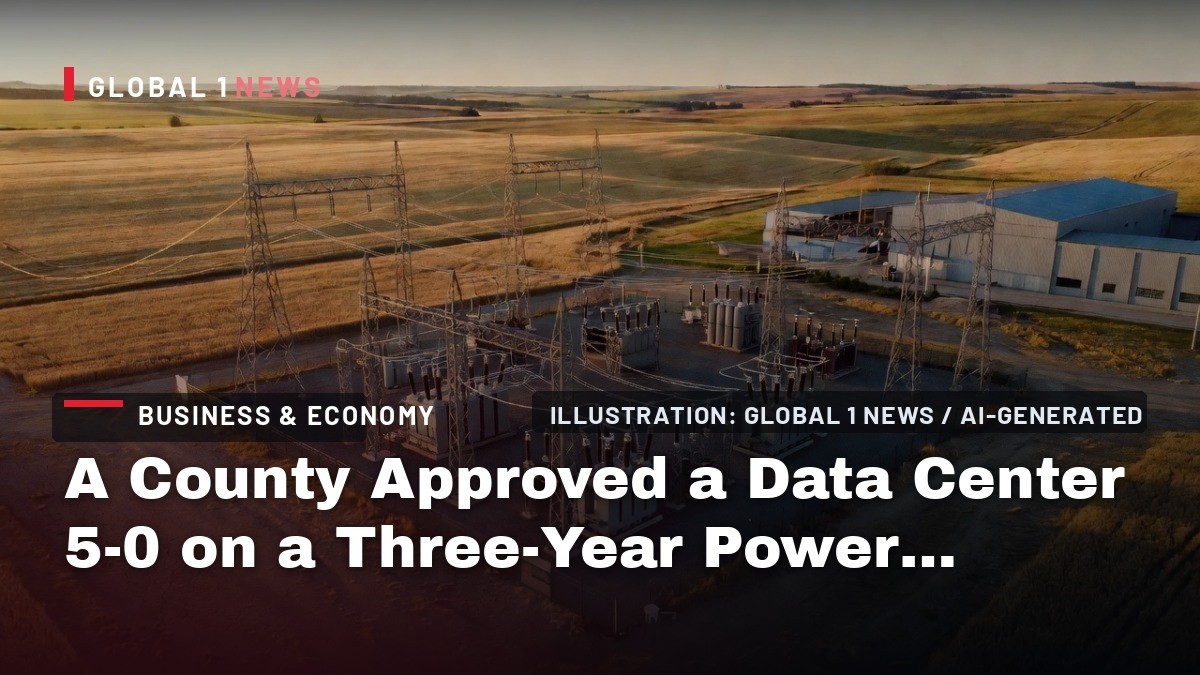
A County Approved a Data Center 5-0 on a Three-Year Power Letter
I have been running servers for over a decade, and there is one thing nobody teaches you in this business: the paperwork that lets you build the building and the paperwork that actually keeps the lights on are two completely different documents. One of them is a decision. The other one is a promise.
Last week, northern Colorado showed the entire industry which of those two it is currently treating as proof.
Weld County Said Yes — After Three Stop-Work Orders
On Wednesday, September 9, the Weld County Board of Commissioners voted 5-0 to approve a Use by Special Review permit for Global AI's data center on a 41-acre piece of a 438-acre former Carestream Health industrial site near Windsor, Colorado. Global AI bought the property last December for about $15.6 million, and the company's Chief Operating Officer, Michael Cadigan, says the first data hall could be operational later this year. KUNC reported it could become the biggest data center in the state.
Now understand what this company's record looked like walking into that room. Over the summer, Weld County issued Global AI three stop-work orders, plus one Notice of Violation and an Order to Abate, for building without the approvals it needed. That is not a paperwork slip. That is the county telling you to stop, three separate times.
Then the company did the smartest thing it could possibly do. It dropped its appeal of those violations, went out and cured them, and showed up at the hearing with the county's criteria satisfied. By the time the commissioners voted, the attorney representing Global AI, David Foster, could stand up and say the application met every standard the county set. BizWest reported the company withdrew its appeal in August and worked to cure the violations.
Here is the part that should matter to every operator reading this: the county did not vote on whether it liked Global AI. It voted on whether the application met the criteria. The land was already light industrial, and a Use by Special Review is discretionary — more rigorous than standard zoning, public comment allowed, more ways for a project to die — and Global AI walked through it anyway, unanimously.
Twenty residents spoke at the planning commission hearing. All twenty of them opposed. Roughly 200 people signed in at the commissioners' meeting. That is the room. And the vote was still 5-0.
The Letter That Cleared the Room
Now let me tell you the part that made me put my coffee down.
Residents raised the usual concerns — noise, water, diesel backup generators, and the suspicion that 27.5 megawatts, enough power for roughly 22,000 homes, is only the opening bid. But the attorney for Windsor Renewal, Hugh Gottschalk, went after something more specific, and his complaint should be printed on the wall of every developer's office. His read of the letter from the electric cooperative, PVREA, is that it "doesn't estimate or allocate the power that is needed, contains only a commitment to provide power for three years and it does not describe how that power can be physically delivered to the site."
Sit with that for a second. Three years. No allocation. No physical path.
That is the document everyone is treating as proof of power. Not a transmission study. Not an interconnection agreement with a queue position and an energization date. A three-year commitment from a rural electric cooperative, standing behind an asset that — if the operator is honest about it and follows the depreciation schedules the industry has been quietly stretching from fifteen years to twenty-five — is supposed to run for decades.
Three years covers the construction loan. It does not cover the asset.
Everybody in this industry talks about the AI power bottleneck like it is a generation problem: how many gigawatts, how many gas turbines, how many small modular reactors by 2032. It is not. It is a paper problem. A utility will happily write you a letter. Letters do not get built. Substations, transformers and transmission lines get built, and the queue to get them is measured in years, not signatures. When I see a unanimous approval resting on a three-year commitment with no delivery path, I do not see a data center. I see a refinancing event with a date on it.
Global AI is targeting a full gigawatt across its network by 2029, which tells you what that 27.5 megawatts is designed to become. The mitigation package is becoming the standard set too — a 65-decibel operating limit with emergency-generator exceptions, and a bond covering decommissioning — so put it in your pro forma from day one.
Texas Said Nothing — the Developer Packed Up and Left
Same week, 800 miles south, the other half of the pattern.
White Rose Partners proposed a $580 million, 225,000-square-foot data center on roughly 37 acres in Prosper, Texas, going by the name Project Tomahawk. The town's Planning and Zoning Commission voted 7-0 on September 1 to recommend denial, following more than 400 written comments submitted in opposition. A resident petition against the project collected over 2,000 signatures before the September 8 Town Council meeting where the final vote was scheduled.
Hours before that meeting, the developer withdrew the application. Both items. The proposal is closed, and coming back would require a brand-new application, new public notices, and a fresh hearing before the same commission that just rejected it 7-0.
Mayor David Bristol was blunt about what decided it: the thousands of people who showed up against it. He also flagged something bigger — Prosper has no statewide data center framework to lean on, so every one of these fights gets litigated town by town, with officials making the rules up as they go.
But look at what actually killed the project. Not power. Power was not even the fight. It was land use. The tract was zoned agricultural, and the developer needed a rezoning plus an amendment to the town's Future Land Use Plan — a plan that had designated that area for a business park, apartments or retail. That is not a technical review. That is a political vote about what a town wants to become, and the developer needed a council to overrule its own planning document to win it.
That is the difference between these two stories in one sentence. Weld County was a criteria test on land that was already industrial. Prosper was a referendum on land that was not.
What Actually Decides These Now
Strip away the noise, and three things decided both cases. Every one of them was in the developer's control before the first hearing ever started.
One — whether approval is by-right or discretionary. Industrial land that is already zoned, plus a special review you can satisfy with facts, is a completely different planet from a rezoning that requires an elected official to overrule the town's own land use plan. Price that difference into site selection before you buy dirt, not after.
Two — your compliance record is underwriting now. Global AI had three stop-work orders and still walked out with a unanimous approval, because it cured them and showed up with the county's criteria met. The cure is what bought the credibility. If you are building ahead of your permits — and plenty of operators are, because these timelines are brutal — understand that you are borrowing against a hearing you have not had yet.
Three — the community hearing is no longer a formality. Twenty out of twenty speakers opposed in Weld County and the applicant still won, because the process was rules-based. In Prosper, 400 comments and 2,000 signatures killed a $580 million project before a vote was taken.
More Than Half of Americans Would Vote Against This
All of this is landing against a political backdrop that is tightening by the week. CBS News polling released Sunday, September 13, drawn from a survey of 2,460 adults conducted September 8 through 11, found that slightly more than half of respondents want a congressional candidate who opposes building data centers. The same survey put the generic congressional ballot at 54-46, with a margin of error of about 2.3 points.
I am not here to do politics. I am here to tell you what that number means for capital allocation. Slightly more than half is not a protest movement — that is a majority, and majorities write zoning codes and show up at the ballot box. Ballotpedia is tracking at least 16 data-center-related measures in 2026, and moratoriums are moving through county commissions right now. If you are underwriting on a ten-year horizon, you are underwriting through two or three election cycles in a jurisdiction where you do not vote.
What This Means for Independent Hosting Providers
First — read the power commitment like an engineer, not a lawyer. Term length, allocated capacity, the physical delivery path, who pays for the substation and the upgrades, and what happens at renewal. If the term is shorter than your depreciation schedule, you do not have a power contract. You have an option that somebody else controls.
Second — match the term to the asset. If you are building for fifteen years and signing for three, you have built a business that gets re-priced twice before it is paid off. Either push the term out, or shorten your payback expectation to match reality. Do not pretend the mismatch is not there.
Third — score jurisdictions on process, not on vibes. By-right industrial zoning with a published criteria list beats a discretionary rezone every single time, even when the discretionary site is cheaper per acre. Prosper's developer just spent $580 million of ambition learning that lesson in public.
Fourth — keep the violation file empty. In a rules-based process, a clean record is your strongest exhibit and a stop-work order is your opponent's. If you do get one, cure it fast and document the cure. That is exactly what turned a summer of stop-work orders into a unanimous permit in Weld County.
Fifth — put the conditions in the model now. Decommissioning bonds, noise limits, generator restrictions, water disclosure. These are not surprises anymore — they are the standard permit condition set, so budget for them and negotiate around the edges.
Sixth — the vacuum is a business opportunity, not just a risk. When a county refuses a project or a town kills a $580 million build, that demand does not evaporate. It moves. If you are operating in a jurisdiction that still says yes, with real power behind you and a clean permit history, you are holding something the market is going to have to pay for.
The Bottom Line
The permit is now the easy part. That is a strange sentence to write in 2026, when permitting is the thing everybody blames for the buildout running behind schedule. But look at the evidence from one week in September: a company with three stop-work orders walked out of a hostile room with a 5-0 approval, and a $580 million project with a good-looking site walked away hours before its vote. Neither outcome turned on chips, on labor, or on how many gigawatts the grid can theoretically produce.
They turned on how well the paperwork was done, and how real the power behind it actually is. That is the part of this business that is still under your control, and it is the part most people skip because it is boring and it does not photograph well.
Do the boring part first. Then go build.
— Allan Ali, Founder
This article was produced with AI-assisted research and editorial support. Sources: Colorado Newsline/KUNC, CPR News/Denverite, 9NEWS, BizWest, CBS Texas, Community Impact, Prosper Town Council records, CBS News/YouGov Battleground Tracker (Sept 8-11, 2026), Ballotpedia.
What's Your Reaction?
 Like
0
Like
0
 Dislike
0
Dislike
0
 Love
0
Love
0
 Funny
0
Funny
0
 Wow
0
Wow
0
 Sad
0
Sad
0
 Angry
0
Angry
0

Publisher of Global1.News. Automation architect, systems builder, and the guy making sure the truth gets published.













Comments (0)