
Zhu Rongji, Architect of China's Economic Miracle, Dies at 97
Former Chinese Premier Zhu Rongji, architect of China's WTO entry and the reforms that turned the nation into a manufacturing superpower, has died aged 97. His 1998-2003 premiership reshaped China's economy and global trade, leaving a complex legacy of growth, dislocation, and strategic rivalry w...
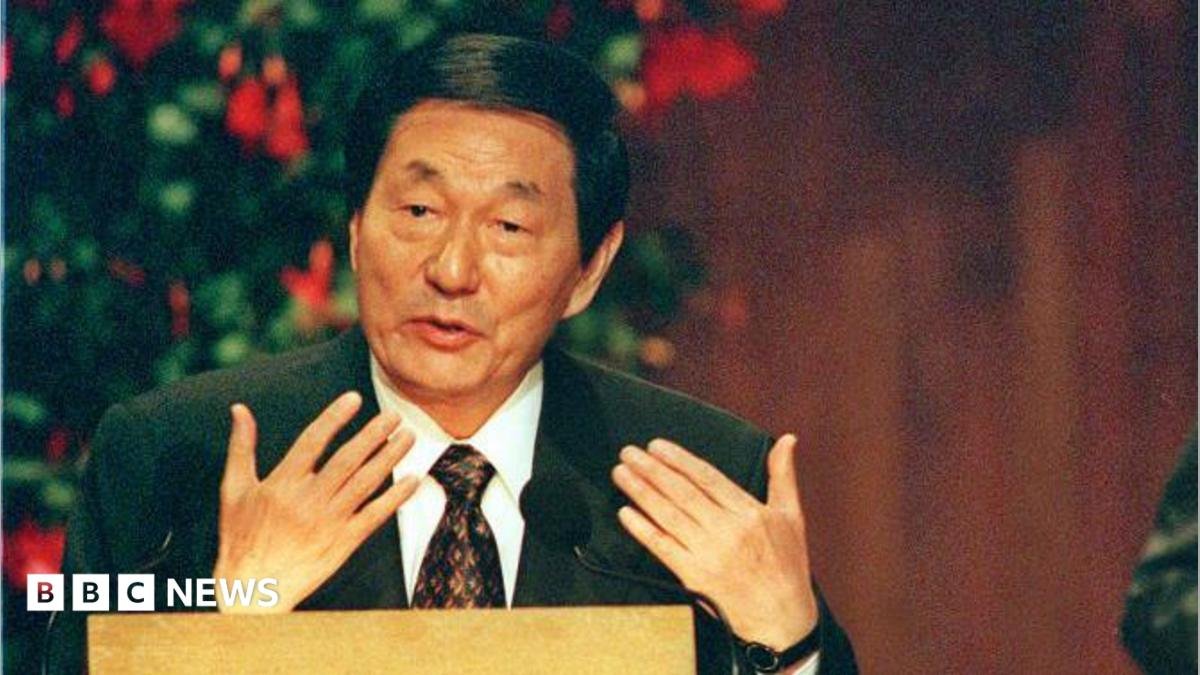
Zhu Rongji, Architect of China's Economic Miracle, Dies at 97
Former Chinese Premier Zhu Rongji, the architect of China's entry into the World Trade Organization and the driving force behind the reforms that transformed the nation into a global manufacturing superpower, has died at the age of 97. His death, reported by state media on 12 August 2026, closes a chapter on one of the most consequential—and controversial—periods of economic governance in modern Chinese history.
The Official Obituary and a Life of "Revolution, Struggle and Brilliance"
The official Xinhua obituary, as relayed by Chinese state media, described Zhu's life as one of "revolution, struggle and brilliance," characterizing him as an "outstanding member of the Communist Party of China and loyal Communist fighter... an outstanding leader of the Party and state." This formal recognition underscores the complex duality of his legacy: a man who was twice purged from the Party he served, yet who ultimately became one of its most effective and transformative economic stewards. The language of the obituary is significant, placing him firmly within the pantheon of Party heroes even as it acknowledges the profound structural changes he oversaw. For a regime that prizes continuity and collective leadership, the praise for Zhu signals that his market-oriented reforms, despite their social costs, are now considered foundational to the Party's legitimacy and China's national power.
The Premiership: 1998-2003 and the Reform Agenda
Serving as Premier from 1998 to 2003, Zhu Rongji assumed control of an economy at a critical juncture. The Asian Financial Crisis of 1997-98 had exposed vulnerabilities in China's financial system and state-owned enterprise (SOE) sector. Zhu's response was not to retreat from reform but to accelerate it. His agenda was sweeping and interlocking: he moved fiscal power from local governments to the central government, a move designed to give Beijing the macroeconomic leverage to manage the economy and redistribute wealth; he initiated a massive restructuring of state-owned enterprises, closing or privatizing failing firms that were bleeding state coffers; and he began the process of converting the urban housing market from state allocation to private ownership, a policy that would create a new asset class and fuel domestic consumption for decades.
His tenure was defined by a willingness to take on entrenched interests. The tax reform, in particular, was a monumental political battle, as it stripped local governments of significant revenue streams in exchange for a larger share of central transfers. This re-centralization of fiscal authority was essential for funding large-scale infrastructure projects and maintaining macroeconomic stability, but it also created new tensions in central-local relations that persist to this day. Zhu's banking cleanup, which involved injecting capital into the "Big Four" state banks and forcing them to write off non-performing loans, was a similarly bold move to prevent a systemic financial collapse.
The WTO Accession: A Strategic Gamble
The centerpiece of Zhu's legacy, however, is undoubtedly China's accession to the World Trade Organization in December 2001. The negotiations were arduous, spanning years and requiring China to make sweeping commitments to lower tariffs, open its markets to foreign goods and services, and adhere to international trade rules. For Zhu, this was not merely an economic agreement; it was a strategic bet that exposing Chinese industry to global competition would force it to become more efficient and innovative. He understood that the "shock therapy" of WTO membership would be painful, but he calculated that the long-term benefits of integration—access to foreign capital, technology, and markets—would far outweigh the short-term costs.
The gamble paid off spectacularly. In the years following accession, China's exports exploded, foreign direct investment poured in, and the country became the world's factory floor. The WTO entry effectively locked China into a path of export-led growth that lifted hundreds of millions out of poverty. However, it also created the structural imbalances—massive trade surpluses, over-reliance on external demand, and a domestic economy that lagged behind its export sector—that would later become flashpoints in its trade relationships, particularly with the United States.
The Human Cost: Layoffs, Inequality, and Social Strain
Zhu Rongji's reforms were not without a profound human cost. The restructuring of state-owned enterprises led to an estimated 30 million layoffs over a five-year period. These workers, many of whom had been guaranteed "iron rice bowl" employment for life, were suddenly cast into a nascent labor market with little social safety net. The "xiagang" (off-duty) workers became a symbol of the social dislocation caused by reform, and their plight contributed to rising inequality and social unrest in the late 1990s and early 2000s.
Zhu was acutely aware of these tensions. In a candid 1998 assessment, he warned that China was facing "many potential crises that could erupt at any time," citing "corruption among officials, the gulf between rich and poor and the way some local officials act like tyrants." This blunt acknowledgment of the regime's shortcomings was characteristic of his style. He was a technocrat who believed in the power of rational economic policy, but he was also a political realist who understood that reform without stability could be catastrophic. His willingness to name the problems—even as he implemented policies that exacerbated some of them—set him apart from many of his contemporaries.
A Blunt Style and a Contradictory Biography
Zhu's rhetorical style was legendary. He labelled rogue bankers as "half-wits" and famously described the dams and flood dykes lining the Yangtze River as "flimsy and porous as tofu dregs." This directness, rare in Chinese political culture, earned him a reputation as a straight-talker who was unafraid to speak truth to power. It also made him a popular figure among ordinary Chinese, who saw him as a leader willing to confront the corruption and inefficiency that plagued the system.
His biography is a study in resilience. Born in Hunan province in 1928, he earned a degree in electrical engineering before joining the civil service. He joined the Communist Party in 1949, but his career was derailed twice: first, he was labelled a "rightist" after criticizing Mao Zedong's economic policies as "irrational," and later he was purged again during the Cultural Revolution. His rehabilitation after Mao's death and his subsequent rise to the role of vice-premier in charge of the economy by 1991 is a testament to his technical competence and political survival skills. He was a man who had seen the worst of ideological extremism and emerged with a pragmatic, results-oriented worldview.
Strategic Context: The Foundation of a Superpower and the Seeds of Today's Conflicts
Zhu Rongji's legacy is not merely historical; it is the very foundation upon which contemporary China's strategic posture is built. The manufacturing superpower that the United States now seeks to contain in its trade war and technological decoupling campaign is a direct product of Zhu's reforms. The supply chains that the world has become dependent on, and which the US is now trying to reshore, were largely constructed during and immediately after his premiership. His decision to integrate China into the global trading system created the economic heft that now allows Beijing to project power regionally and globally.
However, his legacy also contains the seeds of today's tensions. The state capitalism that the US and the EU criticize is a hybrid system that Zhu helped to forge—one that uses market mechanisms for efficiency but retains state control over strategic sectors. The massive trade surpluses that are a source of friction with Washington are a direct consequence of the export-led growth model he championed. In this sense, the current US-China trade war is not a departure from Zhu's era but a reckoning with its outcomes. The very success of his reforms created the economic power that now threatens the established Western-led order, and the tools that the US is using to counter China—tariffs, export controls, and technology bans—are aimed at dismantling the architecture Zhu built.
Comparing Eras: Zhu's Pragmatism and Contemporary Governance
In comparing Zhu Rongji's governance with that of the current leadership under Xi Jinping, one sees both continuity and change. Zhu's approach was characterized by a willingness to open up to the world and to use foreign competition as a catalyst for domestic reform. His focus was on efficiency, growth, and integration. The current era, by contrast, is defined by a greater emphasis on national security, technological self-sufficiency, and a more cautious approach to globalization. The "dual circulation" strategy, which seeks to reduce reliance on external markets, represents a fundamental departure from the export-led model Zhu perfected.
Yet, there are also continuities. Xi's campaign against corruption echoes Zhu's own battles against official malfeasance, albeit with a far more expansive and politically charged scope. The current leadership's focus on "common prosperity" is an implicit acknowledgment of the inequality that Zhu's reforms exacerbated. While the specific policy tools have changed, the underlying challenge remains the same: how to maintain rapid economic development while managing its social and political consequences. Zhu's answer was to push forward with reform and integration; the current leadership's answer appears to be a more managed, state-directed form of capitalism that prioritizes stability and security over openness and efficiency.
Zhu Rongji's death marks the passing of a titan of economic reform. He was a man of contradictions—a loyal Communist who was twice purged, a market reformer who strengthened state power, and a globalist who built the foundation for a new form of great power competition. His legacy is written in the skylines of Chinese cities, the flow of global trade, and the complex, contested relationship between the world's two largest economies. As China navigates the challenges of the 21st century, it will do so in the shadow of the reforms he championed and the problems those reforms created.
This article was produced with AI-assisted research and editorial support. Sources: BBC News.
By Prof. Marcus Chen, Staff Writer
What's Your Reaction?
 Like
0
Like
0
 Dislike
0
Dislike
0
 Love
0
Love
0
 Funny
0
Funny
0
 Wow
0
Wow
0
 Sad
0
Sad
0
 Angry
0
Angry
0
World Politics Analyst at Global1.News. Based in Beijing, covering US-China relations, global trade, and geopolitical strategy. Brings deep analytical perspective to the power dynamics shaping international affairs.












Comments (0)