
Yabloko List Candidates Disqualified in Tomsk Regional Elections
In the run‑up to the 2026 regional assembly elections, the liberal Yabloko party has faced a coordinated legal offensive that has stripped it of its candidate lists in most of the country.
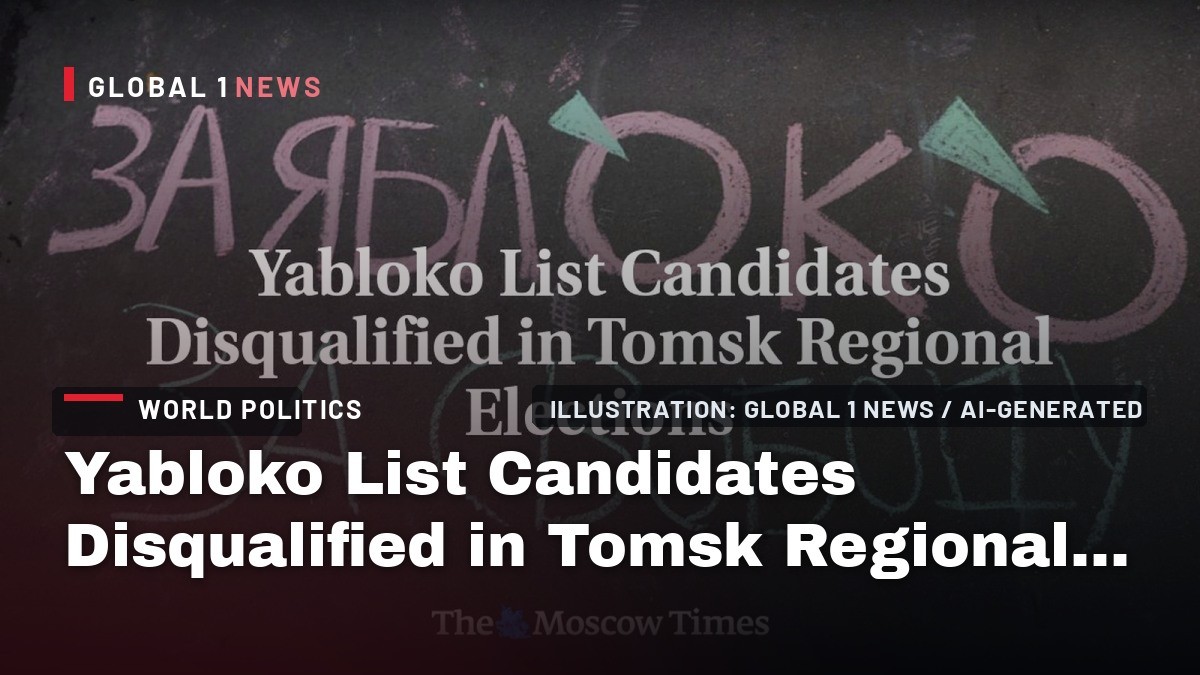
In the run‑up to the 2026 regional assembly elections, the liberal Yabloko party has faced a coordinated legal offensive that has stripped it of its candidate lists in most of the country. The latest blow came from a Tomsk regional court, which ruled to disqualify Yabloko’s party list while leaving a handful of its single‑member district candidates on the ballot. This development is part of a broader pattern of judicial actions that appear designed to curtail the party’s ability to compete, even as it remains the sole registered force campaigning on a pro‑peace platform.
Judicial decision in Tomsk: a microcosm of the wider crackdown
A judge of the Tomsk Regional Court sided with the right‑wing Liberal Democratic Party of Russia (LDPR) and ordered the removal of Yabloko’s regional list from the ballot. LDPR’s complaint alleged that Yabloko had violated copyright law, exceeded campaign‑spending limits and used banned social‑media platforms. The court’s ruling therefore invalidated the party’s list of candidates for the Tomsk regional assembly.
Despite the list’s disqualification, seven Yabloko candidates who are contesting single‑member constituencies in Tomsk remain on the ballot. This partial preservation of the party’s presence mirrors the selective approach taken by the judiciary: it allows individual candidates to run while eliminating the party’s coordinated slate, thereby fragmenting any collective liberal challenge.
Geographic spread of list disqualifications
According to Yabloko, the Tomsk ruling is the latest in a series of similar decisions across the federation. So far, the party’s candidate lists have been invalidated or denied registration in seven regions. The only region where Yabloko’s list can still appear is the northwestern Novgorod oblast, which remains the sole stronghold for the party’s coordinated campaign at the regional level.
The pattern of regional bans suggests a systematic strategy to isolate Yabloko’s organizational capacity. By limiting the party’s ability to field list candidates, authorities effectively reduce its visibility and the logistical advantages that come with a coordinated slate, while still permitting a limited number of individual candidacies to persist.
National context: Supreme Court’s recent cancellation of the federal slate
At the national level, the Russian Supreme Court issued a ruling last month that cancelled the registration of Yabloko’s federal slate of candidates for the State Duma. This decision removed the party’s ability to contest the lower house on a party‑wide basis, relegating it to a fragmented presence in single‑member districts.
Even within those single‑member contests, Yabloko’s campaign infrastructure is under pressure. The party reports that courts in several regions have received last‑minute lawsuits aimed at barring its candidates from the State Duma elections. If upheld, these suits could strip 17 of its single‑member district candidates of registration, leaving the party represented in roughly 104 single‑member races nationwide.
Legal thresholds that threaten Yabloko’s official status
Beyond the immediate impact on the 2026 elections, Yabloko faces a longer‑term existential risk. Russian law requires a party to field candidates in at least 20 % of regional assembly elections or 10 % of gubernatorial races within a seven‑year cycle to retain official registration. Failure to meet these thresholds could result in the party’s deregistration, effectively removing its legal standing and its ability to appear on ballots at any level.
The current wave of disqualifications jeopardizes Yabloko’s compliance with these statutory quotas. With list candidates barred in six of the seven regions where they were previously registered, the party’s ability to meet the 20 % regional threshold is severely compromised, raising the specter of a forced deregistration before the end of the seven‑year period.
LDPR’s role as a legal adversary
The LDPR, a right‑wing nationalist party that routinely aligns with Kremlin policy, has positioned itself as the primary litigant against Yabloko. In Tomsk, LDPR’s complaint framed Yabloko’s activities as violations of copyright, campaign‑finance rules and prohibitions on certain internet platforms. By casting the liberal party’s actions as illegal, LDPR seeks to legitise the judicial interventions and to portray Yabloko as a law‑breaking entity.
This legal maneuvering serves a dual purpose: it not only removes a political competitor from the ballot but also reinforces the narrative that liberal opposition is outside the bounds of acceptable political conduct. The use of procedural accusations—rather than overtly political rhetoric—provides a veneer of legality to what many observers view as a politically motivated suppression.
Implications for Russia’s political pluralism
The systematic erosion of Yabloko’s electoral capacity underscores a broader contraction of political pluralism in Russia. As the only registered party campaigning on a pro‑peace platform, Yabloko’s marginalisation signals a narrowing of the permissible political spectrum. The removal of party lists—an essential tool for presenting a coherent policy programme—forces liberal candidates to rely on personal reputation rather than party infrastructure, weakening their ability to influence legislative agendas.
Moreover, the legal thresholds that threaten Yabloko’s registration create a structural incentive for the state to engineer disqualifications. By imposing burdensome quantitative requirements, authorities can justify the dissolution of parties that fail to meet arbitrary benchmarks, thereby consolidating power within the Kremlin‑aligned parties that routinely pass such tests.
Consequences for independent journalism and civil society
The Moscow Times, the source of this report, has itself become a target of state repression. The Prosecutor General’s Office has designated the outlet as an “undesirable” organization, criminalising its operations and exposing its staff to prosecution. This designation follows an earlier classification of the publication as a “foreign agent.” Such measures are part of a broader campaign to silence independent media that document and analyse the very legal and political pressures faced by opposition parties.
The suppression of both political opposition and independent journalism creates a feedback loop that deepens the climate of fear and self‑censorship. When outlets like The Moscow Times are forced to operate under the threat of criminal charges, the public loses a critical source of information about the mechanisms of political control. Consequently, the Kremlin’s ability to shape public perception goes largely unchecked, reinforcing the dominance of state‑aligned narratives and limiting the space for dissent.
This article was produced with AI-assisted research and editorial support. Reporting is based on the source material cited below. Sources: The Moscow Times; themoscowtimes.com; Global1.News (13 September 2026).
By Irina Volkov, Staff Writer
What's Your Reaction?
 Like
0
Like
0
 Dislike
0
Dislike
0
 Love
0
Love
0
 Funny
0
Funny
0
 Wow
0
Wow
0
 Sad
0
Sad
0
 Angry
0
Angry
0

Russia/Eastern Europe Correspondent at Global1.News. Covering Russian politics, energy, security, and the shifting dynamics of the post-Soviet space. Provides clear-eyed analysis on one of the world's most opaque regions.












Comments (0)