
Xi, Trump, Putin Trilateral Possible at Shenzhen APEC Summit
Kremlin aide Yuri Ushakov says Xi Jinping, Donald Trump and Vladimir Putin could hold a trilateral meeting at the APEC summit in Shenzhen on November 18-19, a prospect discussed at the SCO summit in Bishkek and one that is rattling US allies across the Asia-Pacific.
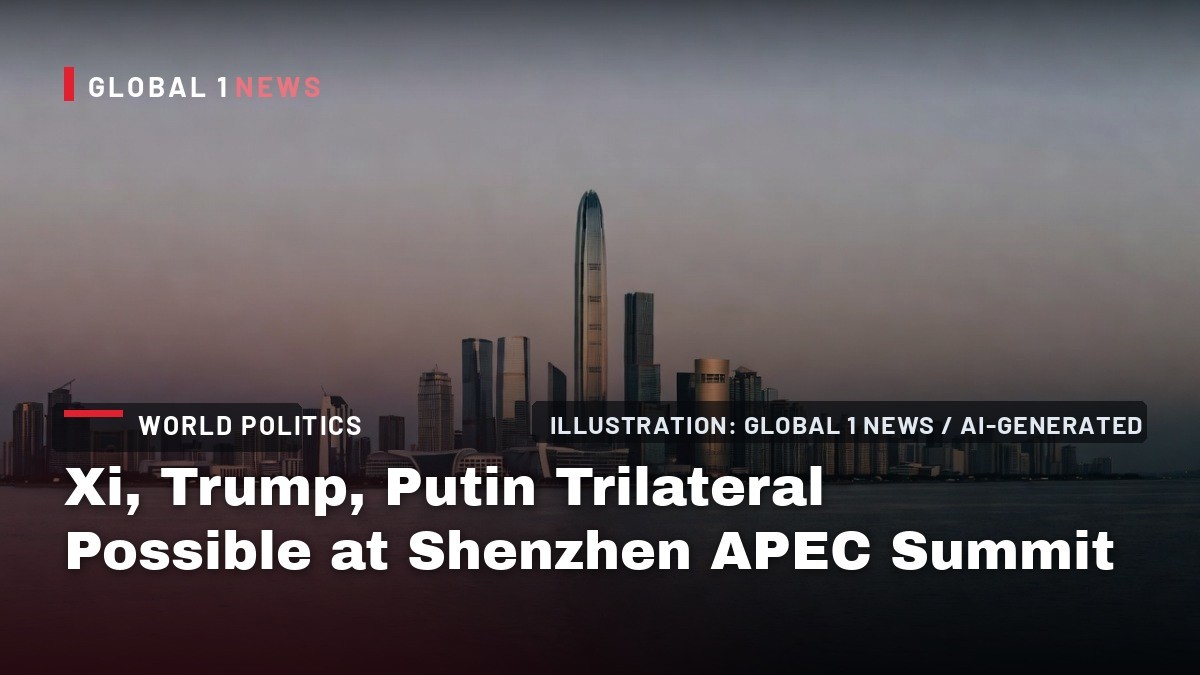
Kremlin Raises Prospect of Three-Way Summit in Shenzhen
A senior Russian aide suggested on Tuesday that Chinese President Xi Jinping, US President Donald Trump and Russian President Vladimir Putin could hold a trilateral meeting at the next Asia-Pacific Economic Cooperation (Apec) summit, a prospect that would reshape the diplomatic calendar for the region's leaders heading into 2027.
Leaders of the 21-member grouping are scheduled to meet in Shenzhen, the Chinese technology powerhouse in southern China, on November 18 and 19, setting up the possibility of Xi and Trump meeting four times this year. Asked on Russian state television about the possibility of such a meeting, Kremlin aide Yuri Ushakov said: "This issue was discussed, yes."
Ushakov spoke from Bishkek, the capital of Kyrgyzstan, at the two-day summit of the China-led Shanghai Cooperation Organisation (SCO) attended by Xi and Putin that ended on Tuesday. Putin confirmed in May his intention to attend the Apec meeting, but Trump has not yet done so.
What the Kremlin Is Saying
Ushakov said Putin plans to attend the Apec summit and to hold talks with both Xi and Trump, either bilaterally or in a joint format. "And if it turns out, as has been said, then the three of them will be able to have a meeting," he said.
Trump's presence may depend in part on whether Xi agrees to attend the December 14-15 Group of 20 meeting at the US president's Doral golf course resort in Florida. The Chinese embassy in Washington did not immediately respond to a request for comment, while White House spokeswoman Anna Kelly said: "We have no announcements regarding President Trump's attendance at Apec at this time."
The Kremlin's openness contrasts with the friction visible elsewhere in the bilateral relationship. Analysts read the timing as deliberate: Moscow wants the optics of a three-way summit normalized while the West remains divided over how to treat Russia after its invasion of Ukraine.
The Bessent Clash and the Economic Fault Line
Even as Trump has been complimentary of Xi, tensions continue to fester in the bilateral relationship. On Tuesday, US Treasury Secretary Scott Bessent called out China for refusing to agree to a joint communique at the G20 Finance Ministers meeting this week in North Carolina.
"It is clear that the country with the world's largest and unsustainable current account surplus, the People's Republic of China, was the dissenter," Bessent said. "I think that the fact that 19 countries did want to address this shows the sheer enormity of the problem."
The clash underscores how the economic agenda could shadow any diplomatic breakthrough in Shenzhen. US officials have pressed China on its surplus, currency policy and reliance on exports for growth, issues that have repeatedly derailed joint statements at multilateral gatherings this year.
A 'Problematic Message' for US Allies
US analysts said any such three-way meeting could undercut long-standing US alliances, and none would watch more closely than Tokyo, Seoul and Taipei. "It wouldn't surprise me because clearly Trump is seeing this Shenzhen trip as a chance to see all of his most authoritarian friends," said Zack Cooper, senior fellow with the conservative American Enterprise Institute.
"It would send just an incredibly problematic message to American allies and partners, right? Trump continues to berate many of our closest allies from Canada to Europe to [South] Korea," Cooper said. While this could help Beijing and Moscow in their long-term bid to weaken Western ties, it could also undercut Western unity, he added.
"It will just further accelerate the drive from a lot of US allies to decrease their reliance on the United States," said Cooper, a former National Security Council and Department of Defence official. "And it may embolden Russia and China to test those alliances even more. So I think it's a very problematic possibility."
For Japan, which chairs its own regional security architecture and has hardened its stance toward Moscow over the Ukraine war and the unresolved Northern Territories dispute, a US president seated beside both Xi and Putin would be a signal with consequences for the alliance debate in Tokyo.
The Kim Factor and the South Korea Equation
A major factor as Trump weighs whether to attend the Apec conclave could be whether North Korean leader Kim Jong-un agrees to meet him. Late last month, Trump told reporters he expected to meet with Kim this year, adding that North Korea has 57 nuclear weapons.
Trump declined to say whether his goal in any such meeting was North Korea's denuclearisation, even as he used the opportunity to undercut former US presidents Joe Biden and Barack Obama. "I don't want to talk about that, but I do have a good relationship with Kim Jong-un as you know, you've seen," Trump said. "He didn't like Biden. He didn't like Obama. He didn't like anybody. But he likes me."
Jeremy Chan, senior analyst with the Eurasia Group consultancy, said Trump's recent displeasure with South Korea - seen in his decision to cut short the US-South Korean Ulchi Freedom Shield military exercises in mid-August - may be in part driving his outreach to Pyongyang. Trump has reportedly been unhappy with Seoul's slow movement on fulfilling a pledge to invest US$350 billion in the US and on reducing its trade surplus. "There's any number of things that could have just got stuck in his craw," said Chan. "Trump in some ways is more mercurial than Kim is."
Xi as Broker Between Washington and Moscow
Analysts added that Xi could play a brokering role leading up to any meeting before the end of the year between himself, Trump and Putin, either at Apec or at the G20. "Xi will also offer to broker a tripartite meeting," the Scowcroft Group consultancy said in a report. "Trump has previously said he would include Putin. Xi will suggest that he will try to deliver the Russian leader."
Kevin Nealer, a partner at Scowcroft and one of the report's authors, added that the decision to invite Russian Finance Minister Anton Siluanov to this week's G20 also sent a jarring signal. "Four years into the Russian invasion of Ukraine, allowing a sanctioned Russian Finance Minister to attend a US-hosted G20 meeting is antithetical to US interests," he said. "Ratifying Russian aggression and getting nothing in return is simply bizarre."
For Beijing, the calculus is straightforward: a trilateral format elevates China's position as the indispensable intermediary between Washington and Moscow, reinforces its claim to be a stabilizing power in the Asia-Pacific, and gives Xi a stage in Shenzhen - the city that embodies China's tech ambitions - to showcase economic openness while Washington presses it on trade imbalances.
What to Watch For
The next milestones come quickly. Trump's decision on Apec attendance is expected in the coming weeks, and his administration will face renewed pressure from allies to explain how a trilateral with Xi and Putin squares with its stated strategy of deterring both Beijing and Moscow. Watch also for whether Xi confirms attendance at the Doral G20, which the Kremlin and the White House both view as a potential precursor to the Shenzhen meeting.
For Tokyo, the deeper question is whether the United States under Trump treats the trilateral as a transactional photo opportunity or a shift in grand strategy. Japan has responded to regional uncertainty with record defence budgets and a deepening of its own alliance networks, from the Quad to trilateral talks with South Korea. A Shenzhen summit that brings the world's three most powerful leaders together, with Kim's meeting with Trump potentially nearby, would compress those calculations into a single autumn week - and force Japan's policy establishment to rethink what it can expect from Washington when the room also contains Beijing and Moscow.
By Kenji Tanaka, Staff Writer
This article was produced with AI-assisted research and editorial support. Sources: South China Morning Post, Bloomberg, Associated Press, Anadolu Agency, Reuters.
What's Your Reaction?
 Like
0
Like
0
 Dislike
0
Dislike
0
 Love
0
Love
0
 Funny
0
Funny
0
 Wow
0
Wow
0
 Sad
0
Sad
0
 Angry
0
Angry
0

Japan Correspondent at Global1.News. Tokyo-based voice covering Japanese politics, technology, economy, and culture. Tracks the intersection of tradition and innovation in one of the world's most dynamic societies.










Comments (0)