
Natthaphong says 1.6bn-baht TH-AI Passport poor value, raises concerns over restrictions
BANGKOK — The leader of Thailand’s People’s Party has publicly challenged the government’s 1.6-billion-baht TH-AI Passport initiative, arguing that the substantial budget could be redirected toward more practical applications of artificial intelligence within state agencies.
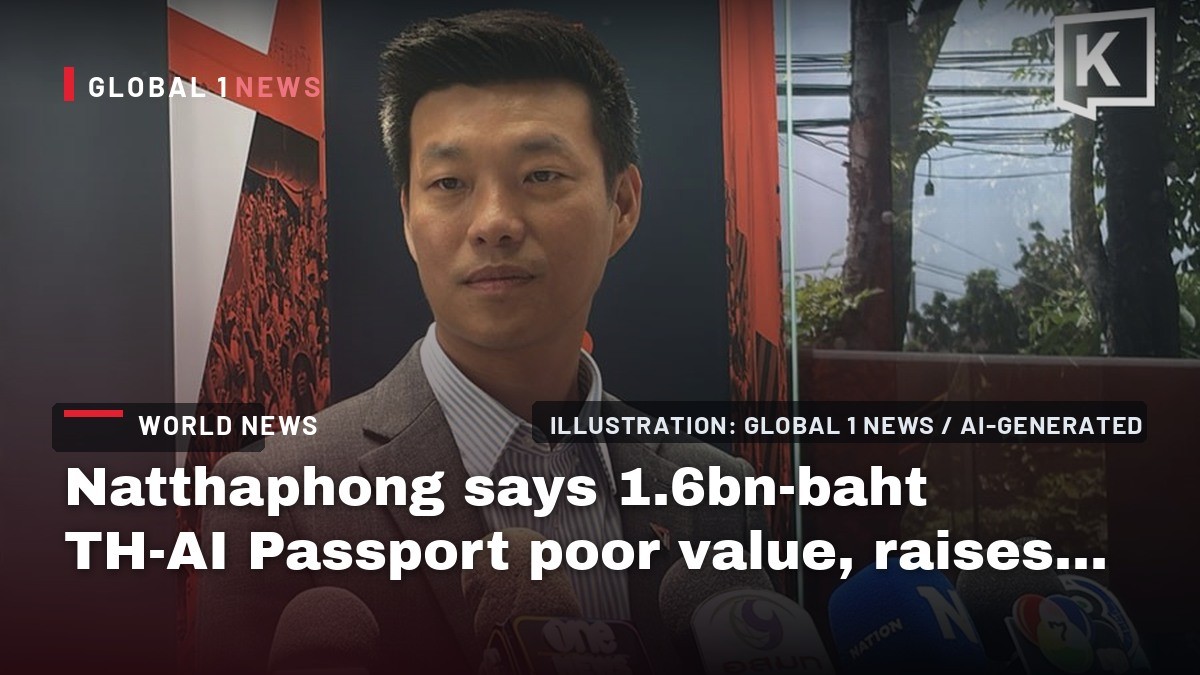
BANGKOK — The leader of Thailand’s People’s Party has publicly challenged the government’s 1.6-billion-baht TH-AI Passport initiative, arguing that the substantial budget could be redirected toward more practical applications of artificial intelligence within state agencies. Speaking at the Future Forward Building on Tuesday, Natthaphong Ruengpanyawut questioned both the project’s value for money and its transparency, while also raising concerns about potential restrictions on user prompts involving sensitive topics.
Natthaphong, who leads the main opposition party, was careful to state that he does not oppose efforts to boost public understanding of AI. However, he argued that the current expenditure does not deliver adequate returns for Thai taxpayers. The TH-AI Passport project, which aims to provide citizens with access to AI tools and educational resources, has become a flashpoint in the ongoing debate over how Thailand should position itself in the rapidly evolving regional AI landscape.
A Question of Priorities in Thailand’s AI Strategy
The core of Natthaphong’s criticism centers on what he perceives as a misallocation of resources. He argued that if the People’s Party were in government, the 1.6 billion baht could be invested more effectively to expand the practical use of AI in Thailand’s public sector. This is not merely a political talking point; it reflects a broader strategic question facing the Royal Thai Government as it seeks to modernize state services and compete with regional neighbors.
Natthaphong pointed to Singapore as a model worth studying. He noted that the city-state’s government has not focused simply on competing to develop proprietary AI models or encouraging the public to use AI for its own sake. Instead, Singapore has prioritized applying the technology to reform government processes, reduce operational costs, and improve efficiency. For Thai businesses, he suggested, this would mean simpler and faster interactions with government agencies, cutting through layers of bureaucracy that have long been a complaint among entrepreneurs in Bangkok and the provinces.
“If we had the opportunity and authority to decide how to spend the 1.6 billion baht, I think it could be used much more effectively,” Natthaphong said. His remarks signal a clear policy direction: rather than funding a public-facing awareness campaign, the opposition would prefer to see AI embedded in the machinery of state, from tax filing to business registration to public health administration.

The TH-AI Passport Project Under Scrutiny
The TH-AI Passport project, launched by the Thai government earlier this year, is designed to provide citizens with access to AI-powered tools and training. Its stated purpose is to encourage wider AI adoption and improve AI literacy among the general public. The initiative is part of a broader national strategy to ensure Thailand does not fall behind in the global AI race, particularly as neighboring countries such as Vietnam and Malaysia accelerate their own digital transformation efforts.
However, the project has drawn criticism from multiple quarters. Earlier on Tuesday, fellow People’s Party MP Rukchanok Srinok made headlines by describing the project as “worse than something free,” a sharp rebuke that quickly circulated on social media platforms popular in Thailand. Natthaphong, when asked about his colleague’s remark, acknowledged that he had tried the service himself, though not as extensively as some others. He suggested that the debate should not be reduced to whether the AI offered through the scheme performs better or worse than other services, because TH-AI Passport already relies on AI models supplied by commercial technology companies.
This is a crucial point. The government-backed service does not use a proprietary Thai-developed AI model; it leverages existing commercial models. This raises the question of what added value the 1.6 billion baht expenditure brings, beyond what citizens could already access for free or at low cost through commercially available services. For a country like Thailand, where the digital divide between Bangkok and the Isaan region remains significant, the government’s argument is that the project helps bridge this gap by providing structured access and education. Critics, however, see it as an expensive duplication of existing tools.
Concerns Over Censorship and Freedom of Expression
Beyond the budget question, Natthaphong raised a more sensitive issue that touches on fundamental democratic principles. He cited reports from users indicating that some prompts and generated responses appeared to be restricted when dealing with sensitive subjects. This is a significant concern in Thailand, where freedom of expression has been a contentious issue, particularly in the context of the country’s strict lese-majeste laws and ongoing political divisions.
Natthaphong noted that some questions that the government-backed service would not answer could still be answered by commercially available services using the same underlying AI models. This discrepancy suggests that TH-AI Passport may have been configured with additional restrictions, potentially limiting users’ freedom to ask questions or express opinions on certain topics. He said this raised questions over whether the project had been designed in a way that could curtail open inquiry.
For Thai citizens, this is not an abstract concern. In recent years, the Thai Ministry of Digital Economy and Society has been active in regulating online content, and civil society groups have repeatedly warned about the chilling effect of state oversight on digital platforms. If a government-funded AI service is seen as a tool for soft censorship, it could undermine public trust not only in the project itself but in the government’s broader digital agenda. The People’s Party, which has positioned itself as a defender of democratic freedoms, is likely to continue pressing this issue in Parliament.

Regional Context: The ASEAN AI Race
Thailand’s debate over AI spending does not happen in a vacuum. Across Southeast Asia, governments are racing to establish themselves as hubs for artificial intelligence development and adoption. Singapore has long been the regional leader, with substantial investments in AI research and a clear strategy for integrating AI into public services. Malaysia has announced ambitious plans to build AI infrastructure, while Vietnam has focused on developing its own AI talent pool and attracting foreign investment.
Thailand, for its part, has made AI a pillar of its Thailand 4.0 economic strategy, with the government promoting digital transformation across industries. The TH-AI Passport project is one component of this broader push. However, the opposition’s criticism highlights a tension within Thai policy: is the goal to build a domestic AI ecosystem, or to ensure that Thai citizens and businesses can effectively use the AI tools already available on the global market?
Natthaphong’s argument suggests that the latter should take priority. By focusing on reforming government services, Thailand could achieve immediate, tangible benefits for its citizens and businesses. This would also help build public confidence in AI, which is essential for long-term adoption. A government that uses AI to reduce waiting times at provincial offices or to streamline business licensing processes would do more to promote AI literacy than a public awareness campaign, no matter how well-funded.
Implications for Thai Governance and Daily Life
For ordinary Thais, the outcome of this debate will have practical consequences. If the government heeds the opposition’s advice and redirects funds toward AI-driven government reform, citizens could see faster, more efficient public services. Businesses, particularly small and medium-sized enterprises that form the backbone of the Thai economy, would benefit from reduced red tape and lower compliance costs. This would be especially meaningful in the provinces, where access to government services is often more time-consuming and costly than in Bangkok.
On the other hand, if the TH-AI Passport project proceeds without significant changes, the government will need to address the transparency concerns raised by Natthaphong and others. The Thai public has become increasingly sophisticated in its use of digital tools, and citizens are likely to notice if a government-sponsored AI service is more restrictive than free alternatives. This could lead to a backlash that damages the credibility of the government’s entire digital agenda.
The debate also has implications for Thailand’s democratic health. In a country where political expression is often carefully calibrated, the prospect of a state-controlled AI service that limits certain questions is troubling. The People’s Party has signaled that it will hold the government accountable on this issue, and it is likely that further parliamentary inquiries will follow. For now, the TH-AI Passport project remains a symbol of both Thailand’s ambitions and its challenges in navigating the AI era.
By Ann Srisawat, Staff Writer
This article was produced with AI-assisted research and editorial support. Sources: Khaosod English.
What's Your Reaction?
 Like
0
Like
0
 Dislike
0
Dislike
0
 Love
0
Love
0
 Funny
0
Funny
0
 Wow
0
Wow
0
 Sad
0
Sad
0
 Angry
0
Angry
0

Southeast Asia Correspondent at Global1.News. Based in Bangkok, covering Thai and Southeast Asian politics, economy, technology, and culture. Deep regional perspective on one of the world's most dynamic regions.















Comments (0)