
Xi's Cairo Landing: A 70-Year Bond, a Eurasian Pivot, and the New Middle East Chessboard
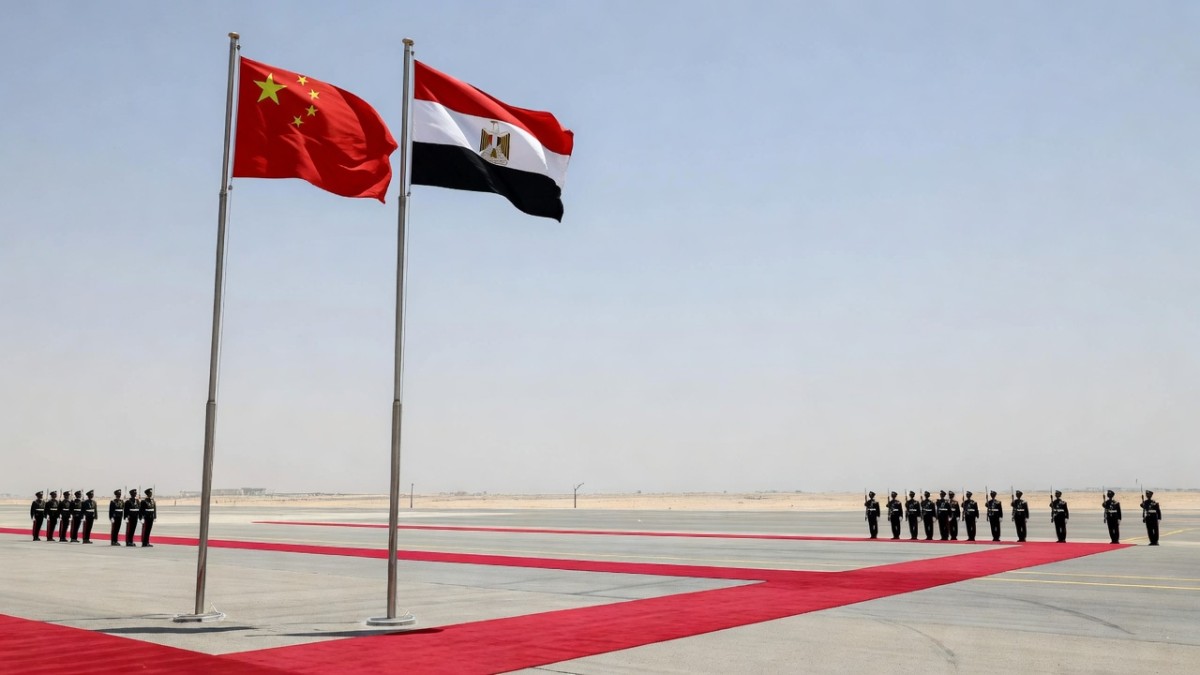
In a recent CGTN report, the visual of Chinese President Xi Jinping stepping onto the tarmac in Cairo, greeted personally by Egyptian President Abdel Fattah El-Sisi amid a grand airport ceremony, was more than a diplomatic courtesy. It was a tableau of shifting global tectonics. The arrival on Tuesday, September 1, 2026, marks Xi's first state visit to Egypt in a decade, a gap that underscores the strategic weight of this moment.
Xi's Cairo Landing: A 70-Year Bond, a Eurasian Pivot, and the New Middle East Chessboard
In a recent CGTN report, the visual of Chinese President Xi Jinping stepping onto the tarmac in Cairo, greeted personally by Egyptian President Abdel Fattah El-Sisi amid a grand airport ceremony, was more than a diplomatic courtesy. It was a tableau of shifting global tectonics. The arrival on Tuesday, September 1, 2026, marks Xi's first state visit to Egypt in a decade, a gap that underscores the strategic weight of this moment. This is not a routine bilateral stop; it is a calculated intersection of China's Eurasian connectivity ambitions, Egypt's post-American hedging strategy, and the volatile geopolitics of the Red Sea and Gaza.
The itinerary itself is the story. Xi arrived in Cairo directly from Bishkek, Kyrgyzstan, where he attended the Shanghai Cooperation Organization (SCO) summit. This single flight path—linking Central Asia's security architecture to the Mediterranean's gateway—is the physical manifestation of Beijing's "connected Eurasia" doctrine. For Cairo, the timing is equally potent. With 2026 marking the 70th anniversary of China-Egypt diplomatic relations—Egypt being the first Arab state to recognize the People's Republic in 1956—the visit is a celebration of a foundational partnership that has evolved from political solidarity to deep economic integration. As CGTN reported, Egyptians from many walks of life are anticipating the visit, a sentiment that reflects the tangible footprint of Chinese investment in the Suez Canal Economic Zone and Belt and Road Initiative (BRI) projects.
 political development. It would signal that China is ready to move from being a passive observer to an active participant in Middle Eastern peace processes, using Egypt as its primary conduit.
The Symbolism of a Decade: From 2016 to a Multipolar 2026
The ten-year interval between Xi's visits is not an oversight; it is a measure of how profoundly the regional and global order has changed. In 2016, Xi's visit was part of a broader charm offensive across the Middle East, a signal of China's growing economic interest. The world of 2026 is starkly different. The post-Cold War unipolar moment has decisively faded, replaced by a competitive multipolarity where middle powers like Egypt are actively diversifying their strategic dependencies. The 70th anniversary framing is critical. It allows Beijing to position itself not as a newcomer or an interloper in the Middle East, but as a long-standing, reliable partner—one that predates the current turbulence. For Cairo, this anniversary is a diplomatic asset. It provides a narrative of historical depth that justifies a deepening relationship with Beijing without necessarily severing ties with Washington. The grandeur of the welcome ceremony, with El-Sisi personally receiving Xi, signals that Egypt views this relationship as a cornerstone of its foreign policy, not a transactional sidebar. It is a public declaration that Cairo's future is not exclusively tied to the West.
The Bishkek-to-Cairo Axis: Evidence of a Cohesive Eurasia Strategy
The SCO summit in Bishkek followed by a state visit to Egypt is the clearest evidence yet that Beijing views Central Asia and the Middle East as a single, interconnected strategic theater. This is not a random pairing of destinations; it is a deliberate sequencing that highlights the "Belt and Road" logic. The SCO provides the security and political framework for overland connectivity, while Egypt anchors the maritime and logistical southern flank. This itinerary serves a dual purpose. First, it reassures SCO members that the organization's expansion is not merely a Central Asian affair but part of a larger vision that includes the Middle East. Second, it signals to Cairo that China's commitment is not isolated but part of a vast network of infrastructure, trade, and security dialogues. For Egypt, this means access to a broader ecosystem—from the energy corridors of Central Asia to the manufacturing hubs of Western China. The strategic calculus is clear: by aligning with the SCO-to-Cairo axis, Egypt positions itself as the indispensable link between the Eurasian heartland and the African and Mediterranean markets, a role that maximizes its geopolitical leverage.Egypt's Tightrope: Balancing the Chinese Dragon and the American Eagle
Egypt's foreign policy has long been characterized by a pragmatic balancing act, and this visit is the apex of that strategy. Cairo maintains a significant security and military relationship with Washington, receiving billions in aid, yet it has simultaneously deepened its economic and political ties with Beijing. The visit forces a recalibration of this tightrope act. For the United States, Xi's red-carpet reception in Cairo is a strategic irritant. It underscores Washington's diminished influence in a region it once dominated. However, Egypt is not defecting; it is diversifying. The El-Sisi government is leveraging the China card to extract more concessions from the West, whether in terms of economic aid, debt relief, or political understanding regarding regional security. For Beijing, this is a low-cost, high-reward engagement. China does not demand the political reforms or human rights conditionality that often accompany Western partnerships. This transactional purity is highly attractive to Cairo. The visit solidifies Egypt's role as a sovereign actor capable of engaging the world's superpowers on its own terms, a position that enhances its prestige and its bargaining power in every other relationship it holds.The Red Sea and Gaza Factor: China's Mediation Ambitions
The backdrop of this visit is a region in turmoil. The Red Sea has seen elevated tensions, and the Gaza conflict continues to cast a long shadow over Middle Eastern diplomacy. Egypt, as a key mediator in the region, is at the center of these crises. Xi's visit, therefore, carries a security dimension that transcends economics. China has consistently advocated for a "Middle East version" of its security concept, one that emphasizes development as the root of stability. By landing in Cairo, Xi is implicitly endorsing Egypt's central role in regional mediation. This is a strategic alignment: China provides the economic oxygen for reconstruction and development, while Egypt provides the political and diplomatic muscle for conflict resolution. The visit allows Beijing to project an image of a responsible global power that contributes to peace, contrasting with the perceived belligerence of other external actors. For Egypt, having China's implicit backing strengthens its hand in any future negotiations, whether regarding Gaza's reconstruction or the security of the Red Sea shipping lanes. It is a partnership where political capital and economic capital are exchanged for mutual strategic benefit.What to Watch: From Suez Expansion to BRICS Alignment
Beyond the pageantry, the substantive outcomes of this visit will define its legacy. The first area to watch is the expansion of the Suez Canal Economic Zone. With China being a major investor, new agreements are likely to focus on green energy, digital infrastructure, and advanced manufacturing within the zone. This is not just about trade; it is about Egypt becoming a hub for Chinese supply chains that seek to bypass traditional chokepoints. The second area is Egypt's alignment within the BRICS framework. Having joined the grouping in 2024, Egypt is now a formal member of the alternative global architecture that China champions. This visit will likely solidify Egypt's role within BRICS, pushing for de-dollarization initiatives and alternative payment systems that reduce reliance on the US financial system. Finally, watch for the diplomatic language regarding Gaza. A joint statement calling for a ceasefire and a two-state solution, backed by Chinese investment in reconstruction, would be a significant geo
political development. It would signal that China is ready to move from being a passive observer to an active participant in Middle Eastern peace processes, using Egypt as its primary conduit.
A Forward-Looking Assessment: The Cairo Consensus
Xi Jinping's arrival in Cairo is a watershed moment for the Global South's evolving architecture. It signifies the maturation of a relationship that has moved from symbolic solidarity to strategic interdependence. The 70-year bond is not just a historical footnote; it is the foundation for a future where Egypt serves as a linchpin in China's vision of a multipolar world order. The true test will be in the implementation. Can China's investments translate into tangible economic relief for Egypt's struggling population? Can Egypt maintain its balancing act without being forced to choose sides in a new Cold War? The answers will unfold in the coming months. However, one thing is certain: the image of Xi and El-Sisi shaking hands in Cairo is a powerful symbol of a world where the Middle East is no longer a passive arena for great power rivalry, but an active participant in shaping its own destiny. For Beijing, this visit is a strategic investment in a stable, prosperous, and aligned partner at the crossroads of three continents. For Cairo, it is a declaration of independence in a multipolar age. By Prof. Marcus Chen, Staff WriterThis article was produced with AI-assisted research and editorial support. Reporting is based on sources cited in the article.
What's Your Reaction?
 Like
0
Like
0
 Dislike
0
Dislike
0
 Love
0
Love
0
 Funny
0
Funny
0
 Wow
0
Wow
0
 Sad
0
Sad
0
 Angry
0
Angry
0

Marcus Chen
World Politics Analyst at Global1.News. Based in Beijing, covering US-China relations, global trade, and geopolitical strategy. Brings deep analytical perspective to the power dynamics shaping international affairs.












Comments (0)