
Why Europe finds it easier to punish Israeli settlers than to pressure Israel
Europe’s professed commitment to human rights and international law sits uneasily beside its privileged partnership with Israel. The EU‑Israel Association Agreement, signed decades ago, explicitly makes respect for human rights an “essential element” of the relationship.
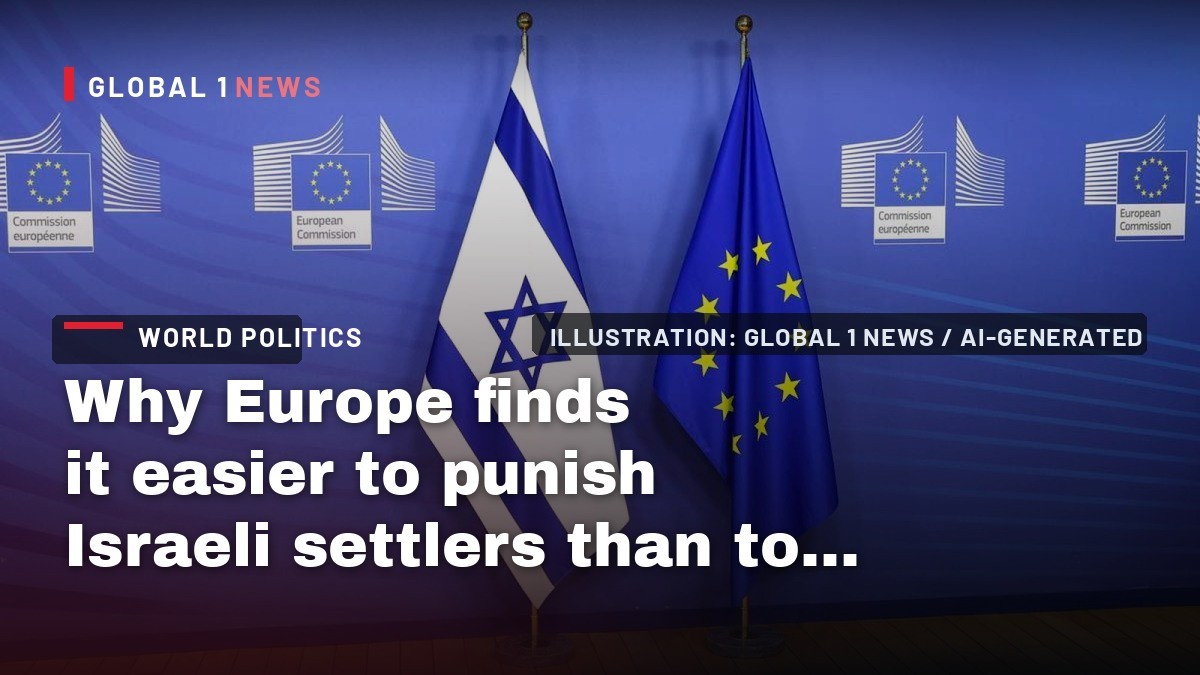
Europe’s professed commitment to human rights and international law sits uneasily beside its privileged partnership with Israel. The EU‑Israel Association Agreement, signed decades ago, explicitly makes respect for human rights an “essential element” of the relationship. Yet the recent war in Gaza has exposed a stark gap between that wording and the actions of European capitals. While the Union has moved to sanction individual Israelis linked to extremist settler violence, it has stopped short of applying the same pressure to the Israeli state itself, even though the same legal framework obliges it to do so.
Legal foundations and the promise of accountability
Article 2 of the EU‑Israel Association Agreement obliges both parties to respect human rights and democratic principles. This clause is not a symbolic footnote; it is presented as a core condition of the partnership. In 2025 the EU conducted a formal review of Israel’s compliance with these obligations and concluded that there were “indications that Israel was breaching those obligations.” The review linked Israel’s conduct on the ground directly to the legal basis of the EU‑Israel relationship, turning abstract concern into a concrete legal finding.
When a treaty includes such a clause, the logical question is whether violation triggers a cost. The source material argues that the existence of the clause proves the EU has the legal tools to impose consequences, but the political will to use them remains uncertain. The review’s outcome shows that the EU can, in principle, hold Israel accountable, yet the subsequent actions reveal a selective application of that accountability.
Targeted sanctions versus structural pressure
European governments have found it politically easier to sanction “extremist settlers” and “organizations linked to settlement violence.” These measures can be framed as narrow, focused actions against the “extremes” of Israeli policy, allowing member states to maintain a veneer of unchanged strategic relations with Israel. The source notes that such sanctions “require unanimity, and one member state can block collective action,” yet the fact that targeted measures have been adopted demonstrates that unanimity is not an absolute barrier.
By contrast, restricting the benefits Israel receives under the Association Agreement would confront the state’s broader policies, including settlement expansion and the overall legal status of the occupied territories. The source material emphasizes that this shift “moves the debate from the actions of a few extremists to the conduct of the Israeli state itself,” a step that carries higher political costs for European capitals.
Political will and the cost of confronting the state
The reluctance to apply economic conditionality stems from the political risks involved. Sanctioning a single settler can be presented as a moral stance without jeopardising the broader EU‑Israel partnership. Pressuring Israel as a state, however, would invite accusations of hostility, strain relations with Washington, and force European governments to confront contradictions between their declared values and their strategic interests.
Different member states illustrate this divide. Spain and Ireland have advocated for stronger action and greater reliance on international law, while Germany approaches Israel through a historically nuanced lens, and Hungary has repeatedly used unanimity rules to block or dilute common foreign‑policy decisions. The source material argues that these national positions alone do not explain the overall hesitancy; the underlying issue is a broader lack of political readiness to accept the “price” of confronting Israel’s core policies.
Economic leverage that remains untapped
The EU‑Israel relationship encompasses extensive trade, research, technology cooperation, and political dialogue. Access to the EU market, substantial research funding, and deep scientific collaboration are assets Israel values highly. The source material points out that “the EU may not have America’s military dominance, but it has something Israel values deeply.” If the EU were to link these benefits directly to human‑rights compliance, the economic cost to Israel would be far greater than the symbolic impact of targeting individual settlers.
Economic conditionality could therefore serve as a powerful lever. By conditioning trade, research grants, and technology transfers on compliance with international law, Europe could compel Israel to reconsider policies that fuel settlement expansion and civilian casualties. The article stresses that the tools exist; the decision hinges on whether European leaders are prepared to bear the political discomfort that such leverage would generate.
Comparisons with other geopolitical challenges
The source material draws a parallel with Europe’s response to Russia’s invasion of Ukraine. When Russia violated international law, the EU moved beyond statements, employing sanctions that directly targeted key sectors of the Russian economy. This decisive economic pressure contrasted sharply with the more limited, symbolic measures applied to Israel. The comparison underscores a perceived double standard: Europe is willing to impose “structural pressure” on a major power when the political cost aligns with broader strategic interests, yet hesitates when confronting a state with which it maintains a long‑standing, mutually beneficial partnership.
By highlighting this contrast, the article suggests that Europe’s approach to Israel is not merely a matter of institutional incapacity but a conscious choice shaped by political calculations. The willingness to sanction settlers but not the state itself reveals a selective application of the same legal and economic tools used elsewhere.
Human‑rights language versus lived realities
The human cost of the settlement enterprise and the Gaza conflict remains at the heart of the EU’s stated principles. The Venice Declaration of 1980, cited in the source, recognized the Palestinian right to self‑determination and declared settlements illegal under international law. Yet, more than forty years later, Europe continues to “oppose settlements, reject annexation, support a two‑state solution, and respect international law” without translating these positions into substantive pressure on Israel.
This disconnect is felt most acutely by Palestinians living under occupation, where settlement expansion brings land loss, home demolitions, and daily violence. While targeted sanctions may offer a symbolic acknowledgment of these harms, they do not alter the systemic drivers of the conflict. The article argues that without structural pressure, the “system that allows settlement expansion and violence to continue” remains untouched, leaving the human suffering unmitigated.
The way forward: aligning principle with power
To bridge the credibility gap exposed by the Gaza war, European governments would need to move from isolated punitive actions to a comprehensive strategy that ties the EU‑Israel Association Agreement’s human‑rights clause to concrete economic consequences. This could involve a calibrated review mechanism that triggers sector‑specific sanctions when breaches are identified, ensuring that the response is proportionate yet impactful.
Such a shift would require a collective political decision to prioritize international law over short‑term diplomatic convenience. As the source material concludes, the essential question is not “whether Europe has power” but “whether Europe is willing to use power when the price becomes politically uncomfortable.” If the Union chooses to align its stated values with its economic leverage, the cost to Israel could become a genuine deterrent, and the promise of human‑rights respect embedded in the Association Agreement would move from rhetoric to reality for the people whose lives are most affected.
This article was produced with AI-assisted research and editorial support. Reporting is based on the source material cited below. Sources: Middle East Monitor; middleeastmonitor.com; Global1.News (16 September 2026).
By Fatima Al-Rashid, Staff Writer
What's Your Reaction?
 Like
0
Like
0
 Dislike
0
Dislike
0
 Love
0
Love
0
 Funny
0
Funny
0
 Wow
0
Wow
0
 Sad
0
Sad
0
 Angry
0
Angry
0

Gulf/MENA Correspondent at Global1.News. Based in Doha, covering Gulf politics, energy markets, diplomacy, and development across the Middle East and North Africa. Tracks the economic transformation of the Gulf states.










Comments (0)