
While America Fights Over 194 Gigawatts, China Just Moved the Compute to the Power
While American communities fight data centers over power and prices, China is shipping compute to rural western provinces under its Eastern Data Western Computing strategy. A founder on the logistics win, the wage mirage, and the latency wall neither can bend.
While America Fights Over 194 Gigawatts, China Just Moved the Compute to the Power
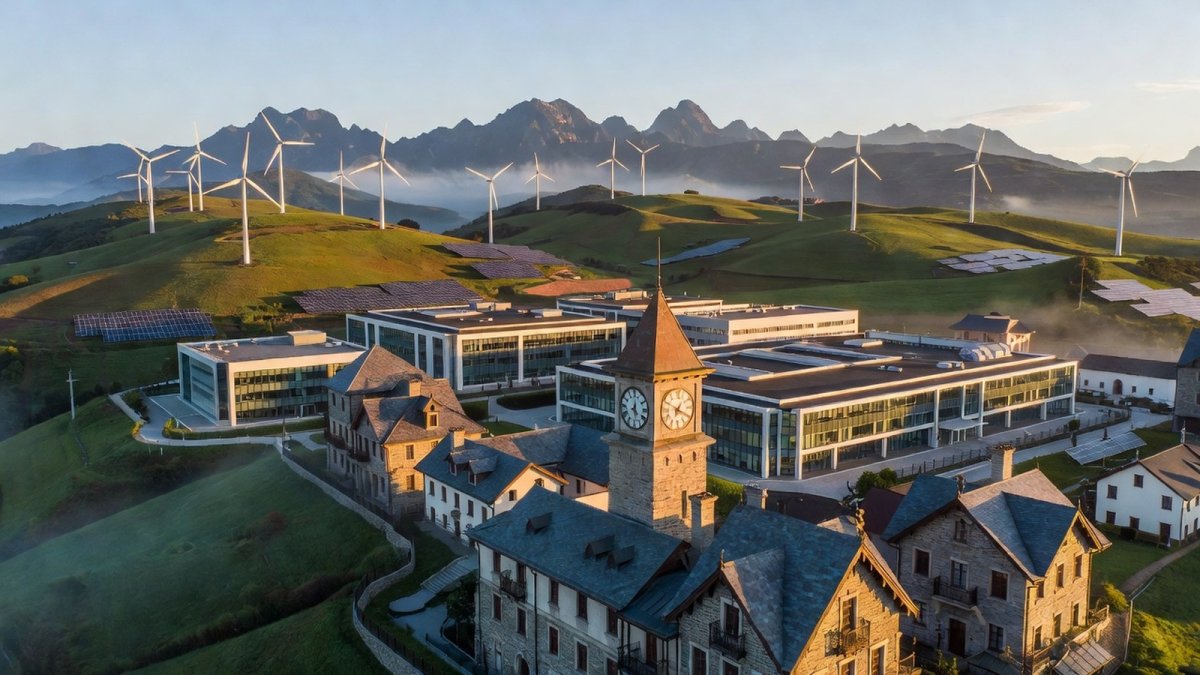
Let me tell you something that's been sitting with me since I read the AFP wire this morning. I've been running hosting infrastructure for over a decade, and I've spent the last year watching American communities fight data center projects to a standstill — 142 protests in 42 states, more than 500 local bans, PJM rates up 76 percent, governors who courted the buildout now running from it. And then I read about a cluster of European-style buildings in hilly Guizhou — a clock tower, a multi-arched bridge — humming in the middle of what used to be a barren mountain. That's Huawei's largest data center. And it's not alone — dozens more are rising.
Because while America fights over 194 gigawatts of load by 2035, Beijing did something different. They didn't drag the power to the compute. They dragged the compute to the power. Which side of the equation moves — that's the whole story of the AI buildout in two systems.
The News — A European-Style Village That Hums
AFP was in Guian New Area, Guizhou province, about 500 miles northwest of Shenzhen, and the detail that got me is the hum. A town-like complex with European architecture, a clock tower, a bridge — it looks like a postcard, not a data center. But it emits a low, permanent hum. That's the sound of Huawei's largest data center on Earth — and of a strategy working exactly as planned.
Dozens of these facilities have gone up across Guizhou in recent years — and more are coming. China is on course to nearly double its data center capacity within five years, because the tech race with the US is a compute race and Beijing treats computing power as national power. That's not my framing — Chinese policy documents have said it since before ChatGPT: "Computing power is correlated with national power." And they're executing on it.
The Strategy — "Eastern Data, Western Computing"
In 2021, Beijing gave this program a name: "Eastern Data, Western Computing." The logic is simple and brutal. The eastern seaboard — where the population and the money live — is built up, land is scarce, the grid is strained. The west — Guizhou, Inner Mongolia — has cooler climates, empty space, and a renewable buildout that's actually overproducing.
China has demanded data centers draw 80 percent of their power from renewables by the end of this decade — a hard requirement that makes Guizhou and Inner Mongolia, which have massively expanded solar and wind capacity, the natural home for the industry. Rystad Energy's Simeng Deng put it the right way: the data centers "can be an engine to digest or absorb the surplus of renewable power generation." Think about that. In the US we can't generate power fast enough. In western China they generate too much and have to curtail it. The data centers eat the surplus.
And the locals? They're not protesting. A shopkeeper named Shu Peihua told AFP: "It used to be a barren mountain, but since the area has developed, transportation has become more convenient, trade has picked up, business opportunities have emerged." Another local, Li Xixiu, said the main road was built because of the centers and that "all the villagers in our neighbourhood now find jobs nearby, unlike before, when they had to go to other places." Street vendors serve the workers on lunch breaks. Two universities have been built. It reads like a miracle.
But here's the part that should give every American town with a data center pitch pause.
The Two Readings — Genius Logistics, or Consent by Deletion
Reading one: this is a masterclass in logistics. America's approach has been to bring power to the compute — gas plants next to data centers, transmission lines fought over in court, eminent domain battles, ocean-cooled floating centers, tent data centers with off-grid turbines. Every one of those lands in someone's backyard and becomes a fight. China's approach inverts the whole thing: don't bring the power to the compute, bring the compute to the power. The energy is already there, the land is cheap, the climate does the cooling, and the surplus renewables stop getting wasted. Capacity doubles in five years. No NIMBY, no lawsuits, no rate shock. The cleanest answer to the power constraint I've seen from any government.
Reading two: the consent problem didn't disappear — it was deleted. China's electricity prices don't go up for residents when a data center arrives because the state subsidizes residential and agricultural power. And the steep electricity discounts for AI companies are tied to a condition: use Chinese chips. The cheap power is a policy instrument, not a market signal. And when dissent is tightly controlled, especially around central policy, the absence of protest tells you nothing about whether the people had a choice. The "enthusiasm" AFP captured is real — I believe the shopkeepers. But it's the enthusiasm of a system where the alternative channel doesn't exist.
Then there's the economic fine print. Guizhou has averaged 7.4 percent annual GDP growth over the past decade — and its wage growth ranked second-to-last in the country. Taiwan's DSET research institute put it bluntly: "data centres drive heavy investment in land and equipment, their impact on boosting local per capita income remains limited." The province also carries one of China's highest debt burdens — 30th of 31 provinces on debt-to-revenue ratio in 2024. Andrew Stokols of Singapore Management University said the "immediate benefits have been elusive" — in China and everywhere else.
The Secondary Bottleneck Nobody's Talking About — You Can't Bend Latency
Here's what the strategy papers don't advertise: compute followed the power, but the data still has to follow the compute. Guizhou is 500 miles from Shenzhen — a 500-mile data highway, one way, for every training run and every inference request. And physics doesn't care about five-year plans.
Training workloads? They'll tolerate the distance. You shove a dataset into a cluster in a Guizhou cave — and yes, they've built them inside mountains: Tencent's Qixing facility in Gui'an is China's first cave-depot data center, tens of thousands of servers in excavated chambers, saving an estimated 58 percent on power bills versus the coast — and you wait. Latency doesn't matter when the job runs for hours.
But inference — the chat responses, the API calls, the autonomous systems — is latency-sensitive, and 500 miles is a lifetime in network terms. You cannot serve Shanghai from a mountain cave at single-digit milliseconds. So the "Eastern Data, Western Computing" model has an invisible ceiling: it's a training and batch strategy, not a full-stack one. The moment China's AI usage shifts from model-building to model-serving at scale, they'll discover what every colo operator in America already knows — distance is the one resource you can't manufacture.
And that's the secondary bottleneck: the data highway. It's the same constraint that makes America's "ship compute to the desert" fantasies — everything in West Texas or rural Wyoming — hit the same wall. You can move the compute to the power, but you can't move the users. Somewhere, someone has to bridge the distance — with fiber, backhaul, edge nodes, and real estate near population centers. It's the boring part of the AI buildout, and it's the part that decides which workloads live where.
What This Means for Independent Hosting Providers
First, understand what the China model really proves: workload placement is about which side of the equation moves. When power is the constraint, move the compute. When latency is the constraint, move the compute back. Your job as an independent provider is to know which workloads you're actually selling into — a training shop can chase cheap power and long-haul fiber; a real-time application shop cannot. Don't copy the strategy, copy the analysis.
Second, treat the jobs promise with the skepticism it deserves. Guizhou's decade is the control group: 7.4 percent GDP growth, wages second-to-last, debt piling up. Every American community being offered "good jobs" by a data center developer should be asking for the wage data, not the headline GDP number. Data centers are real estate and power infrastructure dressed up as economic development. The spillover only happens when you build an actual digital economy around them — universities, services, an industry that hires. That's a policy choice, not a byproduct.
Third, watch what the subsidies do to the hardware market. China is coupling cheap power to domestic chips — the $295 billion national AI data center grid plan requires at least 80 percent domestic silicon, Huawei Ascend first. That's not just a China story — it's a subsidized demand pool for Chinese accelerators that changes the global price and availability picture for everyone who buys compute. When a government this size underwrites a domestic chip ecosystem with power discounts, every hardware procurement decision you make for the next five years gets hit.
Fourth — and this is the one that keeps me up — price the consent gap. In America, community opposition is a real line item: delays, moratoriums, lawsuits, protests. In China, the opposition channel doesn't exist, so the buildout moves at state speed. Both systems deliver power to AI at enormous social cost — one pays in conflict and delay, the other in suppressed wages and closed dissent channels. Neither is free. When you see a headline about China's "smooth" buildout, remember that smoothness has a price tag too, and it's not on the balance sheet.
The Bottom Line
I've been writing for months about how the AI buildout keeps hitting walls — power, transformers, copper, water, community consent. The China story is the first time I've seen a government treat the whole stack as one logistics problem instead of a series of fights. That's genuinely impressive. It's also a reminder that every system solves the constraint in the image of its politics: America fights, and China computes. But the physics underneath is the same for both — power is finite, distance is real, and the data always has to get to the user.
So don't ask which model is better. Ask which one you can actually replicate in your market — with your consent costs, your latency requirements, your customers. The answer is your real competitive position. Mine's still being built, and it's a lot closer to the users than 500 miles from anywhere.
— Allan Ali, Founder
This article was produced with AI-assisted research and editorial support. Sources: AFP (Aug 19, 2026, "China goes rural with data centres in quest to power AI"), Tom's Hardware (Aug 19, 2026), Rystad Energy analyst commentary, DSET (Taiwan), Singapore Management University research, Xinhua/China Daily (Tencent Qixing cave data center), Bloomberg ($295B national AI data center grid plan).
What's Your Reaction?
 Like
0
Like
0
 Dislike
0
Dislike
0
 Love
0
Love
0
 Funny
0
Funny
0
 Wow
0
Wow
0
 Sad
0
Sad
0
 Angry
0
Angry
0

Publisher of Global1.News. Automation architect, systems builder, and the guy making sure the truth gets published.















Comments (0)