
A Crater the Width of the Asteroid: Hera Sends Back the First Close-Ups of Dimorphos
ESA's Hera spacecraft has returned the first close-up images of the asteroid Dimorphos, revealing a crater spanning one entire face four years after NASA's DART mission struck it, and showing that the moonlet is now tumbling chaotically in its orbit.
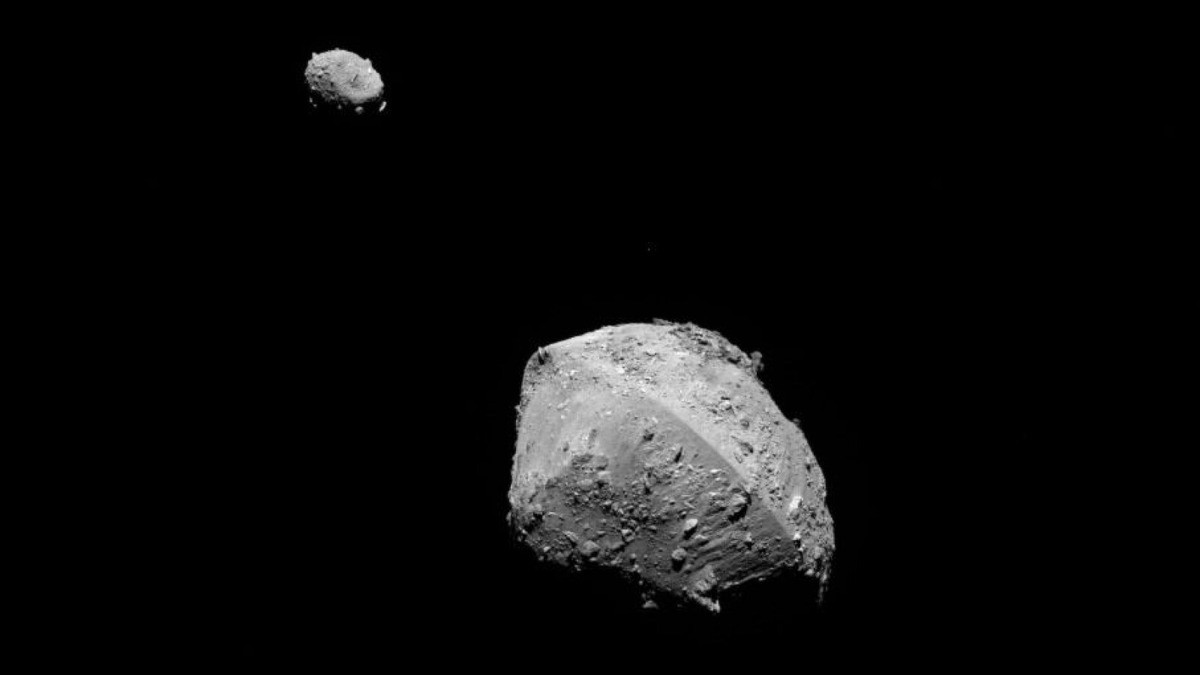
Four years after NASA rammed a spacecraft into an asteroid to test whether humanity could shove a rock off a collision course with Earth, Europe has finally reached the wreckage to see what the punch actually did. On Wednesday the European Space Agency released the first close-up images from its Hera mission, and the answer to the question scientists had spent four years arguing about turns out to be all of the possible answers, at once.
A Crater the Width of the Asteroid: Hera Sends Back the First Close-Ups of Dimorphos
BERLIN — The images were unveiled in the dinosaur hall of Berlin's natural history museum, a setting ESA described as a fitting reminder of why any of this matters. They show Dimorphos, the 151-meter moonlet that NASA's DART spacecraft struck on 26 September 2022, with one entire face caved in and the rest of it looking untouched.
What Hera Found at the Scene of the Crime
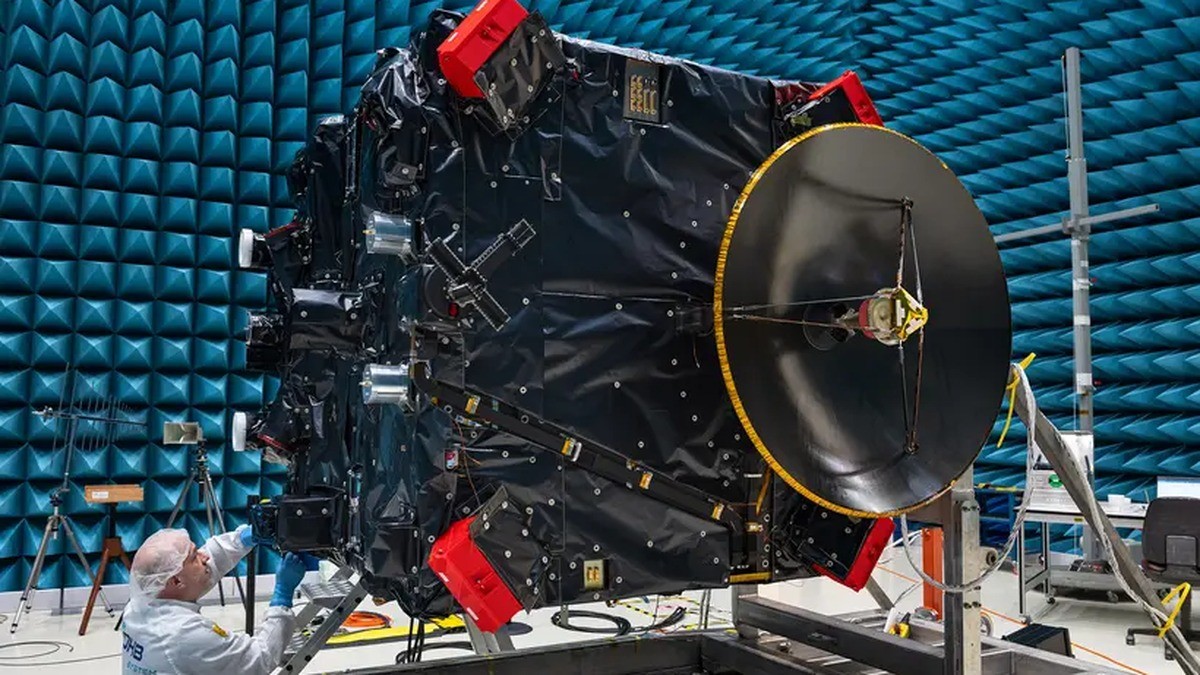
Hera is a small-car-sized probe that launched in October 2024 and spent two years catching up with a pair of asteroids now about 193.5 million kilometers from Earth. It reached the Didymos system in early November and flies roughly 25 to 30 kilometers from the two bodies, holding position with thruster burns at an average speed of about 12 centimeters per second.
The first published image was taken on 7 November from a range of 29 kilometers, Reuters reported. Hera is not in a conventional orbit; the gravity is so weak that it traces rectangular paths around the pair instead. It carries three instruments: a monochrome framing camera, a multi-spectral imager reading 25 colors at once, and a Japanese-built thermal infrared imager taking surface temperatures.
What the cameras returned is the first close-up look at the aftermath of the only time humans have deliberately moved a celestial body. The orbital change was already measured from Earth: Dimorphos now circles Didymos 33 minutes faster than before the impact, a bigger shift than the mission had predicted. What nobody could see from more than 120 million miles away was the damage.
A Hole the Size of a Stadium, Across the Entire Face
Dimorphos is 151 meters across. The impact scar left by DART, by the Hera team's own description, runs across the full width of the little world.
"Scientists debated whether Dimorphos had sustained an impact crater, changed its shape or stayed the same," said Patrick Michel, Hera's principal investigator and a director of research at the CNRS and the Observatoire de la Côte d'Azur. "Much to our surprise the answer turns out to be all three at once! The face struck by DART has been flattened into an impact crater the size of a sports stadium, which extends across the asteroid's entire width."
Sabina Raducan, a planetary scientist at the International Space Science Institute in Bern and the Free University of Brussels, put the scale more plainly at the Berlin briefing. "It's a big crater that is almost as large as the body itself, which is really spectacular," she said. Reuters described the visual effect as though a piece of the asteroid had been sliced off.
The Part That Did Not Change
The strangeness is in what the crater did not touch. The regions of Dimorphos that DART never hit still carry the same loose fields of boulders that the doomed spacecraft photographed on its way in four years ago, and the Hera team says they look essentially as they did in 2022.
That is why Michel's "all three at once" is the line of the day rather than a flourish. The team had been braced for one outcome: a crater, or a reshaped body, or no change at all. What Hera found was a crater wide enough to swallow one whole face, on a body whose remaining surface is still in its original state. That is a much more specific piece of physics than anyone could confirm from Earth.
For four years, the only evidence that DART had done anything beyond changing an orbit was the plume of debris the impact threw into space and the measurements telescopes on Earth could make of it from afar.
Tumbling Like a Barrel Down the Stairs
The second surprise is in how Dimorphos is moving. Before the impact it was locked to its parent body the way our Moon is locked to Earth, showing the same face to Didymos on every pass. It no longer does.
As Hera returned more images, it became clear that DART had left Dimorphos "tumbling wildly in its orbit," said Michael Kueppers, ESA's Hera mission scientist.
Raducan's description at the briefing was blunter. Dimorphos, she said, is now moving like a barrel thrown down a flight of stairs. That matters for everything the mission does next, because a body spinning chaotically presents a different face at every approach, and the team will need to know its orientation before it can map the crater, measure the asteroid's mass or put a small satellite down on the surface.
Hundreds of Boulders Nobody Knew About
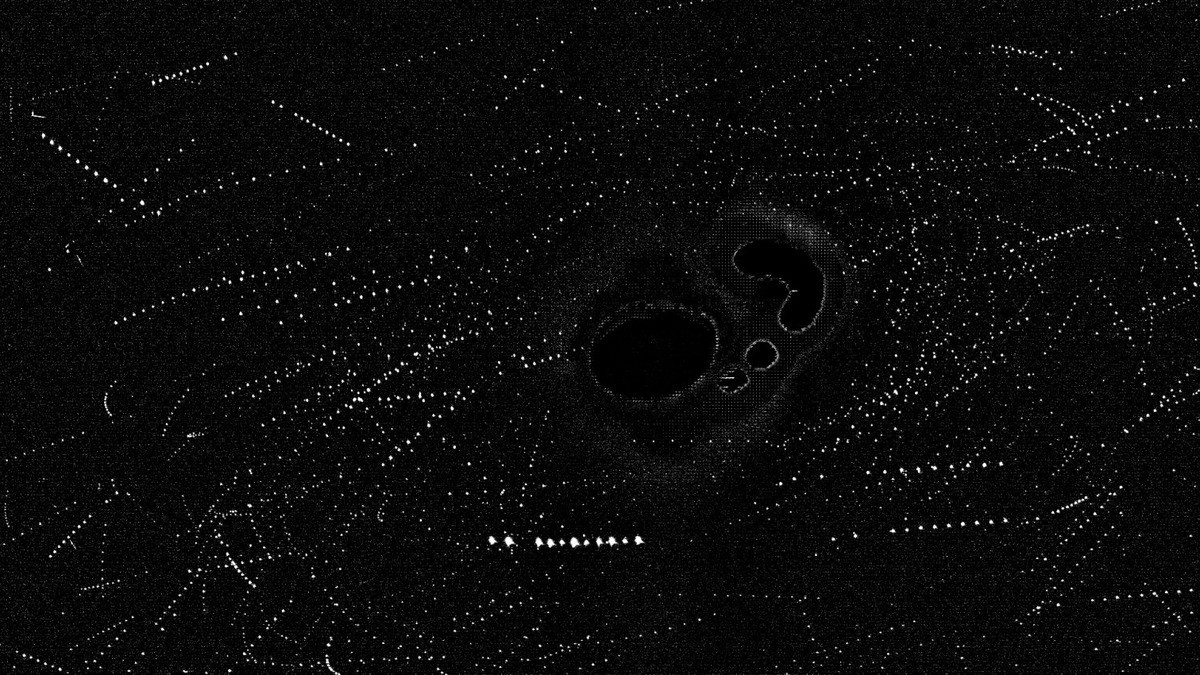
The third surprise is company. Hera found hundreds of previously unknown boulders in orbit around the pair, most of them only a few meters across. Naomi Murdoch, a planetary scientist at the University of Toulouse, said more than 100 of them are between the size of a football and a washing machine.
"As we approached Didymos and Dimorphos, we quickly realized the asteroids were not alone," she said. "In fact, they had a lot of company."
Where the boulders came from is unresolved. Murdoch said the team cannot yet say whether they are debris thrown out by the DART impact or material that came off Didymos by some other route, and that more time is needed. Raducan suggested the DART spacecraft may simply have been moving too fast in 2022 to notice them.
The swarm is also an obstacle. Margherita Cardi, an engineer at Tyvak International who oversees one of Hera's two small satellites, called the discovery a nightmare for her team, then described the mood as a mix of excitement and panic. A cube satellite that has to fly close to Dimorphos and eventually land on it now has to do so through a cloud of moving rocks.
Why a Rubble Pile Behaves Nothing Like a Solid Rock
Both bodies belong to a class called rubble piles: loose conglomerates of boulders held together by gravity and weak cohesion forces, in the words of Antti Penttilä of the University of Helsinki. Didymos, the larger parent at 730 meters across, has a prominent ridge running the length of its equator, which Dimorphos orbits along.
Dimorphos was the target for a reason CNN put plainly: its size is considered comparable to the asteroids that could threaten this planet, which made it a perfect testing ground. A solid asteroid and a loose pile of gravel do not respond to a hammer blow in the same way, and the difference decides how much of the spacecraft's momentum gets handed to the asteroid. Simulations published ahead of Hera's arrival found that boulders sitting on the surface act as armor and reduce momentum transfer, while buried boulders do the opposite and increase it.
Other modeling found that more porous material between the boulders produces wider craters. A crater that swallows the entire face of Dimorphos is, in that framework, a reading of how soft the thing actually is.
The Models Said 40 to 60 Meters
That makes the crater size the most valuable number in the mission, and it is the one nobody has published yet. ESA's release on Wednesday described the crater in stadiums and widths, not in meters or depth, and the team has not given a diameter.
What the models expected is on the record. A 2025 study led by Angela Stickle, published in the Planetary Science Journal, ran shock-physics simulations of the DART impact and put the estimated crater diameter at 15 to 60 meters, with 40 to 60 meters the likeliest outcome. The same work tied that range to near-surface strength of a few pascals up to tens of kilopascals.
Hera has now shown a crater spanning 151 meters. Set against the likeliest modeled window of 40 to 60 meters, that is more than twice the upper figure and almost four times the lower one. The authors of the simulation flagged one caveat in advance, that a modeled crater keeps growing after the simulation stops, so their figures were never meant to be final. The measurement that settles it is still coming.
December, and Then the Mass
In December, Hera is scheduled to close to about 13 kilometers from the pair and start returning higher-resolution images. That pass is what allows the team to calculate Dimorphos's mass, which is the missing half of the deflection equation.
"With the Hera measurements of the mass, we will then be able to see exactly how effective and efficient the DART impact was," Murdoch said.
In January 2027 the mission moves to its second stage, releasing two shoebox-sized cube satellites. Juventas, led by Luxembourg, carries the smallest radar instrument ever flown in space and will probe the interior of an asteroid for the first time before attempting a landing. Milani, led by Italy, will survey surface material and the surrounding dust, and is scheduled for release on 30 January, according to the University of Turku.
What Europe Built, and the Scale of the Collision
Hera and its two companions were built by a consortium of 18 ESA states led by OHB in Germany. The mission exists because of a cancellation: an earlier European craft, the Asteroid Impact Mission, was meant to be watching when DART hit, and was dropped, leaving four years in which the only record of the collision was what telescopes and a brief Italian flyby by a cube satellite called LICIACube could capture.
The scale of the experiment is worth holding onto. DART weighed about 610 kilograms and struck at 13,645 miles per hour; Dimorphos is estimated at 4.8 billion kilograms. A spacecraft small enough to sit in a parking space shifted the path of a rock almost eight million times its own mass, and Europe's job now is to explain the mechanism rather than celebrate the result.
Apophis, 2029, and the Part Still Unproven
The next test is already on the calendar. ESA is developing a mission called Ramses to accompany asteroid Apophis during its flyby on Friday 13 April 2029, when the object will pass about 32,000 kilometers above Earth's surface.
"Hera is helping us understand the consequences of deliberately striking an asteroid," said Holger Krag, head of ESA's space safety program. "Ramses will investigate how an asteroid responds to the gravitational influence of a planet."
The United Nations and the International Astronomical Union have made 2029 the International Year of Asteroid Awareness and Planetary Defense. Tomáš Kohout of the University of Turku notes that meter-sized objects enter the atmosphere almost daily and do no harm, while a 50-meter asteroid is estimated to strike on average once every few hundred years, with damage across an area the size of a medium-sized city.
What Hera has not shown yet is whether the technique scales. One asteroid, hit once, at one speed, tells you how that particular pile of rubble behaved. December's mass measurement, and then two satellites going in close, are where an experiment becomes a tool. Watch for those images.
By Jessica Ali, Staff Writer
This article was produced with AI-assisted research and editorial support. Sources: European Space Agency; CNN; Reuters; BBC News; The Register; UPI; Engadget; Space.com; University of Turku; OHB SE; Planetary Science Journal (Stickle et al., 2025). Images: ESA (lead image shows the Didymos-Dimorphos system with the DART impact site visible; the boulder-trail composite is Hera's Hyperscout H long exposure; the third photograph shows the Hera spacecraft during ground testing).
What's Your Reaction?
 Like
0
 Dislike
0
 Love
0
 Funny
0
 Wow
0
 Sad
0
 Angry
0

Editor-in-Chief at Global1.News. Atlanta-based journalist who cuts through the BS and tells it like it is. Lead anchor, host, and the voice you hear when the spin stops and the truth starts.















Comments (0)