
It has cost more than $100K a month to house 1 tenant in Vancouver SRO
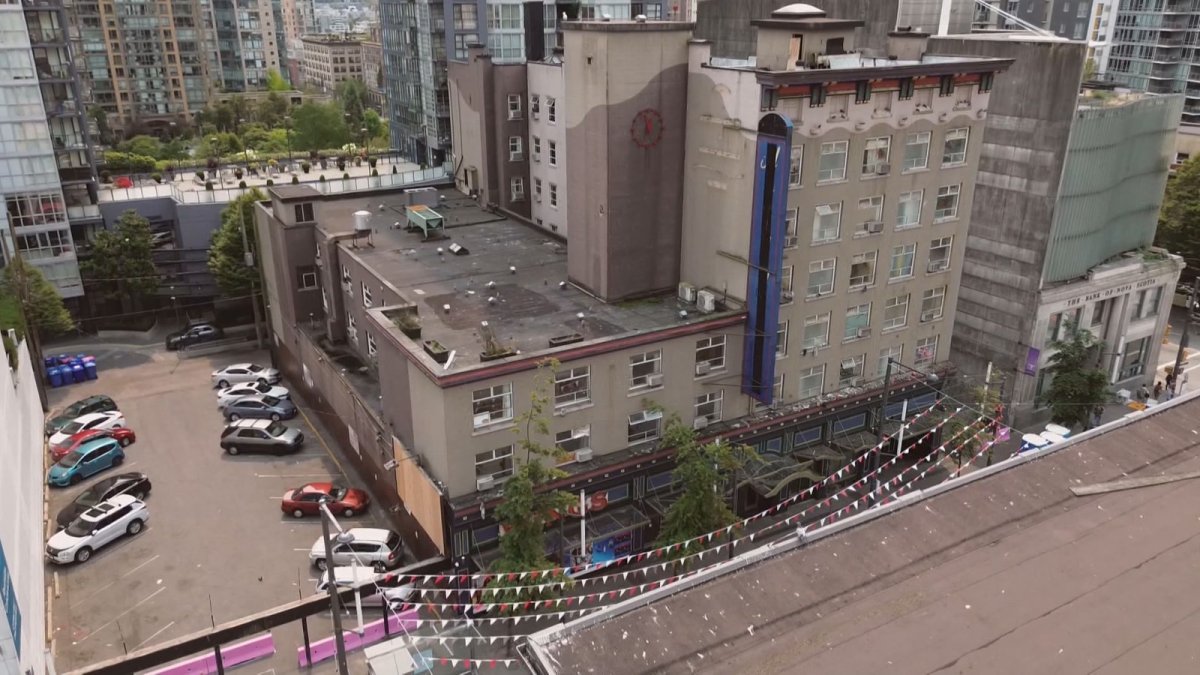
The numbers are difficult to reconcile with the reality of a single room in a former Granville Street hotel. But according to the B.C. Ministry of Housing, it cost $101,000 to house one tenant at the Luugat during the month of July. That tenant, Ryan Donnelly, remains the sole resident of a building the provincial government promised to shut down — and there is now no timeline for when that closure will happen.
One Tenant, One Month, $101,000: The Luugat's Costly Final Chapter
The numbers are difficult to reconcile with the reality of a single room in a former Granville Street hotel. But according to the B.C. Ministry of Housing, it cost $101,000 to house one tenant at the Luugat during the month of July. That tenant, Ryan Donnelly, remains the sole resident of a building the provincial government promised to shut down — and there is now no timeline for when that closure will happen.
Global News has learned that Donnelly, who suffers from a seizure disorder and requires a large room, is still living in the building. He was there in mid-July, and he remains there now. The Luugat, which is owned by the B.C. government, was supposed to be emptied as part of a broader agreement to close three aging single-room occupancy hotels in Vancouver's Granville Entertainment District. That agreement, reached in principle in March 2026 between the City of Vancouver and the Province of B.C., was announced by Mayor Ken Sim as a step toward replacing substandard SRO housing with new units located outside the area.
But the promise of closure has collided with the practical challenges of moving a vulnerable tenant. And the cost of keeping Donnelly in place while that process unfolds has become a flashpoint for critics who question whether the province is spending public money wisely.
The Story: A Building That Won't Close
The Luugat, a former hotel on Granville Street, has been the subject of ongoing scrutiny since Global News first reported on the province's efforts to shutter it. In May 2026, Global News reported that the B.C. government had paid more than half a million dollars over two months to keep two tenants in the building while the facility was being wound down. That reporting, by Kristen Robinson, drew attention to the extraordinary costs associated with maintaining a nearly empty SRO for a handful of residents.
Now, with only Donnelly left, the monthly tab has dropped — but only to a figure that still strains credulity. The Ministry of Housing confirmed that housing Donnelly in July cost $101,000. That figure includes the operational costs of keeping the building open, staffing, security, and other expenses associated with maintaining a single-occupancy residence in a commercial district.
Donnelly's situation is not simple. He has a seizure disorder that requires him to have a larger room than a typical SRO unit. He also showed Global News a hole in his ceiling last month, raising questions about the condition of the building he continues to call home. The province has not explained why a suitable alternative has not been found, nor why the cost of his current arrangement remains so high.
Housing Minister Christine Boyle did not make herself available for an interview on Tuesday to answer those questions. The ministry has not provided a revised timeline for when the Luugat might finally close its doors.
Canadian Context: SROs and the Affordability Crisis
The Luugat's situation sits at the intersection of several pressing Canadian policy challenges: housing affordability, the cost of caring for vulnerable populations, and the accountability of public spending. SROs have long been a last resort for low-income and vulnerable tenants in Vancouver, particularly in the Downtown Eastside and the Granville Entertainment District. These buildings, many of them decades old, offer small rooms at relatively low rents — but often with shared bathrooms, limited kitchen facilities, and deteriorating conditions.
The March 2026 agreement between the city and province was meant to address exactly these concerns. The plan was to close three aging SROs in the Granville Entertainment District and replace them with new housing located outside the area, with the aim of improving living conditions for tenants. But the transition has proven slower and more expensive than anticipated.
The broader context is a housing market that remains among the most expensive in the country. Vancouver's average rent for a one-bedroom apartment has climbed steadily, yet even at market rates, the cost of housing Donnelly for a year would be a fraction of what the province is spending each month. The gap between the $101,000 monthly figure and the cost of a market rental is not a small discrepancy — it is an order of magnitude.
This is not merely a Vancouver problem. Across Canada, provinces and municipalities are grappling with how to house vulnerable populations in a way that is both humane and fiscally sustainable. The Luugat case offers a stark illustration of what happens when those two goals come into conflict.
Impact on Canadians: The Cost of Inaction
For taxpayers, the numbers are hard to ignore. Vancouver Coun. Sarah Kirby-Yung, who has been outspoken on the issue, did the arithmetic herself. "It's insane," she said. "I did some quick math and based on the average rent for, let's say a one-bedroom apartment in Vancouver, you could house somebody at market rent for more than four years for what it is costing taxpayers to keep one person in that building for one month."
That comparison is not hyperbole. The average rent for a one-bedroom apartment in Vancouver is roughly $2,500 to $3,000 per month, depending on the source. At $2,800 per month, four years of rent would total approximately $134,000 — close to the cost of a single month at the Luugat. The province could, in theory, house Donnelly in a market apartment for years on what it is spending to keep him in a building with a hole in the ceiling.
The comparison becomes even more striking when considering alternatives. For significantly less money than the province is spending, it could rent the Lieutenant Governor's Suite at the Fairmont Hotel Vancouver. The monthly cost of that suite, including breakfast and evening snacks in the executive lounge, would total about $70,000. That is $31,000 less than the current monthly expenditure — and it would come with considerably better amenities than an SRO.
The point is not that Donnelly should be housed in a luxury hotel. It is that the province's current approach is costing an extraordinary amount of money without delivering a clear benefit. The funds being spent on the Luugat could be redirected toward permanent housing solutions, supportive services, or other interventions that would serve Donnelly — and other vulnerable tenants — more effectively.
Reactions and Analysis: Questions Without Answers
Kirby-Yung's frustration reflects a broader concern among municipal officials who feel the province is not moving quickly enough to resolve the situation. The lack of a timeline for the Luugat's closure is particularly troubling to those who expected the March agreement to produce results within a matter of months, not indefinitely.
The Ministry of Housing has not explained why Donnelly cannot be moved to a more suitable location, nor has it provided a breakdown of the $101,000 in monthly costs. Without that information, it is difficult to assess whether the expenditure is justified or whether there are inefficiencies that could be addressed.
There is also a human dimension that should not be lost in the discussion of dollars and cents. Donnelly is a person with a medical condition that requires specific accommodations. He has been living in a building that the government has deemed unfit for continued use, yet he remains there because no suitable alternative has been arranged. The hole in his ceiling is a reminder that the building's condition is not improving while he waits.
The broader pattern is concerning. The Tyee reported in August 2026 that Vancouver's SROs are changing hands and tenants are being pushed out, with advocates warning of a coming increase in homelessness without government action. The Luugat may be an extreme example, but it is not an isolated one. Across the city, vulnerable tenants are caught in a housing system that is struggling to meet their needs.
What Happens Next: A Test of Political Will
The absence of a timeline for the Luugat's closure raises questions about the province's commitment to the March agreement. If the government cannot close a building with a single tenant, how will it manage the more complex task of relocating tenants from other SROs?
Housing Minister Christine Boyle's decision not to make herself available for an interview on Tuesday does little to inspire confidence. The public deserves a clear explanation of why the situation has dragged on, what the $101,000 monthly expenditure covers, and when a resolution can be expected.
There are practical steps the province could take. It could commission an independent review of the costs associated with the Luugat. It could work with Donnelly and his support network to identify a suitable alternative residence, whether that is a supportive housing unit, a market rental with appropriate modifications, or another option that meets his medical needs. It could set a firm deadline for the building's closure and hold itself accountable to that timeline.
None of these steps are easy, and the province faces genuine challenges in finding appropriate housing for individuals with complex needs. But the current situation is not sustainable. Spending $101,000 per month to house one person in a building with a hole in the ceiling is not a defensible use of public funds, and it is not a humane outcome for Donnelly.
The Luugat was supposed to be closed. Instead, it has become a symbol of a housing system that is failing both vulnerable tenants and the taxpayers who fund it. Until the province provides answers — and a timeline — that symbol will continue to cast a long shadow over B.C.'s housing policy.
Tags: Vancouver SRO, Luugat, Ryan Donnelly, BC housing, Christine Boyle, Sarah Kirby-Yung, Granville Street, SRO closure, housing costs, taxpayer spending, single-room occupancy, Vancouver housing, BC government, supportive housing, Downtown Eastside
By Alex Thompson, Staff Writer
This article was produced with AI-assisted research and editorial support. Reporting is based on sources cited in the article.
What's Your Reaction?
 Like
0
Like
0
 Dislike
0
Dislike
0
 Love
0
Love
0
 Funny
0
Funny
0
 Wow
0
Wow
0
 Sad
0
Sad
0
 Angry
0
Angry
0

Canada Correspondent at Global1.News. Based in Toronto, covering Canadian politics, energy, trade, and US-Canada relations. Provides the Canadian perspective on North American and global affairs.














Comments (0)