
US Widens Iran Sanctions, Beijing Vows Countermeasures Ahead of Trump-Xi Summit
Washington's widened sanctions against Iran directly target Beijing, the buyer of roughly 90% of Tehran's oil exports. China vows "all necessary measures" against what it calls illegal unilateral sanctions, setting up a confrontation ahead of the Trump-Xi summit.
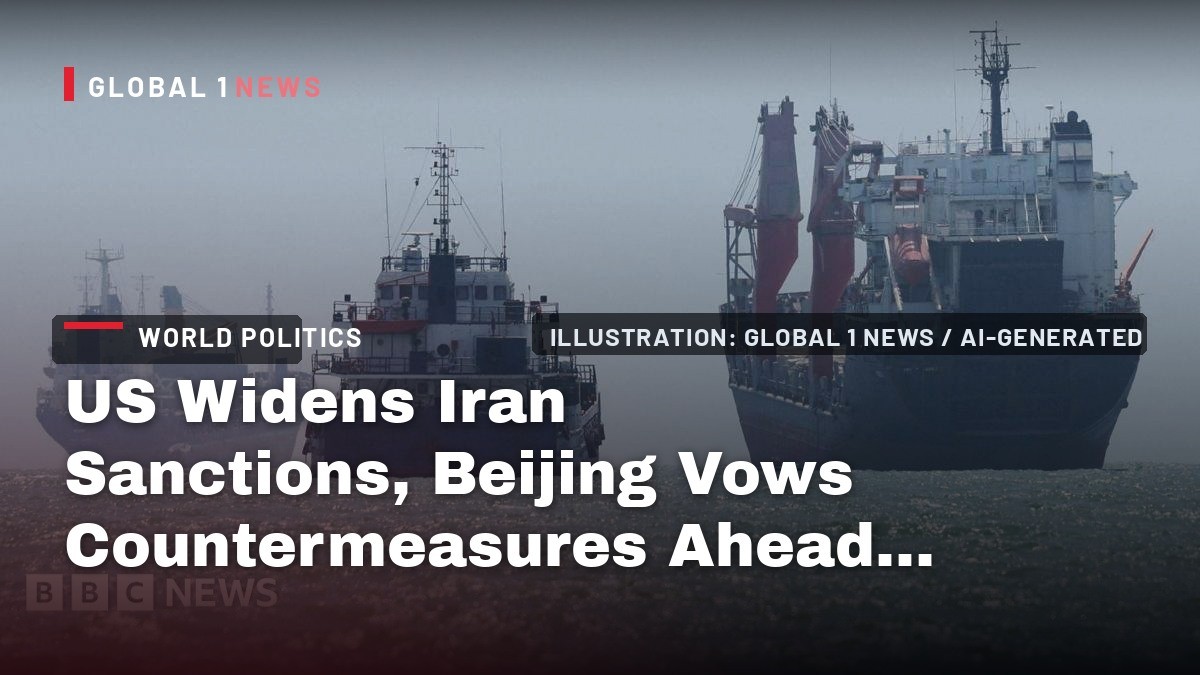
The United States has unveiled its most expansive sanctions package yet against Iran, explicitly targeting the Islamic Republic's global trading partners—a move that places the world's largest buyer of Iranian crude, China, directly in the crosshairs. As the BBC reported, Washington has dubbed the initiative "Operation Economic Outcast" and Treasury Secretary Scott Bessent warns that no nation is "above the reach of US sanctions," Beijing has responded with a firm declaration that it will take "all necessary measures" to safeguard its interests. The confrontation sets the stage for a potentially explosive dynamic ahead of next month's planned summit between President Donald Trump and Chinese President Xi Jinping, where economic coercion and strategic leverage will now dominate the agenda.
The Announcement: An "Economic D-Day" with Global Reach
The new sanctions regime, announced by Treasury Secretary Scott Bessent on Monday, represents a significant escalation in Washington's maximum pressure campaign against Tehran. Bessent described the package as "the single greatest financial offensive ever" against Iran, claiming the Treasury had mapped the financial channels, facilitators, and networks used by Iran to evade existing sanctions. The measures target nearly 60 entities, individuals, and vessels, with a specific focus on choking off the revenue streams that sustain the Iranian regime.Crucially, the announcement extends beyond Iran itself to encompass any nation or business that continues financial partnerships with Tehran. Bessent warned that banks and corporations refusing to sever ties with Iran would "share in Iran's isolation," and indicated that President Trump would be personally contacting world leaders "with specific requests to cease their interactions with the regime." While Bessent declined to single out specific nations, the implication for China—which purchases roughly 90% of Iran's exported oil—was unmistakable. When pressed on Chinese banks specifically, Bessent stated emphatically that "no one was above the reach of US sanctions."China's Official Response: Defiance Within the Framework of International Law
The Chinese foreign ministry's reaction was swift and unequivocal. Spokesman Lin Jian declared that Beijing was "firmly opposed" to what it characterized as "illegal unilateral sanctions" and would take "all necessary measures" to safeguard its rights and interests. Lin's framing was deliberate, positioning China's continued engagement with Iran as legitimate conduct under international law, rather than defiance of a lawful international order."Cooperation between China and Iran has always been conducted within the framework of international law and should not be interfered with or disrupted," Lin stated. This formulation serves multiple strategic purposes for Beijing. It allows China to present itself as a defender of the rules-based international system against American unilateralism—a narrative that resonates strongly across the Global South. It also provides diplomatic cover for continued energy purchases that are vital to China's economic security, while avoiding the need for direct confrontation with Washington over the specific mechanics of sanctions evasion.The Rare Earths Leverage: Beijing's Strategic Counterweight
The sanctions announcement comes at a moment when Washington is acutely aware of its vulnerability to Chinese retaliation in critical mineral supply chains. China processes the overwhelming majority of the world's rare earths and other critical minerals, which are indispensable inputs for high-tech manufacturing, defense systems, and green energy technologies. Beijing has already demonstrated its willingness to weaponize this dominance, having tightened export controls on rare earths during previous trade negotiations with the United States.This asymmetry in leverage is not lost on either side. While the US can threaten to isolate Chinese financial institutions from the dollar-based global payments system, Beijing holds the keys to the raw materials that underpin American technological and military superiority. The strategic calculus suggests that Washington will need to calibrate its enforcement carefully, wary of triggering a rare earths embargo that could paralyze US manufacturing and disrupt global supply chains. For Beijing, the rare earths card represents a credible deterrent against overreach in the sanctions campaign, and its mere existence may constrain the aggressiveness of US enforcement actions.Iran's Posture: Defiance and a Two-Year Plan
Tehran has responded to the escalating pressure with a studied display of confidence. Iranian Economy Minister Ali Madanizadeh told state television that the government was "fully prepared" for the wider sanctions, which he predicted would result in "another defeat" for the United States. Madanizadeh revealed that Tehran had developed a "two-year plan" to manage the economic fallout, asserting that "we also have our own tools and know how to play the game."The Iranian government's rhetoric suggests a regime that has internalized the costs of prolonged sanctions and developed coping mechanisms over decades of isolation. The Iranian leadership appears to calculate that it can "absorb any pain" and pass the burden onto its population, as analysts have noted, while maintaining its core strategic objectives. This resilience, born of necessity, complicates Washington's assumption that economic pressure alone will force a change in Iranian behavior. The regime's willingness to endure hardship rather than capitulate has been a consistent feature of its response to sanctions since the 1979 revolution.The Strait of Hormuz and Energy Markets: A Global Flashpoint
The sanctions escalation unfolds against the backdrop of an ongoing conflict that has already disrupted global energy markets. The Iran war, now nearly six months old, has led to significant hikes in oil prices worldwide, with Tehran effectively blocking exports through the Strait of Hormuz—a waterway that carries roughly one-fifth of global petroleum consumption. The US naval blockade has further slowed traffic, creating a supply squeeze that reverberates through economies across Asia, Europe, and Africa.The new sanctions package aims to tighten the noose around Iranian revenue sources, but the immediate effect may be to exacerbate market volatility. With Iran's oil exports already constrained by the blockade and the ongoing conflict, the additional sanctions risk pushing prices higher at a time when global inflationary pressures remain elevated. For China, the world's largest crude importer, the combination of higher prices and potential sanctions on its financial institutions creates a dual challenge: securing energy supplies while maintaining access to the international banking system.Analyst Skepticism: Questioning the Effectiveness of the New Measures
Even before Beijing's formal response, analysts had cast doubt on the likely impact of the new sanctions. David Oxley, chief climate and commodities economist at Capital Economics, told the BBC that the direct effect on Iran's energy revenues would be "somewhat of a damp squib." Oxley noted that the new package would likely have "only a limited direct impact on Iranian energy flows in the short term," largely because of China's dominant position as a buyer."Roughly 90% of Iran's oil goes to China," Oxley observed, "which has not recognised US sanctions in the past and is unlikely to be cowed this time either." This assessment aligns with the historical pattern of Chinese behavior. Ali Vaez, deputy director of the Middle East and North Africa Program at the International Crisis Group, explained that Beijing's opposition to unilateral sanctions is principled and consistent: "Generally, the Chinese are against unilateral sanctions. They would comply with multilateral or international sanctions, but unilateral sanctions just imposed by the US—they have always seen that as illegitimate."Vaez also highlighted the broader limitations of the sanctions approach, noting that Iran's neighbors—Pakistan, Turkey, and Iraq—while desiring good relations with Washington, "can't really afford to cut off ties with Iran." The economic interdependence of the region, combined with Iran's demonstrated willingness to endure hardship, suggests that the new measures may achieve limited strategic results while imposing significant costs on global trade.The Trump-Xi Summit: A Test of Strategic Leverage
The sanctions announcement injects a volatile new element into the planned talks between President Trump and President Xi next month. Washington's decision to target Chinese financial institutions and trading relationships directly challenges Beijing's core economic interests, setting the stage for a high-stakes negotiation. The Trump administration appears to be testing whether China will prioritize its relationship with the United States over its energy security needs and its principled opposition to unilateral sanctions.For Beijing, the summit represents an opportunity to demonstrate that it cannot be coerced through economic pressure. China's position is strengthened by its rare earths leverage, its status as the indispensable trading partner for much of the developing world, and the fact that the US needs Chinese cooperation on a range of global issues, from climate change to debt restructuring. The outcome of the summit will signal whether the two powers can manage their rivalry through diplomacy or whether economic confrontation will become the defining feature of their relationship.Implications for the Global Order: Unilateralism vs. Multilateralism
The widening sanctions against Iran and its trading partners represent more than a bilateral dispute between Washington and Tehran—they constitute a fundamental challenge to the post-war international economic order. By threatening to isolate any nation that maintains financial partnerships with Iran, the United States is asserting extraterritorial jurisdiction over global commerce in a manner that many countries, particularly in the Global South, view as illegitimate overreach.China's response positions Beijing as the champion of a multipolar world order in which no single nation can dictate the terms of international trade. This narrative has significant appeal among emerging economies that have grown weary of US dominance over the global financial system. The sanctions dispute thus becomes a proxy battle over the future shape of global governance: whether the international order will be defined by multilateral rules and institutions, or by the unilateral exercise of American power. As the Trump-Xi summit approaches, the resolution of this tension will have profound implications not only for Iran and China, but for the entire architecture of global economic relations.By Prof. Marcus Chen, Staff WriterThis article was produced with AI-assisted research and editorial support. Sources: BBC News.
What's Your Reaction?
 Like
0
Like
0
 Dislike
0
Dislike
0
 Love
0
Love
0
 Funny
0
Funny
0
 Wow
0
Wow
0
 Sad
0
Sad
0
 Angry
0
Angry
0

World Politics Analyst at Global1.News. Based in Beijing, covering US-China relations, global trade, and geopolitical strategy. Brings deep analytical perspective to the power dynamics shaping international affairs.











Comments (0)