
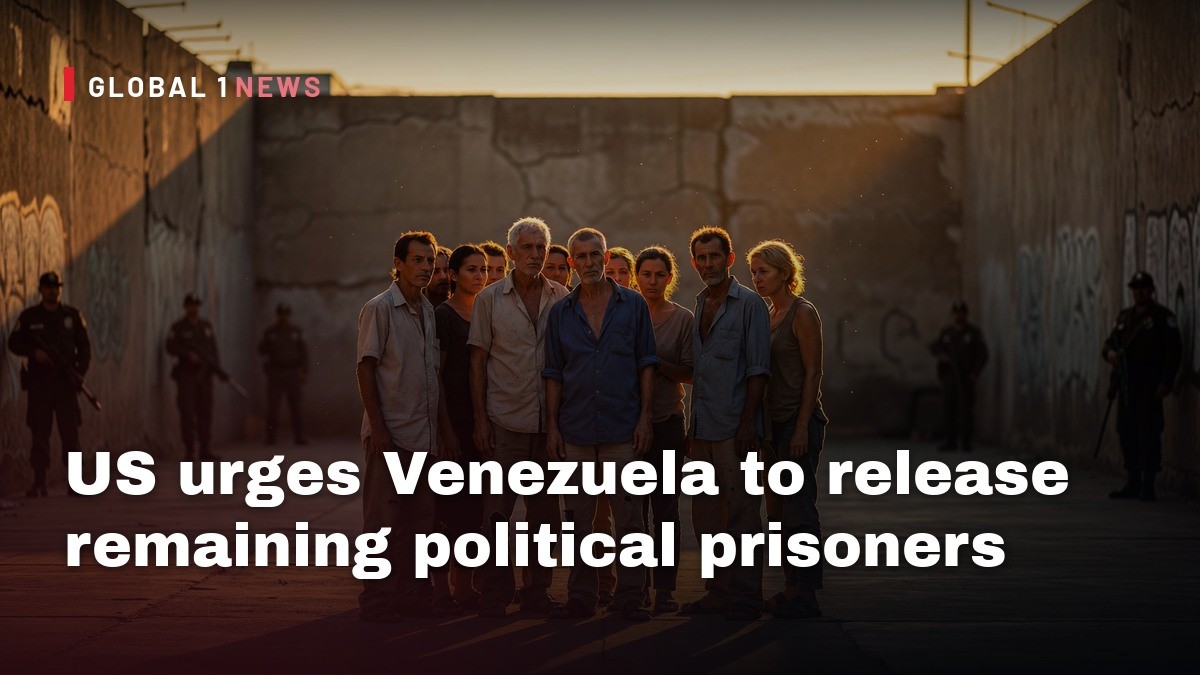
US urges Venezuela to release remaining political prisoners
In the wake of a dramatic U.S. operation that saw former Venezuelan president Nicolás Maduro seized in Caracas and flown to New York for trial, the United States has renewed its call for the release of the remaining political detainees still held in Venezuela.
In the wake of a dramatic U.S. operation that saw former Venezuelan president Nicolás Maduro seized in Caracas and flown to New York for trial, the United States has renewed its call for the release of the remaining political detainees still held in Venezuela. The appeal, voiced by Secretary of State Marco Rubio during a meeting with his Venezuelan counterpart Oliver Blanco, underscores a broader U.S. strategy that links the fate of political prisoners to the prospect of “free, fair, and credible” elections in the embattled nation.
From raid to release: the numbers behind the crackdown
Since the raid on 3 January that removed Maduro from power, more than a thousand political prisoners have been freed, according to U.S. officials. Yet the human‑rights group Foro Penal reports that 322 individuals remain behind bars, many of whom were arrested in the chaotic aftermath of the disputed 2024 presidential election. The disparity between the large wave of releases and the still‑significant number of detainees highlights the incomplete nature of the current de‑escalation.
These remaining prisoners are not merely statistics; they represent a cross‑section of opposition activists, journalists, and ordinary citizens caught up in a government‑wide crackdown. Their continued detention fuels the opposition’s demand for a comprehensive political settlement, a demand that has been amplified by the return of Nobel laureate María Corina Machado, who has made the release of political prisoners a central pillar of her platform.
Maduro’s downfall and the interim government
The seizure of Maduro marked an unprecedented moment in Latin American politics, a direct U.S. military intervention that toppled a long‑standing authoritarian regime. In the power vacuum that followed, Vice‑president Delcy Rodríguez was sworn in as interim president, a move backed by the Trump administration. Rodríguez’s ascent has been framed by Washington as a transitional step toward a democratic transition, yet her legitimacy remains contested both domestically and abroad.
Rodríguez has repeatedly promised elections, describing a “renewed” electoral authority in a televised address. However, she has not provided a concrete timeline, leaving the opposition and the international community to question the sincerity of her commitments. The lack of a clear schedule underscores the delicate balance the interim government must strike between appeasing U.S. pressure and maintaining the support of Maduro’s loyalist base.
The opposition’s push for elections
Since the contested 2024 vote, opposition parties have been vocal about the need for a credible electoral process. The National Electoral Council, dominated by government loyalists, declared Maduro the winner despite independent tallies suggesting the opposition candidate had prevailed. International observers, including the Carter Center, dismissed the election as undemocratic, reinforcing the opposition’s claim that the results were fabricated.
María Corina Machado, fresh from exile, has positioned the timing of new elections at the heart of her political agenda. While she once floated 24 July 2027—coinciding with the birthdate of independence hero Simón Bolívar—as a possible election date, she now advocates for a vote “some point in the next year,” signaling urgency. Her stance reflects a broader impatience among opposition groups, who see the interim government’s reforms as moving too slowly.
U.S. diplomatic pressure and the three‑phase plan
Secretary Rubio’s appeal to release the remaining detainees is part of a larger U.S. diplomatic framework. The State Department reiterated its commitment to President Donald Trump’s three‑phase plan: stabilization, economic recovery, and political reconciliation leading to a democratic transition. By tying the release of political prisoners to the broader goal of free elections, Washington is leveraging humanitarian concerns to press for political change.
Rubio also warned that Venezuela’s “election infrastructure” must be overhauled quickly, dismissing any timeline longer than two years as unacceptable. This hard‑line stance signals that the United States is prepared to maintain pressure until substantive reforms are enacted, a posture that may strain relations with the interim government if progress stalls.
Human stories behind the numbers
For families of the 322 remaining detainees, the political debate is a daily reality of fear and uncertainty. Upon her return on 25 October, Machado visited relatives of political prisoners, a symbolic act that highlighted the personal toll of repression. These meetings underscore how state‑driven crackdowns ripple through communities, turning political dissent into a private tragedy.
The UN fact‑finding mission documented a “harsh repression” against anyone perceived as an opponent, a pattern that continues to shape the lives of ordinary Venezuelans. The lingering presence of political prisoners serves as a stark reminder that, despite the high‑profile release of many detainees, the mechanisms of intimidation remain intact.
International reactions and the regional context
Beyond the United States, regional actors have watched Venezuela’s turmoil with a mixture of concern and caution. The Carter Center’s assessment that the 2024 election “could not be considered democratic” aligns with broader doubts about the legitimacy of Maduro’s regime. Meanwhile, the UN’s condemnation of post‑election repression adds weight to calls for accountability.
Latin America’s history of foreign intervention fuels skepticism toward U.S. involvement. While many in the region recognize the need for democratic reforms, there is wariness about external agendas that could echo past interventions. This ambivalence shapes the diplomatic landscape, where any U.S. push for change must navigate both domestic opposition demands and regional sensitivities.
Looking ahead: scenarios for Venezuela’s transition
The path forward hinges on several interconnected variables: the willingness of the interim government to release the remaining detainees, the speed of electoral reforms, and the capacity of opposition forces to organize a credible challenge. If Rodríguez accelerates the overhaul of the electoral system and sets a clear election date, international pressure may ease, and a negotiated transition could emerge.
Conversely, a continued stalemate—marked by the persistence of political prisoners and vague election promises—could deepen the crisis, prompting further U.S. sanctions or diplomatic isolation. The upcoming months will test whether the United States’ strategy of linking humanitarian concerns to political reform can translate into tangible change for a nation still reeling from the shock of a foreign‑led regime change.
This article was produced with AI-assisted research and editorial support. Reporting is based on the source material cited below. Sources: BBC News Latin America; bbc.co.uk; Global1.News (03 November 2026).
By Elena Vasquez, Staff Writer
What's Your Reaction?
 Like
0
 Dislike
0
 Love
0
 Funny
0
 Wow
0
 Sad
0
 Angry
0
Latin America Correspondent at Global1.News. Based in Mexico City, covering politics, economics, energy, and culture across the region. Brings an on-the-ground perspective to stories spanning from the Rio Grande to Patagonia.









Comments (0)